Гилберт Честертон - Heretics
Здесь есть возможность читать онлайн «Гилберт Честертон - Heretics» — ознакомительный отрывок электронной книги совершенно бесплатно, а после прочтения отрывка купить полную версию. В некоторых случаях можно слушать аудио, скачать через торрент в формате fb2 и присутствует краткое содержание. Год выпуска: 2014, Издательство: epubBooks Classics, Жанр: Публицистика, Религия, на английском языке. Описание произведения, (предисловие) а так же отзывы посетителей доступны на портале библиотеки ЛибКат.
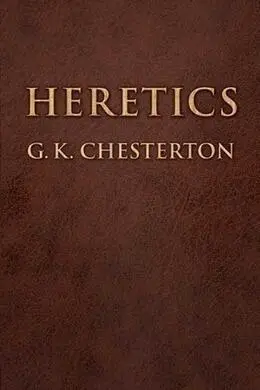
- Название:Heretics
- Автор:
- Издательство:epubBooks Classics
- Жанр:
- Год:2014
- ISBN:нет данных
- Рейтинг книги:4 / 5. Голосов: 1
-
Избранное:Добавить в избранное
- Отзывы:
-
Ваша оценка:
Heretics: краткое содержание, описание и аннотация
Предлагаем к чтению аннотацию, описание, краткое содержание или предисловие (зависит от того, что написал сам автор книги «Heretics»). Если вы не нашли необходимую информацию о книге — напишите в комментариях, мы постараемся отыскать её.
In addition to incisive assessments of well-known individuals (“Mr. Rudyard Kipling and Making the World Small” and “Mr. H. G. Wells and the Giants”), these essays contain observations on the wider world. On Sandals and Simplicity, Science and the Savages, On Certain Modern Writers and the Institution of the Family, On Smart Novelists and the Smart Set, and Slum Novelists and the Slums, reflect the main themes of Chesterton’s life’s work. Heretics roused the ire of some critics for censuring contemporary philosophies without providing alternatives; the author responded a few years later with a companion volume, Orthodoxy.
Heretics — читать онлайн ознакомительный отрывок
Ниже представлен текст книги, разбитый по страницам. Система сохранения места последней прочитанной страницы, позволяет с удобством читать онлайн бесплатно книгу «Heretics», без необходимости каждый раз заново искать на чём Вы остановились. Поставьте закладку, и сможете в любой момент перейти на страницу, на которой закончили чтение.
Интервал:
Закладка:
X:
On Sandals and Simplicity
The great misfortune of the modern English is not at all that they are more boastful than other people (they are not); it is that they are boastful about those particular things which nobody can boast of without losing them. A Frenchman can be proud of being bold and logical, and still remain bold and logical. A German can be proud of being reflective and orderly, and still remain reflective and orderly. But an Englishman cannot be proud of being simple and direct, and still remain simple and direct. In the matter of these strange virtues, to know them is to kill them. A man may be conscious of being heroic or conscious of being divine, but he cannot (in spite of all the Anglo–Saxon poets) be conscious of being unconscious.
Now, I do not think that it can be honestly denied that some portion of this impossibility attaches to a class very different in their own opinion, at least, to the school of Anglo–Saxonism. I mean that school of the simple life, commonly associated with Tolstoy. If a perpetual talk about one's own robustness leads to being less robust, it is even more true that a perpetual talking about one's own simplicity leads to being less simple. One great complaint, I think, must stand against the modern upholders of the simple life—the simple life in all its varied forms, from vegetarianism to the honourable consistency of the Doukhobors. This complaint against them stands, that they would make us simple in the unimportant things, but complex in the important things. They would make us simple in the things that do not matter—that is, in diet, in costume, in etiquette, in economic system. But they would make us complex in the things that do matter—in philosophy, in loyalty, in spiritual acceptance, and spiritual rejection. It does not so very much matter whether a man eats a grilled tomato or a plain tomato; it does very much matter whether he eats a plain tomato with a grilled mind. The only kind of simplicity worth preserving is the simplicity of the heart, the simplicity which accepts and enjoys. There may be a reasonable doubt as to what system preserves this; there can surely be no doubt that a system of simplicity destroys it. There is more simplicity in the man who eats caviar on impulse than in the man who eats grape–nuts on principle. The chief error of these people is to be found in the very phrase to which they are most attached—"plain living and high thinking." These people do not stand in need of, will not be improved by, plain living and high thinking. They stand in need of the contrary. They would be improved by high living and plain thinking. A little high living (I say, having a full sense of responsibility, a little high living) would teach them the force and meaning of the human festivities, of the banquet that has gone on from the beginning of the world. It would teach them the historic fact that the artificial is, if anything, older than the natural. It would teach them that the loving–cup is as old as any hunger. It would teach them that ritualism is older than any religion. And a little plain thinking would teach them how harsh and fanciful are the mass of their own ethics, how very civilized and very complicated must be the brain of the Tolstoyan who really believes it to be evil to love one's country and wicked to strike a blow.
A man approaches, wearing sandals and simple raiment, a raw tomato held firmly in his right hand, and says, "The affections of family and country alike are hindrances to the fuller development of human love;" but the plain thinker will only answer him, with a wonder not untinged with admiration, "What a great deal of trouble you must have taken in order to feel like that." High living will reject the tomato. Plain thinking will equally decisively reject the idea of the invariable sinfulness of war. High living will convince us that nothing is more materialistic than to despise a pleasure as purely material. And plain thinking will convince us that nothing is more materialistic than to reserve our horror chiefly for material wounds.
The only simplicity that matters is the simplicity of the heart. If that be gone, it can be brought back by no turnips or cellular clothing; but only by tears and terror and the fires that are not quenched. If that remain, it matters very little if a few Early Victorian armchairs remain along with it. Let us put a complex entree into a simple old gentleman; let us not put a simple entree into a complex old gentleman. So long as human society will leave my spiritual inside alone, I will allow it, with a comparative submission, to work its wild will with my physical interior. I will submit to cigars. I will meekly embrace a bottle of Burgundy. I will humble myself to a hansom cab. If only by this means I may preserve to myself the virginity of the spirit, which enjoys with astonishment and fear. I do not say that these are the only methods of preserving it. I incline to the belief that there are others. But I will have nothing to do with simplicity which lacks the fear, the astonishment, and the joy alike. I will have nothing to do with the devilish vision of a child who is too simple to like toys.
The child is, indeed, in these, and many other matters, the best guide. And in nothing is the child so righteously childlike, in nothing does he exhibit more accurately the sounder order of simplicity, than in the fact that he sees everything with a simple pleasure, even the complex things. The false type of naturalness harps always on the distinction between the natural and the artificial. The higher kind of naturalness ignores that distinction. To the child the tree and the lamp–post are as natural and as artificial as each other; or rather, neither of them are natural but both supernatural. For both are splendid and unexplained. The flower with which God crowns the one, and the flame with which Sam the lamplighter crowns the other, are equally of the gold of fairy–tales. In the middle of the wildest fields the most rustic child is, ten to one, playing at steam–engines. And the only spiritual or philosophical objection to steam–engines is not that men pay for them or work at them, or make them very ugly, or even that men are killed by them; but merely that men do not play at them. The evil is that the childish poetry of clockwork does not remain. The wrong is not that engines are too much admired, but that they are not admired enough. The sin is not that engines are mechanical, but that men are mechanical.
In this matter, then, as in all the other matters treated in this book, our main conclusion is that it is a fundamental point of view, a philosophy or religion which is needed, and not any change in habit or social routine. The things we need most for immediate practical purposes are all abstractions. We need a right view of the human lot, a right view of the human society; and if we were living eagerly and angrily in the enthusiasm of those things, we should, ipso facto, be living simply in the genuine and spiritual sense. Desire and danger make every one simple. And to those who talk to us with interfering eloquence about Jaeger and the pores of the skin, and about Plasmon and the coats of the stomach, at them shall only be hurled the words that are hurled at fops and gluttons, "Take no thought what ye shall eat or what ye shall drink, or wherewithal ye shall be clothed. For after all these things do the Gentiles seek. But seek first the kingdom of God and His righteousness, and all these things shall be added unto you." Those amazing words are not only extraordinarily good, practical politics; they are also superlatively good hygiene. The one supreme way of making all those processes go right, the processes of health, and strength, and grace, and beauty, the one and only way of making certain of their accuracy, is to think about something else. If a man is bent on climbing into the seventh heaven, he may be quite easy about the pores of his skin. If he harnesses his waggon to a star, the process will have a most satisfactory effect upon the coats of his stomach. For the thing called "taking thought," the thing for which the best modern word is "rationalizing," is in its nature, inapplicable to all plain and urgent things. Men take thought and ponder rationalistically, touching remote things—things that only theoretically matter, such as the transit of Venus. But only at their peril can men rationalize about so practical a matter as health.
Читать дальшеИнтервал:
Закладка:
Похожие книги на «Heretics»
Представляем Вашему вниманию похожие книги на «Heretics» списком для выбора. Мы отобрали схожую по названию и смыслу литературу в надежде предоставить читателям больше вариантов отыскать новые, интересные, ещё непрочитанные произведения.







Обсуждение, отзывы о книге «Heretics» и просто собственные мнения читателей. Оставьте ваши комментарии, напишите, что Вы думаете о произведении, его смысле или главных героях. Укажите что конкретно понравилось, а что нет, и почему Вы так считаете.