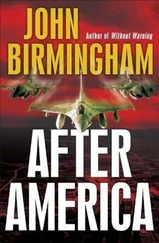
Mark Steyn - After America
Здесь есть возможность читать онлайн «Mark Steyn - After America» весь текст электронной книги совершенно бесплатно (целиком полную версию без сокращений). В некоторых случаях можно слушать аудио, скачать через торрент в формате fb2 и присутствует краткое содержание. Город: Washington, DC, Год выпуска: 2011, ISBN: 2011, Издательство: Regnery Publishing, Жанр: Публицистика, Политика, на английском языке. Описание произведения, (предисловие) а так же отзывы посетителей доступны на портале библиотеки ЛибКат.

- Название:After America
- Автор:
- Издательство:Regnery Publishing
- Жанр:
- Год:2011
- Город:Washington, DC
- ISBN:978-1-59698-100-3
- Рейтинг книги:4 / 5. Голосов: 1
-
Избранное:Добавить в избранное
- Отзывы:
-
Ваша оценка:
After America: краткое содержание, описание и аннотация
Предлагаем к чтению аннотацию, описание, краткое содержание или предисловие (зависит от того, что написал сам автор книги «After America»). Если вы не нашли необходимую информацию о книге — напишите в комментариях, мы постараемся отыскать её.
bestseller,
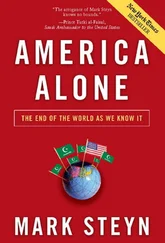
, Mark Steyn predicted collapse for the rest of the Western World. Now, he adds, America has caught up with Europe on the great rush to self-destruction.
It’s not just our looming financial collapse; it’s not just a culture that seems on a fast track to perdition, full of hapless, indulgent, childish people who think government has the answer for every problem; it’s not just America’s potential eclipse as a world power because of the drunken sailor policymaking in Washington—no, it’s all this and more that spells one word for America: Armageddon.
What will a world without American leadership look like? It won’t be pretty—not for you and not for your children. America’s decline won’t be gradual, like an aging Europe sipping espresso at a café until extinction (and the odd Greek or Islamist riot). No, America’s decline will be a wrenching affair marked by violence and possibly secession.
With his trademark wit, Steyn delivers the depressing news with raw and unblinking honesty—but also with the touch of vaudeville stand-up and soft shoe that makes him the most entertaining, yet profound, columnist on the planet. And as an immigrant with nowhere else to go, he offers his own prescription for winning America back from the feckless and arrogant liberal establishment that has done its level best to suffocate the world’s last best hope in a miasma of debt, decay, and debility. You will not read a more important—or more alarming, or even funnier—book all year than
. Praise for “Mark Steyn is a modern day Jeremiah with a quiverful of devastating one-liners, nailing what the liberals have done to our country. He presents an alarming—and frighteningly convincing—prophecy of where we’re headed. The choice is stark—we either listen to Steyn and act on his recommendations or face economic and cultural armageddon.”
—Mark Levin “Mark Steyn has done it again. In his new book,
, he clearly defines the dangerous signals which show America is embracing the same doomed path as the failed European economies, and how vital it is to implement and avoid policies right now to prevent us from the same fate.”
—Sean Hannity “Only Mark Steyn can write about the decline of America and leave you laughing.”
—Ann Coulter
After America — читать онлайн бесплатно полную книгу (весь текст) целиком
Ниже представлен текст книги, разбитый по страницам. Система сохранения места последней прочитанной страницы, позволяет с удобством читать онлайн бесплатно книгу «After America», без необходимости каждый раз заново искать на чём Вы остановились. Поставьте закладку, и сможете в любой момент перейти на страницу, на которой закончили чтение.
Интервал:
Закладка:
In the nineteenth century the Anglophone powers killed or captured pirates. Two centuries later, with primitive vessels seizing tankers the length of carriers off the Horn of Africa, it was all more complicated. The Royal Navy, which over the centuries had done more than anyone to rid the civilized world of the menace of piracy, declined even to risk capturing their Somali successors. They had been advised by Her Majesty’s Government that, under the European Human Rights Act, any pirate taken into custody would be entitled to claim refugee status in the United Kingdom and live on welfare for the rest of his life. 16There was a film series popular at the time: Pirates of the Caribbean . I doubt it would have cleaned up at the box office if the big finale had shown Mr. Geoffrey Rush and his crew of scurvy sea dogs settling down in council flats in Manchester and going to the pub for a couple of jiggers of rum washed down to cries of “Aaaaargh, shiver me benefits check, lad.” For his part, the U.S. Attorney-General, the chief law-enforcement official of the world’s superpower, was circumspect about the legal status of pirates, as well he might be. Obviously, if the United States Navy had seized some eyepatched peglegged blackguard off the coast of Somalia and hanged him from the yardarm or made him walk the plank, pious senators would have risen as one to denounce an America that no longer lived up to its highest ideals… and the network talking-heads would have argued that Plankgate was recruiting more and more young men to the pirates’ cause… and judges by the dozen would have ruled that pirates were entitled to the protections of the U.S. constitution and that under ObamaCare their peglegs had to be replaced by high-tech prosthetic limbs at taxpayer expense.
Conversely, a 2010 headline from the Associated Press: “Pirates ‘Have All Died,’ Russia Says, After Decrying ‘Imperfections’ In International Law.” 17Perhaps it seemed just as funny at the time.
The Somalis had made the mistake of seizing a Russian tanker. When Moscow’s commandos took it back, they found themselves with ten pirates on their hands and the prospect of submitting them to an “imperfect” international legal regime. So, as a Defense Ministry spokesman explained, they “released” them. The Russians supposedly put them in a boat and pointed it in the general direction of Somalia. “They could not reach the coast and apparently have all died,” said the official, poker-faced.
Oh.
Bad cop or metrosexual Euro-cop? On the high seas of reality, it was not a tough call.

FIVE BILLION GUYS NAMED MO
To state the obvious, the world after America is a lot more Muslim.
Between 2010 and 2030, the ummah —the worldwide Muslim community—was predicted to increase from somewhere between a fifth and a quarter of the global population to one third of humanity. 18By the time we got there, they wound up with a little more than that, the demographers having failed to take into account such icing on the ummah ’s cake as the accelerating Muslim conversion rates on the Continent. But one third of humanity turned out to be a good ballpark figure, give or take. Non-Muslims did most of the giving, and Islam did the taking, especially of Europe. According to the UN, global population is supposed to peak at about nine billion in 2050, then level off and start to decline. 19If you were one of those now mostly extinct eco-fetishists who thought of humanity as a species, then that nine billion was the number to watch, up from six billion at the turn of the century. But, if you didn’t think of the world as one unified global parking lot, you were less interested in the big number and more in its constituent parts: on the road to that nine billion, almost all the increase in global population came from Islam and sub-Saharan Africa. Muslims would represent a third of the world’s population, yet, aside from a handful of rapacious emirs and a few thousand layabout Saudi princes gambling and whoring in Mayfair and Macau, enjoy almost none of its wealth.
That would come as no surprise if you recall that statistic about Egypt’s economic decline relative to South Korea. And Mubarak’s thug state was considerably less decayed than Sudan and other Islamic hinterlands where by the dawn of the third millennium they had done a cracking job of killing almost all human progress of the modern age. Nevertheless, they are one in three of the global citizenry. In the first decade of the twenty-first century, Niger, which is over 90 percent Muslim, increased its population by almost half—from just over 10 million to just over 15 million. 20In 2000, half a million of its children were estimated to be starving, but that was no reason not to add a few million more. 21Its population is predicted to hit just under 100 million by the end of this century—in a country that can’t feed a people one-tenth that size. Was it ever likely that an extra 90 million people would choose to stay within Niger? Samuel Huntington, in The Clash of Civilizations (now banned in Europe, following a “human rights” complaint), wrote vividly about “Islam’s bloody borders”—“the boundary looping across Eurasia and Africa that separates Muslims from non-Muslims” and provided so many of the horror stories on the nightly news. 22But by 2020 you could no longer delineate with any clarity that looping boundary: the border was a blur. By 2010, there were more Muslims in Germany than in Lebanon. 23
Within a few years, Germany would be semi-Muslim in its political character. That doesn’t mean a majority of the population is Muslim, but the prevailing culture is. Recently, I saw an old film called Cabaret , with a memorable scene in a beer garden, in which an Aryan youth sings “Tomorrow Belongs to Me” and everybody joins in. It is a long time since I have been to a German beer garden. Tomorrow would belong to chaps less into draining their steins.
Though less bibulous, the new Europe is an unhealthier continent. I am not speaking metaphorically. By the beginning of the twenty-first century, in the city of Bradford, 75 percent of Pakistani Britons were married to their first cousins. 24Even the Neanderthal racists warning against the horrors of after mass immigration in the late 1960s never thought to predict that in the Yorkshire grade-school classes of the early twenty-first century a majority of the pupils would be the children of first cousins. Yet it happened.
The western elites stuck till the end to their view of man as homo economicus, no matter how obvious it was that cultural identity is a primal indicator that mere economic liberty cannot easily trump. If a man is a Muslim mill worker, which is more central to his identity—that he is a Muslim or that he works in a mill? So the mill closed down, and the Muslim remained, and arranged for his British-born sons to marry cousins imported from the old country, and so a short-term need for manual labor in the mid-twentieth century led to Yorkshire adopting Mirpuri marriage customs. Beyond Bradford, in the nation as a whole, 57 percent of British Pakistanis were married to their first cousins by the turn of the twenty-first century. 25If, like most of the experts, you were insouciant about that number and assumed that the seductive charms of assimilation would soon work their magic, well, in 1970 the percentage was half that. But back then there were a lot fewer cousins to marry.
Many non-Pakistani Britons were a little queasy about the marital preferences of their neighbors but no longer knew quite on what basis to object to it. “The ethos of relativism,” wrote the novelist Martin Amis, “finds the demographic question so saturated in revulsions that it is rendered undiscussable.” 26That was why, even though the marital customs of the Pakistani community of New York were little different, you heard not a peep on the subject from brave American urban liberals still cheerfully making sneering cracks about inbred fundamentalist redneck southern hillbillies.
Читать дальшеИнтервал:
Закладка:
Похожие книги на «After America»
Представляем Вашему вниманию похожие книги на «After America» списком для выбора. Мы отобрали схожую по названию и смыслу литературу в надежде предоставить читателям больше вариантов отыскать новые, интересные, ещё непрочитанные произведения.





Обсуждение, отзывы о книге «After America» и просто собственные мнения читателей. Оставьте ваши комментарии, напишите, что Вы думаете о произведении, его смысле или главных героях. Укажите что конкретно понравилось, а что нет, и почему Вы так считаете.