Mark Steyn - America Alone
Здесь есть возможность читать онлайн «Mark Steyn - America Alone» весь текст электронной книги совершенно бесплатно (целиком полную версию без сокращений). В некоторых случаях можно слушать аудио, скачать через торрент в формате fb2 и присутствует краткое содержание. Город: Washington, D.C., Год выпуска: 2006, ISBN: 2006, Издательство: Regnery Publishing, Жанр: Публицистика, Политика, на английском языке. Описание произведения, (предисловие) а так же отзывы посетителей доступны на портале библиотеки ЛибКат.
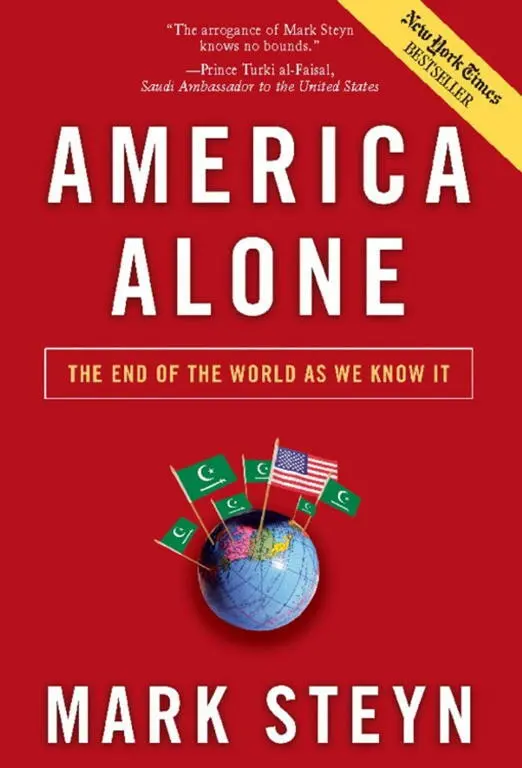
- Название:America Alone
- Автор:
- Издательство:Regnery Publishing
- Жанр:
- Год:2006
- Город:Washington, D.C.
- ISBN:978-0895260789
- Рейтинг книги:5 / 5. Голосов: 1
-
Избранное:Добавить в избранное
- Отзывы:
-
Ваша оценка:
America Alone: краткое содержание, описание и аннотация
Предлагаем к чтению аннотацию, описание, краткое содержание или предисловие (зависит от того, что написал сам автор книги «America Alone»). Если вы не нашли необходимую информацию о книге — напишите в комментариях, мы постараемся отыскать её.
It’s the end of the world as we know it…
Someday soon, you might wake up to the call to prayer from a muezzin. Europeans already are. And liberals will still tell you that “diversity is our strength” — while Talibanic enforcers cruise Greenwich Village burning books and barber shops, the Supreme Court decides sharia law doesn’t violate the “separation of church and state,” and the Hollywood Left decides to give up on gay rights in favor of the much safer charms of polygamy. If you think this can’t happen, you haven’t been paying attention, as the hilarious, provocative, and brilliant Mark Steyn — the most popular conservative columnist in the English-speaking world — shows to devastating effect. The future, as Steyn shows, belongs to the fecund and the confident. And the Islamists are both, while the West is looking ever more like the ruins of a civilization. But America can survive, prosper, and defend its freedom only if it continues to believe in itself, in the sturdier virtues of self-reliance (not government), in the centrality of family, and in the conviction that our country really is the world’s last best hope. Mark Steyn’s
is laugh-out-loud funny — but it will also change the way you look at the world.
[May contain tables.]
From the inside flap
America Alone — читать онлайн бесплатно полную книгу (весь текст) целиком
Ниже представлен текст книги, разбитый по страницам. Система сохранения места последней прочитанной страницы, позволяет с удобством читать онлайн бесплатно книгу «America Alone», без необходимости каждый раз заново искать на чём Вы остановились. Поставьте закладку, и сможете в любой момент перейти на страницу, на которой закончили чтение.
Интервал:
Закладка:
“Sorry,” gulped the mayor, hastily re-smothering Muslims within the great diversity quilt.
“They’re shocked as every Torontonian is.”
Ms. Montagne then expressed bafflement that these allegedly alleged fellows would have wanted to commit a terrorist atrocity in what was, compared to the Great Satan next door, “a very open society, very liberal immigration policy, very good social services.” Mayor Miller agreed. “More than half of the people who live in Toronto, including myself, were not born in Canada. And I think that’s why Canada works.”
“Although it didn’t work in this case,” Ms. Montagne noted, somewhat maliciously.
“Well, we don’t expect these kinds of occurrences, exactly because of our public services, because of diversity,” blah, blah, blah. Insofar as there’s any relation between jihadists and “good social services,” the latter seem to attract the former — at least in the sense that the millennium bomber, the shoe-bomber, the Tube bombers, etc., were all products of the Euro-Canadian welfare system. But go ahead, pretend that these guys were upset about insufficient “social services,” that they wanted to behead the prime minister to highlight the fact that wait times for the beheaded at the Toronto General are now up to eighteen months, and they don’t always reattach the right head. It’s easy to scoff that a chap who can be bothered to blow up the Canadian Parliament must be insane, but if you were a jihadist sitting in the cave back in the Hindu Kush listening to Renee Montagne and David Miller compete to abase themselves before the most irrelevant PC platitudes, wouldn’t you conclude that they’re way more suicidal than you and Ahmed?
A suicide bomber may be a weak weapon, but not against a suicide culture.
THE SICK BED
Shortly after September 11, I reread an old potboiler I vaguely remembered from my childhood: Sir Arthur Conan Doyle, the creator of Sherlock Holmes, had a sick wife and in 1895 they went to Egypt, hoping the climate would alleviate her tuberculosis. No writer likes to waste local color, so in 1898 Conan Doyle published The Tragedy of the Korosko, the story of a party of Anglo-American-French tourists on a trip up the Nile who wind up getting kidnapped by the al Qaeda of the day — the followers of the Mahdi. What’s striking is how familiar it all is. The sudden intrusion of an unbending savagery upon modern man: When, but a year before, he had wandered under the elms of Cambridge, surely the last fate upon this earth which he could have predicted for himself would be that he should be slain by the bullet of a fanatical Mohammedan in the wilds of the Libyan Desert.
Even the techniques are much the same:
“What do you suppose that they will do with us, Cochrane?” he asked, after a pause.
“They may cut our throats, or they may take us as slaves to Khartoum. I don’t know that there is much to choose.”
Then as now, the Islamists believe the infidels are looking at things back to front, that the advanced scientific mind is, in fact, an effete arrogant weakness in the face of unquestioning faith:
“As to the learning of which you speak, my lamb,” said the mullah, in answer to some argument of Fardet’s, “I have myself studied at the University of Alazhar at Cairo, and I know that to which you allude. But the learning of the faithful is not as the learning of the unbeliever, and it is not fitting that we pry too deeply into the ways of Allah. Some stars have tails, oh my sweet lamb, and some have not; but what does it profit us to know which are which? For God made them all, and they are very safe in His hands. Therefore, my friend, be not puffed up by the foolish learning of the West, and understand that there is only one wisdom, which consists in following the will of Allah as His chosen Prophet has laid it down for us in this book. And now, my lambs, I see that you are ready to come into Islam.” And in the face of such clarity there are among the tourists those who take refuge in conspiracy theories. Just as many Westerners believe Bush cooked up the whole war-onterror scam as a pretext to invade Afghanistan and Iraq, so at the beginning of Conan Doyle’s adventure a character believes the Mahdists have been concocted by the British government to provide a pretext for intervention:
“I repeat that there are no dervishes. They were an invention of Lord Cromer in the year 1885.”
“You don’t say!” cried Headingly.
“It is well known in Paris, and has been exposed in La Patrie and other of our so well-informed papers.”
And when the conspiracy theorist is kidnapped and learns that there are, indeed, dervishes, his initial reaction — like those of the misnamed “Christian Peacemaker Teams” seized in Iraq — is to emphasize how much he agrees with their point of view: The Frenchman waved his unwounded hand as he walked. “Vive Ie Khalifa! Vive Ie Mahdi!” he shouted, until a blow from behind with the butt-end of a Remington beat him into silence.
For, as did the kidnappers of those Iraqi “Peacemakers,” the dervishes see even a supportive infidel only as an infidel.
So what is different between a late Victorian “shocker” and our time?
Conan Doyle’s Britons and Americans and Europeans were men and women of the modern world even then:
None of them, except perhaps Miss Adams and Mrs. Belmont, had any deep religious convictions. All of them were children of this world, and some of them disagreed with everything which that symbol upon the earth represented. Yet in the end the English, Irish, and Americans among the party have an instinctive civilizational confidence. They respect their foe, in part because they understand that’s what he is. It was an odd sensation rereading The Tragedy of the Korosko after September 11. As innumerable Western academics lined up across the TV studios and public prints to insist that “poverty breeds desperation,” I came across this passage:
“It isn’t safe to reckon upon a dervish’s fears,” remarked Brown. “We must always bear in mind that they are not amenable to the same motives as other people. Many of them are anxious to meet death, and all of them are absolute, uncompromising believers in destiny. They exist as a reductio ad absurdum of all bigotry — a proof of how surely it leads towards blank barbarism.”
It is absurd: how can the most advanced society in human history fall to a bunch of ignorant death cultists? Well, who do you think advanced societies do fall to? Something worse, something barbarous, something that’s prepared to fight when you’re not. One hundred and eight years later, there was a latterday Cook’s Tour atrocity in Egypt — a terrorist bombing at the popular Western holiday destination of Dahab. Egyptians were polled as to whom was responsible: 4 percent thought it was al Qaeda; 21 percent thought it was internal terrorist groups; 49 percent thought it was the Mossad. Denial really is a river in Egypt. How many Egyptians or Arabs or Muslims living in, say, Brussels or London or Dearborn, Michigan, feel the same?
The key difference between the Anglo-American hostages, in The Tragedy of the Korosko and their successors today is that they accepted their obligations. It’s never easy, and certainly not for Conan Doyle’s dramatis personae in 1898, when the “white man’s burden” seemed especially burdensome:
“It’s my opinion that we have been the policemen of the world long enough. We policed the seas for pirates and slavers. Now we police the land for dervishes and brigands and every sort of danger to civilization. There is never a mad priest or a witch doctor, or a firebrand of any sort on this planet, who does not report his appearance by sniping the nearest British officer. One tires of it at last. If a Kurd breaks loose in Asia Minor, the world wants to know why Great Britain does not America Alone
Читать дальшеИнтервал:
Закладка:
Похожие книги на «America Alone»
Представляем Вашему вниманию похожие книги на «America Alone» списком для выбора. Мы отобрали схожую по названию и смыслу литературу в надежде предоставить читателям больше вариантов отыскать новые, интересные, ещё непрочитанные произведения.







Обсуждение, отзывы о книге «America Alone» и просто собственные мнения читателей. Оставьте ваши комментарии, напишите, что Вы думаете о произведении, его смысле или главных героях. Укажите что конкретно понравилось, а что нет, и почему Вы так считаете.