Mark Steyn - America Alone
Здесь есть возможность читать онлайн «Mark Steyn - America Alone» весь текст электронной книги совершенно бесплатно (целиком полную версию без сокращений). В некоторых случаях можно слушать аудио, скачать через торрент в формате fb2 и присутствует краткое содержание. Город: Washington, D.C., Год выпуска: 2006, ISBN: 2006, Издательство: Regnery Publishing, Жанр: Публицистика, Политика, на английском языке. Описание произведения, (предисловие) а так же отзывы посетителей доступны на портале библиотеки ЛибКат.
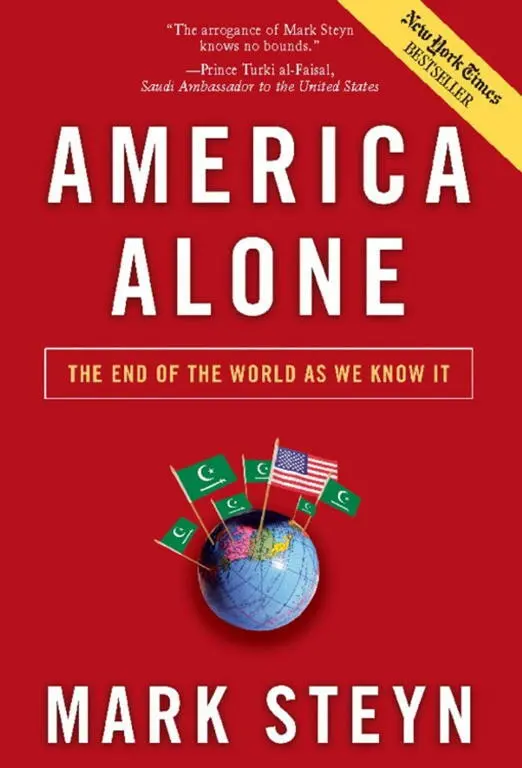
- Название:America Alone
- Автор:
- Издательство:Regnery Publishing
- Жанр:
- Год:2006
- Город:Washington, D.C.
- ISBN:978-0895260789
- Рейтинг книги:5 / 5. Голосов: 1
-
Избранное:Добавить в избранное
- Отзывы:
-
Ваша оценка:
America Alone: краткое содержание, описание и аннотация
Предлагаем к чтению аннотацию, описание, краткое содержание или предисловие (зависит от того, что написал сам автор книги «America Alone»). Если вы не нашли необходимую информацию о книге — напишите в комментариях, мы постараемся отыскать её.
It’s the end of the world as we know it…
Someday soon, you might wake up to the call to prayer from a muezzin. Europeans already are. And liberals will still tell you that “diversity is our strength” — while Talibanic enforcers cruise Greenwich Village burning books and barber shops, the Supreme Court decides sharia law doesn’t violate the “separation of church and state,” and the Hollywood Left decides to give up on gay rights in favor of the much safer charms of polygamy. If you think this can’t happen, you haven’t been paying attention, as the hilarious, provocative, and brilliant Mark Steyn — the most popular conservative columnist in the English-speaking world — shows to devastating effect. The future, as Steyn shows, belongs to the fecund and the confident. And the Islamists are both, while the West is looking ever more like the ruins of a civilization. But America can survive, prosper, and defend its freedom only if it continues to believe in itself, in the sturdier virtues of self-reliance (not government), in the centrality of family, and in the conviction that our country really is the world’s last best hope. Mark Steyn’s
is laugh-out-loud funny — but it will also change the way you look at the world.
[May contain tables.]
From the inside flap
America Alone — читать онлайн бесплатно полную книгу (весь текст) целиком
Ниже представлен текст книги, разбитый по страницам. Система сохранения места последней прочитанной страницы, позволяет с удобством читать онлайн бесплатно книгу «America Alone», без необходимости каждый раз заново искать на чём Вы остановились. Поставьте закладку, и сможете в любой момент перейти на страницу, на которой закончили чтение.
Интервал:
Закладка:
Yet if the purpose of the modern church is to be a cutting-edge political pacesetter, Islam is doing the better job. It’s easy to look at gold-toothed Punjabi yobs in northern England or Berber pseudo-rappers in French suburbs and think, oh well, their Muslim identity is clearly pretty residual. But that’s to apply Westernized notions of piety. Most of us have known that moment when we realize we’re in the presence of someone good, or at least goody-goody: the clean-cut Christian youth group that boards the plane and takes the seats around you, and whose very niceness makes you feel awkward. But the mosque is a meetinghouse, and throughout the West what it meets to discuss is, even when not explicitly jihadist, always political. The mosque or madrassa is not the place to go for spiritual contemplation as much as political motivation. The Muslim identity of those French rioters or English jailbirds may seem spiritually vestigial but it’s politically potent. Pre-modern Islam beats post-modern Christianity.
In 2006, a dozen intellectuals published a manifesto against Islamism and in defense of “secular values for all.” The signatories included Ayaan Hirsi Ali, the Dutch parliamentarian; Irshad Manji, the Canadian writer; and Salman Rushdie, the British novelist. All three are brave figures and important allies in the campaign against the Islamist tide. But they’re making a mistake: secular humanism is an insufficient rallying cry. As another Canadian, Kathy Shaidle, wrote in response: “It is secularism itself which is part of the problem, not the solution, since secularism is precisely what created the Euro spiritual/moral vacuum into which Islamism has rushed headlong.”
It’s not an unprecedented arc: Hitler followed Weimar — or, for fans of Cabaret, prison camps followed transvestites in cutaway buttocks. There’s an extremely fine line between “boldly transgressive” and spiritually barren, and it’s foolish of secular Western elites to assume their own populations are immune to the strong-horse pitch. There’s a reason that Islam is winning reverts in Europe and North America. Prayers for the Assassin, a portrait of the Islamic Republic of America in the year 2040, is an inventive piece of “what if?” fiction by Robert Ferrigno, hitherto an efficient writer of lurid Californian crime novels full of porno stars, druggies, and a decadent elite: a slice of everyday life in the Golden State. In its way, Ferrigno’s imagined Islamic future is a corrective to that present: Jill Stanton’s proclamation of faith while accepting her second Academy Award would have been enough to interest tens of millions of Americans in the truth of Islam, but she had also chosen that moment in the international spotlight to announce her betrothal to Assan Rachman, power forward and MVP of the world champion Los Angeles Lakers. Celebrity conversions cascaded in the weeks after that Oscars night.
They’re the American equivalents of Emma Clark and Britain’s Muslim soccer players. Absent some transformative catastrophe — as in Ferrigno’s novel — the United States has a strain of evangelical Protestantism strong enough to grow in the years ahead. Unfortunately, there is no such surging evangelicalism in Europe. In search of the guiding hand of God, some Europeans will return to Pope Benedict’s church, some will accept Islam, but there will be no takers for the archbishop of Canterbury’s watery obsolescent soft-left pap. In “Dover Beach,” Matthew Arnold wrote:
The Sea of Faith
Was once, too, at the full, and round earth’s shore
Lay like the folds of a bright girdle furl’d.
But now I only hear
Its melancholy, long, withdrawing roar, Retreating, to the breath
Of the night-wind, down the vast edges drear
And naked shingles of the world.
The “melancholy, long, withdrawing roar” has been so long withdrawing in Europe that they don’t yet understand the sound they hear is a new roar, not withdrawing but gradually advancing, a new Sea of Faith that one day will be at the full and round Europe’s shore like the folds of a bright girdle furl’d.
By the time that Olympic mega-mosque is open for business in the London of 2012, you’ll be surprised how well it fits in.
Chapter Six
The Four Horsemen of the Eupocalypse
EUTOPIA VS. EURABIA
The decline of the French monarchy invited the attack of these insatiate fanatics. The descendants of Clovis had lost the inheritance of his martial and ferocious spirit; and their misfortune or demerit has affixed the epithet of “lazy” to the last kings of the Merovingian race. They ascended the throne without power, and sunk into the grave without a name…. The vineyards of Gascony and the city of Bourdeaux were possessed by the sovereign of Damascus and Samarcand; and the south of France, from the mouth of the Garonne to that of the Rhone, assumed the manners and religion of Arabia. But these narrow limits were scorned by the spirit of Abdalraman, or Abderame, who had been restored by the caliph Hashem to the wishes of the soldiers and people of Spain. That veteran and daring commander adjudged to the obedience of the prophet whatever yet remained of France or of Europe; and prepared to execute the sentence, at the head of a formidable host in the full confidence of surmounting all opposition either of nature or of man.
EDWARD GIBBON, THE DECLINE AND FALL OF THE ROMAN EMPIRE (1776-1788)To mark the Fourth of July 2006, the Los Angeles Times published an essay by Mark Kurlansky, author of The Big Oyster: History on the Half Shell . It began thus: Someone has to say it or we are never going to get out of this rut: I am sick and tired of the founding fathers and all their intents. The real American question of our times is how our country in a little over two hundred years sank from the great hope to the most backward democracy in the West. The U.S. offers the worst health care program, one of the worst public school systems, and the worst benefits for workers. The margin between rich and poor has been growing precipitously while it has been decreasing in Europe. Among the great democracies, we use military might less cautiously, show less respect for international law, and are the stumbling block in international environmental cooperation. Few informed people look to the United States anymore for progressive ideas.
We ought to do something. Instead, we keep worrying about the vision of a bunch of sexist, slave-owning eighteenth-century white men in wigs and breeches. Etc. The assumptions behind Kurlansky’s piece are widely held, and not just by the Left-the assumption, for example, that Scandinavia is the natural destination of the fully evolved Western democracy and America’s just taking a little longer to get there than the Dutch and the Canadians. That’s what “the most backward democracy” means: the least like Europe. But it ought to be clear by now that Europe is ahead of America mainly in the sense that its canoe is already halfway over the falls. There may be many things wrong with the United States but only a blind fool who hasn’t been paying attention for the last twenty years would hold Europe up as the alternative. The U.S. has the “worst benefits for workers”? Maybe. But it also has the lowest unemployment rate — about half the rate in France and Germany, where it hovers permanently at around 10 percent. As for being “the stumbling block in international environmental cooperation,” European countries signed Kyoto and failed to meet its emission reduction targets, whereas the United States didn’t sign it but reduced its emissions anyway — through that traditional American virtue of innovation. Self-loathing Americans are in danger of sounding like self-loathing squares if they pin their hopes on a decayed Eutopia a quarter century past its sell-by date.
Читать дальшеИнтервал:
Закладка:
Похожие книги на «America Alone»
Представляем Вашему вниманию похожие книги на «America Alone» списком для выбора. Мы отобрали схожую по названию и смыслу литературу в надежде предоставить читателям больше вариантов отыскать новые, интересные, ещё непрочитанные произведения.








Обсуждение, отзывы о книге «America Alone» и просто собственные мнения читателей. Оставьте ваши комментарии, напишите, что Вы думаете о произведении, его смысле или главных героях. Укажите что конкретно понравилось, а что нет, и почему Вы так считаете.