Mark Steyn - America Alone
Здесь есть возможность читать онлайн «Mark Steyn - America Alone» весь текст электронной книги совершенно бесплатно (целиком полную версию без сокращений). В некоторых случаях можно слушать аудио, скачать через торрент в формате fb2 и присутствует краткое содержание. Город: Washington, D.C., Год выпуска: 2006, ISBN: 2006, Издательство: Regnery Publishing, Жанр: Публицистика, Политика, на английском языке. Описание произведения, (предисловие) а так же отзывы посетителей доступны на портале библиотеки ЛибКат.
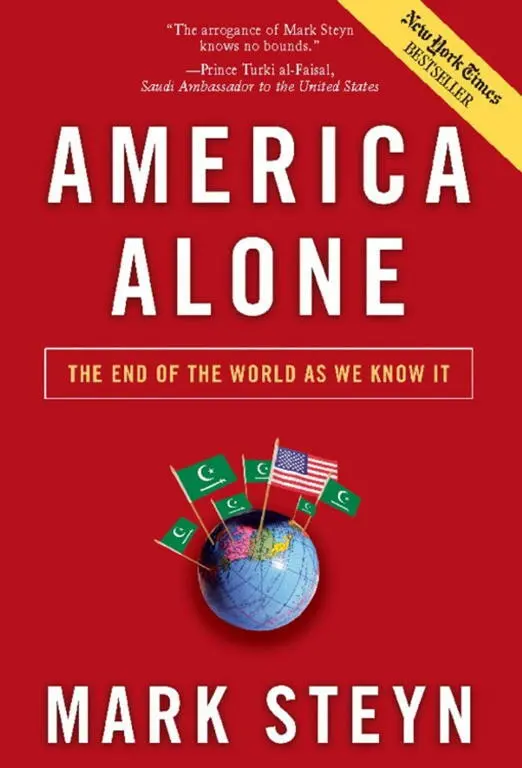
- Название:America Alone
- Автор:
- Издательство:Regnery Publishing
- Жанр:
- Год:2006
- Город:Washington, D.C.
- ISBN:978-0895260789
- Рейтинг книги:5 / 5. Голосов: 1
-
Избранное:Добавить в избранное
- Отзывы:
-
Ваша оценка:
America Alone: краткое содержание, описание и аннотация
Предлагаем к чтению аннотацию, описание, краткое содержание или предисловие (зависит от того, что написал сам автор книги «America Alone»). Если вы не нашли необходимую информацию о книге — напишите в комментариях, мы постараемся отыскать её.
It’s the end of the world as we know it…
Someday soon, you might wake up to the call to prayer from a muezzin. Europeans already are. And liberals will still tell you that “diversity is our strength” — while Talibanic enforcers cruise Greenwich Village burning books and barber shops, the Supreme Court decides sharia law doesn’t violate the “separation of church and state,” and the Hollywood Left decides to give up on gay rights in favor of the much safer charms of polygamy. If you think this can’t happen, you haven’t been paying attention, as the hilarious, provocative, and brilliant Mark Steyn — the most popular conservative columnist in the English-speaking world — shows to devastating effect. The future, as Steyn shows, belongs to the fecund and the confident. And the Islamists are both, while the West is looking ever more like the ruins of a civilization. But America can survive, prosper, and defend its freedom only if it continues to believe in itself, in the sturdier virtues of self-reliance (not government), in the centrality of family, and in the conviction that our country really is the world’s last best hope. Mark Steyn’s
is laugh-out-loud funny — but it will also change the way you look at the world.
[May contain tables.]
From the inside flap
America Alone — читать онлайн бесплатно полную книгу (весь текст) целиком
Ниже представлен текст книги, разбитый по страницам. Система сохранения места последней прочитанной страницы, позволяет с удобством читать онлайн бесплатно книгу «America Alone», без необходимости каждый раз заново искать на чём Вы остановились. Поставьте закладку, и сможете в любой момент перейти на страницу, на которой закончили чтение.
Интервал:
Закладка:
What of America? The hyperpower, demographically, is in Shakespeare’s middle age:
In fair round belly with good capon lined…
Full of wise saws and modern instances…
or, more accurately, divided between the two: blue-staters taking refuge in too many “modern instances,” but with sufficient red-staters who still live by the “wise saws.” The United States has demographic challenges of its own, but, even if one accepts the dubious proposition that its population’s ability to maintain “replacement rate” fertility is largely dependent on Hispanic immigration, its native birth rate is still the highest in the developed world. So the United States’s relatively healthy demographic profile is merely the latest example of American exceptionalism.
What of Europe?
…The sixth age shifts
Into the lean and slippered pantaloon,
With spectacles on nose and pouch on side,
His youthful hose, well saved, a world too wide,
For his shrunk shank; and his big manly voice,
Turning again towards the childish treble, pipes
And whistles in his sound…
That’s the situation the Continent’s in. In constructing the European Union, they’ve built a world too wide for their shrunk shank. Worse, it’s constructed in a particular fashion: since 1945, the big manly voices of the perpetually warring Germans and French and Italians have been turned to socialized health care and welfare and paid vacations that enable modern European man to live his entire life in the childish treble. Unfortunately, such a society is hideously expensive to maintain, so Europe’s aging population requires ever more and ever younger immigrants to prop up the system.
How does Shakespeare conclude?
…Last scene of all,
That ends this strange eventful history,
Is second childishness and mere oblivion,
Sans teeth, sans eyes, sans taste, sans everything.
That’s Russia today: “the sick man of Europe,” with falling life expectancy, riddled with HIV and tuberculosis and heart disease, its infrastructure crumbling, its borders unenforceable, and its wily kleptocracy draining its wealth Westward — a nation all but “sans everything.”
How does Shakespeare begin?
…At first the infant,
Mewling and puking in the nurse’s arms…
Go to any children’s store in Amsterdam or Marseilles or Vienna or Stockholm. Look at the women in headscarves or full abaya. That’s the future.
Chapter Two
Going… Going… Gone
DEMOGRAPHY VS. DELUSION
Like a lecherous stud suddenly stricken with impotence, we are humiliated at the very heart of our faith in ourselves. For all our knowledge, our intelligence, our power, we can no longer do what the animals do without thought.
P. D. JAMES, THE CHILDREN OF MEN (1993)The words are those of Theodore Faron, Fellow of Merton College, Oxford, in the first chapter of Baroness James’s novel, set in 2021, when the human race is unable to breed. We seem to be approaching that situation a little ahead of schedule. The only difference between Lady James’s dystopian fantasy and our current reality is that, in the fictional version, man is physically impotent.
In real life, we appear to be psychosomatically barren — at least in the non-red-state parts of the developed world. Almost every geopolitical challenge in the years ahead has its roots in demography, but not every demographic crisis will play out the same way. That’s what makes doing anything about it even more problematic — different countries’ reactions to their own particular domestic circumstances will impact in destabilizing ways on the international scene. In Japan, the demographic crisis exists virtually in laboratory conditions — no complicating factors; in Russia, it will be determined by the country’s relationship with a cramped neighbor, China; and in Europe, the new owners are already in place — like a tenant with a right-to-buy agreement.
Let’s start in the most geriatric jurisdiction on the planet. In Japan, the rising sun has already passed into the next phase of its long sunset: net population loss. 2005 was the first year since records began in which the country had more deaths than births. Japan offers the chance to observe the demographic death spiral in its purest form. It’s a country with no immigration, no significant minorities, and no desire for any: just the Japanese, aging and dwindling.
At first it doesn’t sound too bad: compared with the United States, most advanced societies are very crowded. If you’re in a cramped apartment in a noisy, congested city, losing a couple hundred thousand seems a fine trade-off. The difficulty, in a modern socialdemocratic state, is managing which people to lose: already, according to the Japan Times, depopulation is “presenting the government with pressing challenges on the social and economic front, including ensuring provision of social security services and securing the labor force.” For one thing, the shortage of children has led to a shortage of obstetricians. Why would any talented, ambitious med school student want to go into a field in such precipitous decline? As a result, if you live in certain parts of Japan, childbirth is all in the timing. On Oki Island, try to time the contractions for Monday morning. That’s when the maternity ward is open-first day of the week, 10 a.m., when an obstetrician flies in to attend to any pregnant mothers who happen to be around. And at 5:30 p.m. she flies out. So if you’ve been careless enough to time your childbirth for Tuesday through Sunday, you’ll have to climb into a helicopter and zip off to give birth alone in a strange hospital unsurrounded by tiresome loved ones.
Do Lamaze classes on Oki now teach you to time your breathing to the whirring of the chopper blades?
The last local obstetrician left the island in 2006 and the health service isn’t expecting any more. Doubtless most of us can recall reading similar stories over the years from remote rural districts in America, Canada, or Australia. After all, why would a village of a few hundred people have a great medical system? But Oki has a population of 17,000, and there are still no obstetricians. Birthing is a dying business.
So what will happen? There are a couple of scenarios. Whatever Japanese feelings are on immigration, a country with great infrastructure won’t empty out for long, any more than a state-of-the-art factory that goes belly up stays empty for long. At some point, someone else will move in to Japan’s plant.
And the alternative? In P. D. James’s The Children of Men , there are special dolls for women whose maternal instinct has gone unfulfilled: pretend mothers take their artificial children for walks on the street or to the swings in the park. In Japan, that’s no longer the stuff of dystopian fantasy. At the beginning of the century, the country’s toymakers noticed they had a problem: toys are for children and Japan doesn’t have many. What to do? In 2005, Tomy began marketing a new doll called Yumela baby boy with a range of 1,200 phrases designed to serve as a companion for the elderly: He says not just the usual things — “I wuv you” — but also asks the questions your grandchildren would ask, if you had any:
“Why do elephants have long noses?” Yumel joins his friend the Snuggling Ifbot, a toy designed to have the conversation of a five-year-old child, which its makers, with the usual Japanese efficiency, have determined is just enough chit-chat to prevent the old folks going senile. It seems an appropriate final comment on the social-democratic state: in a childish infantilized self-absorbed society where adults have been stripped of all responsibility, you need never stop playing with toys. We are the children we never had. And why leave it at that? Is it likely an ever-smaller number of young people will want to spend their active years looking after an ever-greater number of old people? Or will it be simpler to put all that cutting-edge Japanese technology to good use and take a flier on Mister Roboto and the post-human future? After all, what’s easier for the governing class?
Читать дальшеИнтервал:
Закладка:
Похожие книги на «America Alone»
Представляем Вашему вниманию похожие книги на «America Alone» списком для выбора. Мы отобрали схожую по названию и смыслу литературу в надежде предоставить читателям больше вариантов отыскать новые, интересные, ещё непрочитанные произведения.










Обсуждение, отзывы о книге «America Alone» и просто собственные мнения читателей. Оставьте ваши комментарии, напишите, что Вы думаете о произведении, его смысле или главных героях. Укажите что конкретно понравилось, а что нет, и почему Вы так считаете.