Siri Hustvedt - Living, Thinking, Looking - Essays
Здесь есть возможность читать онлайн «Siri Hustvedt - Living, Thinking, Looking - Essays» весь текст электронной книги совершенно бесплатно (целиком полную версию без сокращений). В некоторых случаях можно слушать аудио, скачать через торрент в формате fb2 и присутствует краткое содержание. Год выпуска: 2012, Издательство: Picador, Жанр: Публицистика, Критика, на английском языке. Описание произведения, (предисловие) а так же отзывы посетителей доступны на портале библиотеки ЛибКат.
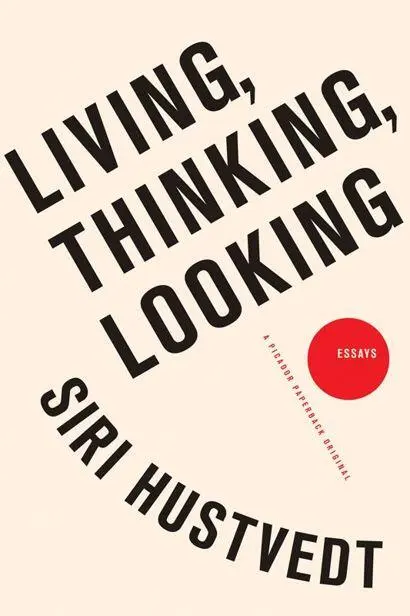
- Название:Living, Thinking, Looking: Essays
- Автор:
- Издательство:Picador
- Жанр:
- Год:2012
- ISBN:нет данных
- Рейтинг книги:4 / 5. Голосов: 1
-
Избранное:Добавить в избранное
- Отзывы:
-
Ваша оценка:
Living, Thinking, Looking: Essays: краткое содержание, описание и аннотация
Предлагаем к чтению аннотацию, описание, краткое содержание или предисловие (зависит от того, что написал сам автор книги «Living, Thinking, Looking: Essays»). Если вы не нашли необходимую информацию о книге — напишите в комментариях, мы постараемся отыскать её.
) as well as an interdisciplinary investigation of a neurological disorder (
). She has given lectures on artists and theories of art at the Prado, the Metropolitan Museum of Art in New York, and the Academy of Fine Arts in Munich. In 2011, she delivered the thirty-ninth annual Freud Lecture in Vienna.
brings together thirty-two essays written between 2006 and 2011, in which the author culls insights from philosophy, neuroscience, psychology, psychoanalysis, and literature.The book is divided into three sections: the essays in
draw directly from Hustvedt’s life; those in
explore memory, emotion, and the imagination; and the pieces in
are about visual art. And yet, the same questions recur throughout the collection. How do we see, remember, and feel? How do we interact with other people? What does it mean to sleep, dream, and speak? What is "the self"? Hustvedt’s unique synthesis of knowledge from many fields reinvigorates the much-needed dialogue between the humanities and the sciences as it deepens our understanding of an age-old riddle: What does it mean to be human?
Living, Thinking, Looking: Essays — читать онлайн бесплатно полную книгу (весь текст) целиком
Ниже представлен текст книги, разбитый по страницам. Система сохранения места последней прочитанной страницы, позволяет с удобством читать онлайн бесплатно книгу «Living, Thinking, Looking: Essays», без необходимости каждый раз заново искать на чём Вы остановились. Поставьте закладку, и сможете в любой момент перейти на страницу, на которой закончили чтение.
Интервал:
Закладка:
When I saw the painting for the first time, I did not know that the objects in the work are symbolic offerings to the Virgin Mary, that lemons are an Easter fruit, that the rose signifies love, purity, and chastity, and the table an altar. I read that later. It did not fundamentally change my feelings about the picture but rather added to what I had already felt in an undogmatic way — that there is something unworldly about the things I see here, that they are objects suffused with transcendent feeling. Much scholarship about art is in the business of explaining these sorts of meanings: the oranges and their blossoms signify the renewal of life. Other academics write long discourses about technique to explain how a work was made, and there is high theory about art as well, the philosophy of art. In my reading of these philosophers I ran across this:
O is a work of art-e = df O is an artifact and O functions to provide for aesthetic appreciation. 24
This is part of a much longer analytical argument, in which James C. Anderson gives the reader a definition of art. Every definition is under siege, and there is little agreement. I have no problem with logical formulas as a way to get at meanings and, in the course of his essay, Anderson modifies this definition to include a second qualifier as a subcategory of appreciation: “art self-conscious art,” 25but what interests me here is the way “aesthetic appreciation” appears in the formula. The words imply an abstract viewer, a general appreciator, and that something happens in that “appreciation,” but the particular embodied dynamics of appreciating are missing, although Anderson suggests that even disgust can be subsumed by the word appreciation. I am not saying that Anderson is necessarily wrong. I am offering here an addendum to theories that have left the drama of creative perception and embodied feeling out of the discussion about art, theories that have largely forgotten that art lives in a viewing subject, in the person who stands in front of whatever the thing is and looks at it, sometimes appreciatively, sometimes not. We might ask how much appreciation does it take to make a work of art. Why do we appreciate art at all? Why do I love the Zurbarán picture? Why am I not alone in loving it? Where and how and when does that love I feel take place? There is no art without the imaginary, and the imaginary is not a given; it arrives at a moment in human development, and it begins in play.
All mammals play, especially young ones, but imaginative play — taking on other roles, being the mother or the father or the baby, building sand castles, making mud pies, drawing a house with a big sun shining over it — belongs to human children and the ability develops over time. Vygotsky argues that in early childhood “there is a union of motives and perception. At this age perception is generally not an independent but rather an integrated feature of a motor action. Every perception is a stimulus to activity.” 26This comment resonates well with my earlier discussion about our proprioceptive, motor-sensory abilities that underlie our visual perceptions of things. Children learn through their active exploration of space, which in time develops into a sixth sense. Around the age of three pretending begins. In imaginative play, the child detaches the usual meaning of a thing, stick, for example, and gives it another significance, horse . The new meaning horse determines the child’s action — galloping across the floor with the stick between his legs. That gallop has been severed from the ordinary meanings of what he sees around him. Dogs romp and play with each other, but they do not indulge in the fantasy of another world. And where does pretending happen? It occurs in an imaginary space that exists side by side with actual or real space. This human flexibility to be two places at once is a function of understanding time and symbolic representation. Because at some moment in my childhood, through my acquisition of reflection — in mirroring and then in language — I developed the ability to remember myself in the past and project myself into the future. I can leave my immediate circumstances and pretend that I am elsewhere or that I am someone else: the old man looking at Duccio, for example. I can imagine myself in the third person and as someone who is not me. Without this there is no art.
Merleau-Ponty writes, “In the case of the normal subject, the body is available not only in real situations into which it is drawn. It can turn aside from the world … lend itself to experimentation, and generally speaking take its place in the realm of the potential.” 27Art happens in this potential space — I would say fictional space of human life, the world of play and its transformations, which Vygotsky refers to as a “realm of spontaneity and freedom.” 28And it always involves some form of intentional motion outward into the other and otherness, not necessarily a specific place or person but an active seeking toward them. In Remembering, Repeating, and Working Through (1914), Freud uses the word playground in connection to the transference, that mysterious fluctuating space between patient and analyst, which he also calls “an intermediate region” where “almost complete freedom” is possible. 29Winnicott elaborated on Freud’s playground as the essential space of creativity: “This area of playing,” he writes, “is not inner psychic reality. It is outside the individual, but it is not the external world.” 30Its origins are deep and bodily. They begin in the first relations between child and mother, in mirroring, in our physical explorations of space and our ability to posit an imaginary zone of experience, which Winnicott also refers to as “potential space.” 31This is the ground on which art lives. It is also where appreciation happens and where love can happen.
When we come to a work of art, we are not only witness to the results of another person’s intentional play in his or her fictive space, we are free to play ourselves, to muse and dream and question and theorize. As spectators, we too find ourselves in a potential space between us and what we see because perception is active and creative, and artworks engage us, not just intellectually but emotionally, physically, consciously, and unconsciously, and that relation, that dialogue may be, as Schelling believed, finally indeterminable. But when we love a work of art, there is always a form of recognition that occurs. The object reflects us, not in the way a mirror gives our faces and bodies back to us. It reflects the vision of the other, of the artist, that we have made our own because it answers something within us that we understand is true. This truth may be only a feeling, only a humming resonance we cannot put into words, or it may become a vast discursive statement, but it must be there for the enchantment to happen — that excursion into you that is also I.
2010
NOTES
Variations on Desire: A Mouse, a Dog, Buber, and Bovary
1. Quoted in Mary Carruthers and Jan M. Ziolkowski, The Medieval Craft of Memory: An Anthology of Texts and Pictures (Philadelphia: University of Pennsylvania Press, 2002), 7.
2. Jaak Panksepp, Affective Neuroscience: The Foundations of Human and Animal Emotions (Oxford: Oxford University Press, 1998), 144.
3. Ibid., 144.
4. Martin Buber, Between Man and Man (New York: Macmillan, 1965), 11.
5. Gustave Flaubert, Madame Bovary , trans. Alan Russell (Baltimore: Penguin, 1965), 71.
6. Ibid., 325.
7. D. W. Winnicott, “The Relationship of a Mother to Her Baby at the Beginning,” The Family and Individual Development (London: Routledge, 1995), 15.
Читать дальшеИнтервал:
Закладка:
Похожие книги на «Living, Thinking, Looking: Essays»
Представляем Вашему вниманию похожие книги на «Living, Thinking, Looking: Essays» списком для выбора. Мы отобрали схожую по названию и смыслу литературу в надежде предоставить читателям больше вариантов отыскать новые, интересные, ещё непрочитанные произведения.


Обсуждение, отзывы о книге «Living, Thinking, Looking: Essays» и просто собственные мнения читателей. Оставьте ваши комментарии, напишите, что Вы думаете о произведении, его смысле или главных героях. Укажите что конкретно понравилось, а что нет, и почему Вы так считаете.