Antony Beevor - Berlin - The Downfall 1945
Здесь есть возможность читать онлайн «Antony Beevor - Berlin - The Downfall 1945» весь текст электронной книги совершенно бесплатно (целиком полную версию без сокращений). В некоторых случаях можно слушать аудио, скачать через торрент в формате fb2 и присутствует краткое содержание. Город: New York, Год выпуска: 2007, ISBN: 2007, Издательство: Penguin Books, Жанр: nonf_military, История, на английском языке. Описание произведения, (предисловие) а так же отзывы посетителей доступны на портале библиотеки ЛибКат.
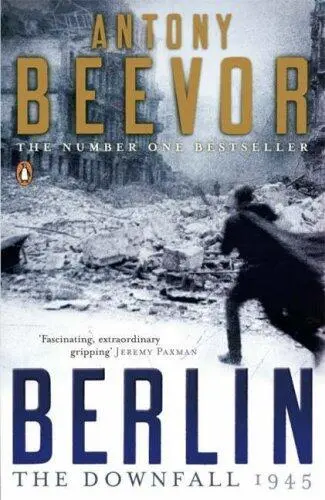
- Название:Berlin: The Downfall 1945
- Автор:
- Издательство:Penguin Books
- Жанр:
- Год:2007
- Город:New York
- ISBN:978-0-141-90302-6
- Рейтинг книги:3 / 5. Голосов: 1
-
Избранное:Добавить в избранное
- Отзывы:
-
Ваша оценка:
Berlin: The Downfall 1945: краткое содержание, описание и аннотация
Предлагаем к чтению аннотацию, описание, краткое содержание или предисловие (зависит от того, что написал сам автор книги «Berlin: The Downfall 1945»). Если вы не нашли необходимую информацию о книге — напишите в комментариях, мы постараемся отыскать её.
Antony Beevor reconstructs the experiences of those millions caught up in the nightmare of the Third Reich's final collapse, telling a terrible story of pride, stupidity, fanatacism, revenge and savagery, but also one of astonishing endurance, self-sacrifice and survival against all odds.
Berlin: The Downfall 1945 — читать онлайн бесплатно полную книгу (весь текст) целиком
Ниже представлен текст книги, разбитый по страницам. Система сохранения места последней прочитанной страницы, позволяет с удобством читать онлайн бесплатно книгу «Berlin: The Downfall 1945», без необходимости каждый раз заново искать на чём Вы остановились. Поставьте закладку, и сможете в любой момент перейти на страницу, на которой закончили чтение.
Интервал:
Закладка:
Stalin did not relax the pressure. He claimed that 212 Soviet soldiers had been killed by Poles. Churchill was forced to agree that attacks on the Red Army by the Polish non-Communist resistance, the Armia Krajowa, were utterly unacceptable. The Prime Minister did not know that the NKVD regiments in charge of rear area security were in most cases the aggressors, arresting any members of the underground and sometimes using torture to force them to reveal other names and the locations of their arms dumps. Roosevelt, clearly too ill and exhausted to intervene, could insist only on free elections in Poland, but that was a pious hope with the machinery entirely in Soviet hands. His chief aide, Harry Hopkins, estimated that Roosevelt had probably not taken in more than half of what was said.
Stalin was convinced that he had won. As soon as the Soviet delegates felt that there was no further challenge to their control of Poland, they suddenly dropped their opposition to the voting system proposed by the Americans for the United Nations. The other principal American concern, that Stalin would commit himself to the war against Japan within a short time of the defeat of Germany, was achieved at a private meeting on 8 February.
The Soviet leader was not gracious in victory. When Churchill expressed his fears at another meeting that such a massive change in Poland’s frontiers at Germany’s expense would cause an enormous shift in population, Stalin retorted that it would not be a problem. He spoke triumphantly of the huge wave of German refugees running away from the Red Army.
On 13 February, two days after the Yalta conference ended, Soviet might was reconfirmed with the fall of Budapest. The end of this terrible battle for the city was marked by an orgy of killing, looting, destruction and rape. Yet Hitler still wanted to counter-attack in Hungary with the Sixth SS Panzer Army. He hoped to smash Marshal Tolbukhin’s 3rd Ukrainian Front, but this was the compulsive gambler throwing on to the table the last few chips left over from the Ardennes.
That night, the British bombed Dresden. The following morning, which happened to be Ash Wednesday, the US Air Force followed in their path and also attacked several lesser targets. It was intended as a rapid fulfilment of the promise to the Stavka to hinder German troop movements by smashing rail communications. The fact that there were 180 V-bomb rocket attacks on England that week, the highest number so far, did little to soften the planners’ hearts. Dresden, the exquisitely beautiful capital of Saxony, had never been seriously bombed before. Dresdeners used to joke, half-believing it, that Churchill had an aunt living in the city and that was why they had been spared. But the raids on 13 and 14 February were merciless. The effect was in some ways comparable to the Hamburg fire-storm raid. But Dresden’s population was swollen by up to 300,000 refugees from the east. Several trains full of them were stuck in the main station. The tragedy was that instead of troops passing through Dresden to the front, as Soviet military intelligence had asserted, the traffic was civilian and going in the opposite direction.
Goebbels apparently shook with fury on hearing the news. He wanted to execute as many prisoners of war as the number of civilians killed in the attack. The idea appealed to Hitler. Such an extreme measure would tear up the Geneva Convention in the face of the Western Allies and force his own troops to fight to the end. But General Jodl, supported by Ribbentrop, Field Marshal Keitel and Grand Admiral Dönitz finally persuaded him that such an escalation of terror would turn out worse for Germany. Goebbels nevertheless extracted all he could from this ‘terror attack’. Soldiers with relatives in the city were promised compassionate leave. Hans-Dietrich Genscher remembers some of them returning from their visit. They were reluctant to talk about what they had seen.
On the Western Front, the Americans and the British had not been advancing anything like as rapidly as the Red Army. The battle for the Rhineland, which began during the talks at Yalta, was also slow and deliberate. Eisenhower was in no hurry. He thought that spring floodwater would make the Rhine impassable until the beginning of May. It was to take another six weeks before all Eisenhower’s armies were ready on the west bank of the Rhine. Only the miracle of capturing intact the Rhine bridge at Remagen allowed an acceleration of the programme.
Eisenhower was deeply irritated by the continuing British criticism of his methodical broad-front strategy. Churchill, Brooke and Field Marshal Montgomery all wanted a reinforced breakthrough to head for Berlin. Their reasons were mainly political. The capture of Berlin before the Red Army arrived would help to restore the balance of power with Stalin. Yet they also felt on military grounds that to seize the capital of the Reich would deal the greatest psychological blow to German resistance and shorten the war. British arguments for the single thrust into the heart of Germany, however, had not been helped by the insufferable Field Marshal Montgomery. At the end of the first week of January, he had tried to take far more credit for the defeat of the German offensive in the Ardennes than was his due. This crass and unpleasant blunder naturally infuriated American generals and deeply embarrassed Churchill. It certainly did not help persuade Eisenhower to allow Montgomery to lead a major push through northern Germany to Berlin.
Eisenhower, as supreme commander, continued to insist that it was not his job to look towards the post-war world. His task was to finish the war effectively with as few casualties as possible. He felt that the British were allowing post-war politics to rule military strategy. Eisenhower was genuinely grateful to Stalin for the effort made to advance the date of the January offensive, even if he was unaware of Stalin’s ulterior motive of securing Poland before the Yalta conference.
United States policy-makers simply did not wish to provoke Stalin in any way. John G. Winant, the United States ambassador in London, when discussing zones of occupation on the European Advisory Commission, even refused to raise the issue of a land corridor to Berlin in case it spoiled his relationship with his Soviet opposite number. The policy of appeasing Stalin came from the top and was widely accepted. Eisenhower’s political adviser, Robert Murphy, had been told by Roosevelt that ‘the most important thing was to persuade the Russians to trust us’. This could not have suited Stalin better. Roosevelt’s claim, ‘I can handle Stalin’, was part of what Robert Murphy acknowledged to be ‘the all-too-prevalent American theory’ that individual friendships can determine national policy. ‘Soviet policy-makers and diplomats never operate on that theory,’ he added. The American longing to be trusted by Stalin blinded them to the question of how far they should trust him. And this was a man whose lack of respect for international law had led him to suggest quite calmly that they should invade Germany via neutral Switzerland, thus ‘outflanking the West Wall’.
Soviet resentment was based on the fact that the United States and Britain had suffered so little in comparison. Nazi Germany also treated Allied prisoners in a totally different way from Red Army prisoners. A 1st Belorussian Front report on the liberation of a prisoner-of-war camp near Thorn underlined the contrast in fates. The appearance of the Americans, British and French inmates was healthy. ‘They looked more like people on holiday than prisoners of war,’ the report stated, ‘while Soviet prisoners were emaciated, wrapped in blankets.’ Prisoners from the Western Allied countries did not have to work, they were allowed to play football and they received food parcels from the Red Cross. Meanwhile, in the other part of the camp, ‘17,000 Soviet prisoners had been killed or died from starvation or illness. The “special regime” for Soviet prisoners consisted of 300 grams of ersatz bread and 1 litre of soup made from rotten mangelwurzels per day. Healthy prisoners were made to dig trenches, the weak ones were killed or buried alive.’ British prisoners there in Stalag XXA insist that it was far from a holiday camp and that their rations were in fact no better than those given to the Soviet prisoners, but they had been saved from starvation by Red Cross parcels.
Читать дальшеИнтервал:
Закладка:
Похожие книги на «Berlin: The Downfall 1945»
Представляем Вашему вниманию похожие книги на «Berlin: The Downfall 1945» списком для выбора. Мы отобрали схожую по названию и смыслу литературу в надежде предоставить читателям больше вариантов отыскать новые, интересные, ещё непрочитанные произведения.








Обсуждение, отзывы о книге «Berlin: The Downfall 1945» и просто собственные мнения читателей. Оставьте ваши комментарии, напишите, что Вы думаете о произведении, его смысле или главных героях. Укажите что конкретно понравилось, а что нет, и почему Вы так считаете.