Dennis Showalter - Armor and Blood
Здесь есть возможность читать онлайн «Dennis Showalter - Armor and Blood» весь текст электронной книги совершенно бесплатно (целиком полную версию без сокращений). В некоторых случаях можно слушать аудио, скачать через торрент в формате fb2 и присутствует краткое содержание. Город: New York, Год выпуска: 2013, ISBN: 2013, Издательство: Random House, Жанр: military_history, на английском языке. Описание произведения, (предисловие) а так же отзывы посетителей доступны на портале библиотеки ЛибКат.
- Название:Armor and Blood
- Автор:
- Издательство:Random House
- Жанр:
- Год:2013
- Город:New York
- ISBN:9780812994650
- Рейтинг книги:5 / 5. Голосов: 1
-
Избранное:Добавить в избранное
- Отзывы:
-
Ваша оценка:
Armor and Blood: краткое содержание, описание и аннотация
Предлагаем к чтению аннотацию, описание, краткое содержание или предисловие (зависит от того, что написал сам автор книги «Armor and Blood»). Если вы не нашли необходимую информацию о книге — напишите в комментариях, мы постараемся отыскать её.
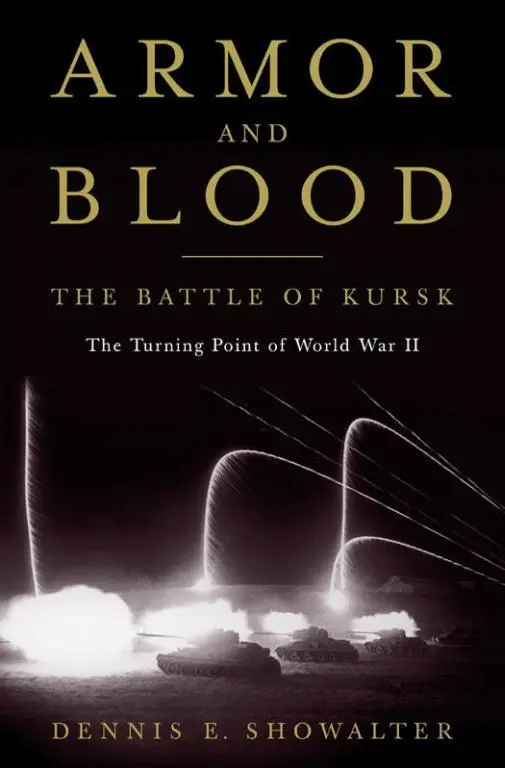
While the Battle of Kursk has long captivated World War II aficionados, it has been unjustly overlooked by historians. Drawing on the masses of new information made available by the opening of the Russian military archives, Dennis Showalter at last corrects that error. This battle was the critical turning point on World War II’s Eastern Front. In the aftermath of the Red Army’s brutal repulse of the Germans at Stalingrad, the stakes could not have been higher. More than three million men and eight thousand tanks met in the heart of the Soviet Union, some four hundred miles south of Moscow, in an encounter that both sides knew would reshape the war. The adversaries were at the peak of their respective powers. On both sides, the generals and the dictators they served were in agreement on where, why, and how to fight. The result was a furious death grapple between two of history’s most formidable fighting forces—a battle that might possibly have been the greatest of all time.
In
Showalter re-creates every aspect of this dramatic struggle. He offers expert perspective on strategy and tactics at the highest levels, from the halls of power in Moscow and Berlin to the battlefield command posts on both sides. But it is the author’s exploration of the human dimension of armored combat that truly distinguishes this book. In the classic tradition of John Keegan’s
Showalter’s narrative crackles with insight into the unique dynamics of tank warfare—its effect on men’s minds as well as their bodies. Scrupulously researched, exhaustively documented, and vividly illustrated, this book is a chilling testament to man’s ability to build and to destroy.
When the dust settled, the field at Kursk was nothing more than a wasteland of steel carcasses, dead soldiers, and smoking debris. The Soviet victory ended German hopes of restoring their position on the Eastern Front, and put the Red Army on the road to Berlin.
presents readers with what will likely be the authoritative study of Kursk for decades to come.
Armor and Blood — читать онлайн бесплатно полную книгу (весь текст) целиком
Ниже представлен текст книги, разбитый по страницам. Система сохранения места последней прочитанной страницы, позволяет с удобством читать онлайн бесплатно книгу «Armor and Blood», без необходимости каждый раз заново искать на чём Вы остановились. Поставьте закладку, и сможете в любой момент перейти на страницу, на которой закончили чтение.
Интервал:
Закладка:
In sharp contrast with the far-reaching objectives set in 1941 and 1942, Citadel’s operational geography was so limited that it requires a small-scale regional map to follow. Order No. 6 insisted on the sovereign importance of maintaining surprise through “camouflage, deception, and disinformation.” Success depended even more on preventing reserve-siphoning Soviet breakthroughs elsewhere. Army Groups South and Center must prepare as well for defensive battles on the remainder of their respective fronts. “All means” must be used to make all sectors secure. But recognizing that the shining times of 1940–41 were past did not make Kursk a limited offensive. Success offered a chance to damage the Red Army sufficiently to at least stabilize the Eastern Front and perhaps even develop a temporary political solution to a militarily unwinnable war.
In principle and in reality, the offensive was promising. Strategically, even a limited victory would remove a major threat to German flanks in the sector and limit prospects for a Red Army breakout toward the Dnieper. In Barbarossa and Blue, the Germans won their victories at the start of campaigns and ran down as they grew overextended. Citadel’s relatively modest objectives seemed insurance against that risk. This time, forward units would not be ranging far beyond the front in a race to nowhere in particular. There were no economic temptations like those the Ukraine offered in 1941 or the Caucasus in 1942. Kursk would be a straightforward soldiers’ battle. As for what would happen next, sufficient unto the day was the evil thereof. It was a line of thinking—perhaps a line of feeling—uncomfortably reminiscent of Erich Ludendorff’s approach to the great offensive of March 1918: Punch a hole and see what happens.
In its immediate contexts, Kursk nevertheless seemed eminently plausible: the kind of prepared offensive that had frustrated the Soviets from divisional to theater levels for eighteen months. Geographically, the sector was small enough to enable concentrating overstretched Luftwaffe assets on scales unseen since 1941. Logistically, the objectives were well within reach. Operationally, the double envelopment of a salient was a textbook exercise. Tactically, from company to corps, the panzer commanders were skilled and confident. Materially, for the first time since Barbarossa they would have tanks to match Soviet quality.
That last point calls for explanation, particularly since “Kursk” and “armor” are symbiotically linked in most accounts of World War II. German armor doctrine stressed avoiding tank-on-tank encounters; German tank designs emphasized mobility and reliability as opposed to protection and firepower. From Poland to North Africa, the system worked. In Russia, it faltered—not least because of the growing presence of the Soviet T-34 tank, which could do anything its German counterparts could do, was better armored, and carried a powerful 76 mm gun. Prior to Barbarossa, German tank crews and tank officers had been a significant, albeit intangible, force multiplier. But the technological discrepancy between the Mark III and IV panzers and the T-34 diminished it. In human terms, the German armored divisions were about as good as they were likely to get given the limits of flesh, blood, intelligence, and character. In numerical terms, every calculation demonstrated inability to outproduce the Soviets. Technically, the Panzer III, backbone of the armored force through 1942, could be upgunned no further.
That left three options. One involved taking advantage of the large turret ring and robust chassis of the Mark III’s stablemate, the Mark IV, and upgrading what had been designed as a support vehicle to a main battle tank. Technically, the reconfiguration was highly successful. However, it was achieved at the expense of production numbers and repair statistics. The second possibility was copying the T-34, either conceptually or by reverse engineering. In the latter case, the Russian vehicle’s cast turret and its aluminum engine would have challenged German capacities and resources. The two-man turret diminished the crew’s effectiveness—still a German strongpoint. In any case, the lead times involved were an almost certain guarantee that when German imitations reached the front, the Red Army would be another generation ahead.
That left a new design, which became the Panther. Its design and preproduction absorbed most of 1942, and delivery projected by May 1943 was only 250. Its 75 mm L/70 was the most ballistically effective tank gun of World War II. But apart from the predictable teething troubles, two fundamental issues emerged. One was protection. Would the Panther’s well-sloped frontal armor suffice against the weapons likely to be introduced as a counter? Its side armor, moreover, was not much better than that of its predecessors. The Panther’s other problem was the engine. The tank weighed forty-five tons. Its Maybach 230 delivered a power-to-weight ratio of 15.5 horsepower per ton: low enough to strain the entire drive system and make uparmoring problematic. “Not perfect, but good enough” was the verdict rendered in the developing crisis of the Eastern Front.
The Panther’s counterpoint, the Panzer VI, better known as the Tiger I, lent its aura to the whole German armored force. Even experienced British and U.S. troops were likely to see Tigers behind every hedgerow and leading every counterattack. There have been at least a hundred books in English, French, and German devoted to the Tiger’s origins and performance. The first Tiger was a birthday present for the Führer in April 1942. Its initial production runs were set modestly, at fifteen a month by September. The Russians were expected to be defeated by the time the new tanks could take the field.
“The Tiger was all muscle, a slab-sided beast as sophisticated as a knee in the groin.” Incorporating components from several firms and several design projects, it was always high maintenance. That does not mean unreliable. “Tiger was like a woman,” in the words of one old hand. “If you treated her right, she’d treat you right.” Tiger was also not a cheap date. Range on a full tank was only 125 miles. Speed was on the low side of adequate by previous panzer standards: about twenty miles per hour on roads, half that and less cross-country. But far from being a semimobile “furniture van” ( Möbelwagen ), Tiger was intended for offensive operations: exploitation as well as breakthrough. Its cross-country mobility was as good as that of most of its contemporaries. And with an 88 mm gun behind more than 100 mm of frontal armor, the Tiger could outshoot anything on any battlefield. Tested in small numbers from Leningrad to Tunisia beginning in August 1942, the Panzer VI seemed ideal for the conditions developing around Kursk, although it could be deployed only in small numbers—128 at the start of Citadel.
In one sense, that was Hitler’s problem—the tank and the situation fit together too well for comfort. As early as April 18, the Führer inquired whether a preferable alternative might be to do the really unexpected and attack the salient’s relatively vulnerable nose. In 1914, with war only hours away, German emperor Wilhelm II reacted to a vague hint of French neutrality by saying that now the whole army could be sent to the Eastern Front. His chief of staff never recovered from the shock. Kurt Zeitzler had a stronger nervous system. The time lost in shifting forces, he replied, would impose unacceptable delay, sacrifice prospects for surprise, and encourage a Soviet attack as the Germans redeployed.
Hitler calmed down for a week. Then he received a disconcerting report from the commanding general of the army responsible for Citadel’s northern half. Walther Model is best remembered as a tactician, a defensive specialist shoring up broken fronts in the Reich’s final years. But he had made his bones with the panzers, commanding a division and then a corps before being assigned to Army Group Center’s right-flank Ninth Army in January 1942. He was also a trained staff officer, and the details of his army’s proposed mission were not reassuring. The plan allowed too little time for preparation. It took too little account of the defense system the Soviets were constructing in Model’s zone of attack. It allotted too few men and tanks to underwrite Model’s original estimate of two days to achieve a breakthrough. As corroborating evidence mounted, six days seemed a more reasonable figure.
Читать дальшеИнтервал:
Закладка:
Похожие книги на «Armor and Blood»
Представляем Вашему вниманию похожие книги на «Armor and Blood» списком для выбора. Мы отобрали схожую по названию и смыслу литературу в надежде предоставить читателям больше вариантов отыскать новые, интересные, ещё непрочитанные произведения.









Обсуждение, отзывы о книге «Armor and Blood» и просто собственные мнения читателей. Оставьте ваши комментарии, напишите, что Вы думаете о произведении, его смысле или главных героях. Укажите что конкретно понравилось, а что нет, и почему Вы так считаете.