Armin Scheiderbauer - Adventures in My Youth
Здесь есть возможность читать онлайн «Armin Scheiderbauer - Adventures in My Youth» весь текст электронной книги совершенно бесплатно (целиком полную версию без сокращений). В некоторых случаях можно слушать аудио, скачать через торрент в формате fb2 и присутствует краткое содержание. Город: Solihull, Год выпуска: 2010, ISBN: 2010, Издательство: Helion & Company Limited, Жанр: Биографии и Мемуары, military_history, на английском языке. Описание произведения, (предисловие) а так же отзывы посетителей доступны на портале библиотеки ЛибКат.
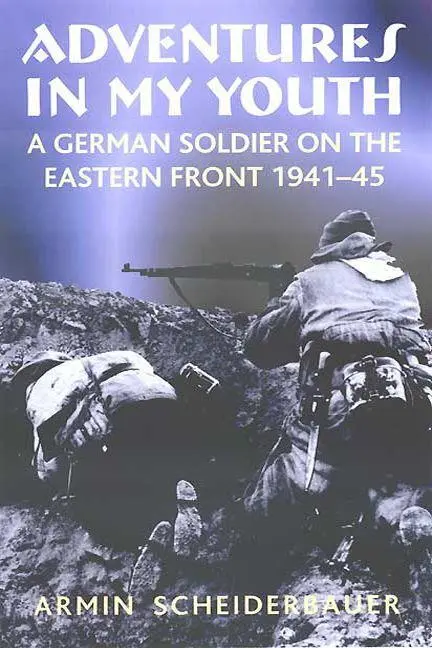
- Название:Adventures in My Youth
- Автор:
- Издательство:Helion & Company Limited
- Жанр:
- Год:2010
- Город:Solihull
- ISBN:978-1-874-62206-2
- Рейтинг книги:3 / 5. Голосов: 1
-
Избранное:Добавить в избранное
- Отзывы:
-
Ваша оценка:
Adventures in My Youth: краткое содержание, описание и аннотация
Предлагаем к чтению аннотацию, описание, краткое содержание или предисловие (зависит от того, что написал сам автор книги «Adventures in My Youth»). Если вы не нашли необходимую информацию о книге — напишите в комментариях, мы постараемся отыскать её.
Scheiderbauer joined his unit at the front in 1942, and during the following years saw fierce combat in many of the largest battles on the Eastern Front. His experiences of the 1943-45 period are particularly noteworthy, including his recollections of the massive Soviet offensives of summer 1944 and January 1945. Participating in the bitter battles in West Prussia, he was captured by the Soviets and not released until 1947.
Adventures in my Youth
Adventures in My Youth — читать онлайн бесплатно полную книгу (весь текст) целиком
Ниже представлен текст книги, разбитый по страницам. Система сохранения места последней прочитанной страницы, позволяет с удобством читать онлайн бесплатно книгу «Adventures in My Youth», без необходимости каждый раз заново искать на чём Вы остановились. Поставьте закладку, и сможете в любой момент перейти на страницу, на которой закончили чтение.
Интервал:
Закладка:
Having been ordered to, I had to look around once more in order to scout out a village that was slightly to the side of our route. I had to see if it was occupied by the enemy. When I arrived within 300 metres of the village with my two volunteers, we came under rifle fire. Bullets whizzed into the damp grass. It was friendly of the Ivans not to let us come any nearer to the edge of the village. But because of that our task was quickly done. We had ascertained that the village was occupied by the enemy, and were able to withdraw, darting from side to side. It was not easy because the terrain offered no cover.
The Division’s route led southward past Smolensk. I could no longer hope to be able to visit the town a fourth time. I regretted my laziness that had prevented me from looking around properly on my previous visits. I would never again be able to wander up to the cathedral of the Assumption of Mary, and I would never again be able to sit down against the eastward-facing fortifications of Boris Godunov. That was something which I had always intended to do, inspired by Napoleon’s equerry Coulaincourt. Then I should have wanted to look down upon the burning city, just as a Wurttemberg artillery major had looked, in 1812, from the walls of the fortifications. He had seen and drawn it with the mighty towers and delicate battlements. Whoever holds Smolensk holds Russia, was how the saying had gone in those days. Then the city had been alternately Russian, Lithuanian, Polish, and Russian again. To draw lessons from history was not for me at my age. That the fortunes of war had changed was something that I would not have been able to judge.
On the night of 25 September we moved through Monastyrschtschina. Here and there a house was on fire and in the light of the fire could be seen a former church and many clean little wooden houses. On the western edge of the little town we stopped for a short while. There I took over command of the 3rd Company. It too was then only 28 men strong. The 1st Battalion, to which the company belonged, was under the command of Hauptmann Beyer who in summer 1942 had been my company commander.
Beyer was determined to let the exhausted men of his battalion sleep for the rest of that night. For weeks they had only had on average two to three hours of sleep. Even then all that could be expected was scarcely likely to be more than four hours. The next village, Worpajewo, was our destination. Each of the weak companies took a card, and the men, who were dead tired, immediately fell to the ground. The company commanders still had to go off for a meeting at the battalion. They were told that the withdrawal was continuing and they would be moving off again in the early morning.
The meeting was interrupted by a Feldwebel who had gone down a little way towards the village in order to ‘organise things’. God knows what the man had hoped to find. In any event he reported that out of the darkness he had been greeted with a shout of Stoj , whereupon he had withdrawn. This was obviously a damned nuisance to Hauptmann Beyer, because he said in his dry, Berlin way: ‘Oh, get away with you, man, they were volunteers whose nags had bolted, stop the bother’. None of those present could bring themselves to contradict him. They did not want to disturb the longed-for peace and quiet. I assigned the watches and lay down with my men on the flat tiled floor, my head in the hollow of my steel helmet.
At 3.30am, the time we were ordered, the battalion assembled on the village street, the companies in ranks, one behind another. We were not even out of the woods when shots whipped along the village street. Men were falling, others were crying out. Panic took hold of the mass of men, who were still drowsy with sleep. Everybody was running and no one was listening to my command. As I ran I snatched a machine-gun belt from the ground and hung it round my neck like a scarf. During the one kilometre flight I turned round several times and saw some cavalry and infantry, perhaps dismounted Cossacks. It was incredible that a handful of enemy had actually put us to flight. But still there was no stopping. Some swine of a machine-gunner had dropped the belt that I was then carrying round my neck. Another whom I overtook, I caught throwing away a box of ammunition. ‘You lousy sod’, I bawled at him and gave him a kick in his behind. When he picked the box up again, I kept him with me with the intention of getting hold of a machine-gun. But still the mass of men had not been brought to a halt. I saw the battalion medical officer, Dr Kolb, shot down as he was struggling to bring a machine-gun into position.
A quiet unheroic man had done what it was our job, the troop officers, to do. Violent rage seized me. Finally I managed to get hold of a machine-gun and the two gunners. I snapped at them, ‘We three are now staying here, even if we have to die here. Do you understand?’ Jawohl, Herr Leutnant, they answered, shocked. Behind a low rise in the ground we went into position. With a few spadefuls the machine-gun position was improved and a small amount of cover was produced. In the complete calm that then gripped them, the two machine-gunners carried out their well-drilled handling of the weapon. The Russians were leaving some time before they followed up. The last stragglers of the battalion passed, then the first gunner let fly with his first bursts of fire. The Ivans went to ground and disappeared behind undulations in the ground. Fifteen minutes later the formation of the battalion was re-established. Hauptmann Beyer had had a line drawn up. When at last the first machine-gun began to chatter behind us we three were able, alternately running and jumping, to withdraw to the battalion line.
A MG 42 and 15 men were all that was then left of my company. We crossed the highway from Smolensk, and the anti-tank ditches that ran to the west of it. In the next village my company and I had to remain behind another two hours, as a rearguard, until 2pm. On both sides of the village and the road along which we were withdrawing was open steppe. Whether and where there were rearguards was unknown. In front of the two houses right and left of the village street at the outskirts of the village I had a start made on digging foxholes. The comrades were not so keen on digging and said that we would have to weather out the two hours over midday. I gave way to them and we left it alone.
For an hour everything remained quiet and no enemy showed themselves. A man kept a look-out, while I sat with some others on the bench in front of the house. The sun was shining and the autumn sky was a cloudless blue. In that contemplative position I stretched out my legs in front of me, pushed my hands into my trouser pockets, and nodded off. Out of a deep sleep of only a few minutes, I was wakened by shots. The sentry ran up and made his report. From the hollow with the anti-tank ditches at the side of the highway, he said that cavalry had appeared. They had turned round when he fired on them and disappeared back into the trenches. The tense waiting and watching lasted about a quarter of an hour, until the cavalry once more came out of the hollow. They were wearing brown Russian uniforms, but with square caps on their heads. First there were 10, then 20, and then more and more, all forming up into a front, and at a gallop storming up to our village.
It must have been a squadron of about a hundred coming closer and closer. The anachronistic picture fascinated and hypnotised me. The last time that cavalry had attacked was the Polish cavalry in the Poland campaign. But in seconds I was awake and gave my order. It could only be to fire at will. They had already approached to within 300 metres of us when from the right flank, apparently from a neighbouring village, the flak of an unknown unit opened fire. While at first only individual horses reared and only a few cavalrymen fell, our rifle fire too was then beginning to hit. The remnants of the hundred or so drove down on us in a confused tangle. We had climbed out of the foxholes and were firing at will into the mass of them.
Читать дальшеИнтервал:
Закладка:
Похожие книги на «Adventures in My Youth»
Представляем Вашему вниманию похожие книги на «Adventures in My Youth» списком для выбора. Мы отобрали схожую по названию и смыслу литературу в надежде предоставить читателям больше вариантов отыскать новые, интересные, ещё непрочитанные произведения.











Обсуждение, отзывы о книге «Adventures in My Youth» и просто собственные мнения читателей. Оставьте ваши комментарии, напишите, что Вы думаете о произведении, его смысле или главных героях. Укажите что конкретно понравилось, а что нет, и почему Вы так считаете.