Ed Macy - Hellfire
Здесь есть возможность читать онлайн «Ed Macy - Hellfire» — ознакомительный отрывок электронной книги совершенно бесплатно, а после прочтения отрывка купить полную версию. В некоторых случаях можно слушать аудио, скачать через торрент в формате fb2 и присутствует краткое содержание. Город: London, Год выпуска: 2009, ISBN: 2009, Издательство: HarperPress, Жанр: Биографии и Мемуары, nonf_military, на английском языке. Описание произведения, (предисловие) а так же отзывы посетителей доступны на портале библиотеки ЛибКат.
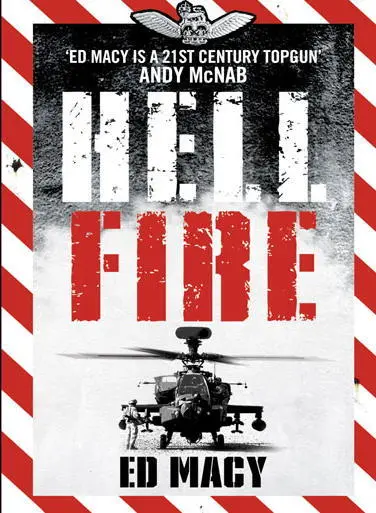
- Название:Hellfire
- Автор:
- Издательство:HarperPress
- Жанр:
- Год:2009
- Город:London
- ISBN:978-0-007-34292-1
- Рейтинг книги:3 / 5. Голосов: 1
-
Избранное:Добавить в избранное
- Отзывы:
-
Ваша оценка:
Hellfire: краткое содержание, описание и аннотация
Предлагаем к чтению аннотацию, описание, краткое содержание или предисловие (зависит от того, что написал сам автор книги «Hellfire»). Если вы не нашли необходимую информацию о книге — напишите в комментариях, мы постараемся отыскать её.
Ed Macy bent every rule in the book to get to where he wanted to be: on Ops in the stinking heat of the Afghan summer, with the world’s greatest weapons system at his fingertips. It’s 2006 and he is part of an elite group of pilots assigned to the controversial Apache AH Mk1 gunship programme. So far, though, the monstrously expensive Apache has done little to disprove its detractors. For the first month ‘in action’ Ed sees little more from his cockpit than the back end of a Chinook.
But everything changes in the skies over Now Zad. Under fire and out of options, Ed has one chance to save his own skin and those of the men on the ground. Though the Apache bristles with awesome weaponry, its fearsome Hellfire missile has never been fired in combat. Then, in the blistering heat of the firefight, the trigger is pulled.
It’s a split-second decision that forever changes the course of the Afghan war, as overnight the gunship is transformed from being an expensive liability to the British Army’s greatest asset. From that moment on, Ed and his squadron mates will face the steepest learning curve of their lives – fighting an endless series of high-octane missions against a cunning and constantly evolving enemy. Ed himself will have to risk everything to fly, fight and survive in the most hostile place on earth.
http://www.youtube.com/watch?v=LNP1lbLNKqA
Hellfire — читать онлайн ознакомительный отрывок
Ниже представлен текст книги, разбитый по страницам. Система сохранения места последней прочитанной страницы, позволяет с удобством читать онлайн бесплатно книгу «Hellfire», без необходимости каждый раз заново искать на чём Вы остановились. Поставьте закладку, и сможете в любой момент перейти на страницу, на которой закончили чтение.
Интервал:
Закладка:
The three guys playing their parts moved and stood together.
‘And then the Battery Commander and the convoy leader will be in position here overnight.’ The BC and another guy I’d never met before sat down.
‘At whatever time it is, minus L hour – and I don’t know how long it’ll take them to move – the convoy will then depart the gun position.’
The convoy guy moved round to the north-west.
‘At the same time, Patrols Platoon and the mortars, with Widow Seven Zero, are going to move forwards to secure the LS.’
They moved forward on the sand map to the site of the intended LS.
The 3 Para Ops Officer said, ‘Right, what’s the next thing we’re going to hear?’
The Patrols Platoon Commander put his hand up. ‘LS secure.’
‘Right, the LS is secure – that means we can go ahead with it. At that point, we’re going to send out the Chinooks with B Company and the CO’s JTAC. With them will be the first wave of Apaches.’
As four Chinook guys, four passengers, Pat and Chris walked to the LS, the BC said, ‘At this point we’ll be registering – we’ll be firing into this area, to make sure our guns are ready.’
The Mortar Platoon Commander said, ‘And at this point, I’m going to be firing too.’
The aircrew could see where the gun line was, where the mortar line was, how they were going to get in, how they were going to get out and the location of the gun-to-target line they needed to stay out of. The four Chinook pilots headed back to the Bastion Coke can where we stood.
The CO, 2i/c and Ops Officer of 3 Para threw in a constant stream of questions.
‘What happens if that compound fires at you now?’ the CO asked.
‘I would call you and D Company, sir. D Company would put fire down and your JTAC would get those two Apaches onto it.’
The whole rehearsal was done at speed but relative to the time-frame so everyone knew where everyone else was, what they would be doing or saying at any point along the line. We walked out and replaced Pat and Chris and the rotations continued until everyone at the RoC drill was standing back at the Bastion Coke can.
The rehearsal ended, a host of questions answered.
Later, we talked through the brief again within our squadron. We ironed out how we would RIP at any given moment because even on the day we wouldn’t know how slowly or quickly each phase of the Op would take.
There was still one nagging doubt in my mind.
I knew I had to voice it.
I had to address our operational effectiveness with the boss again. It had degraded to the point that we rarely hit our targets with a first burst. The main reason was the gun Dynamic Harmonisation (DH).
‘We RIP’d with Dan the last time we tried to get into Musa Qa’leh,’ I said. ‘Dan had fired 250 rounds at the Taliban and we still don’t know if they got a hit.’
Major Black tried to laugh it off. ‘Maybe his shooting’s not very good.’
I took a deep breath.
‘His firing was good. In fact, it was brilliant. He would have hit first time if the gun had been on. Pat had exactly the same problem on Op Mutay. He couldn’t even fire in zoom field of view because his rounds landed outside of what he could see.’
The boss hadn’t known because he’d only fired forty cannon rounds and a Hellfire, but the current policy between crews was to test fire into the desert on the way to a scramble. If they didn’t hit they would register in which direction the gun was off and aim off accordingly. It was ridiculously costly in time and munitions, dangerous to the point of a blue-on-blue, and a serious degradation in combat effectiveness.
‘If the gun fails to hit first time, the Taliban get a clear warning and the crews end up chasing their tails, not knowing where to aim to get a kill. And a whole lot of Taliban are living to fight another day.’
He wasn’t having it. He said he didn’t have enough flying hours to let us DH the guns.
I tried to keep the red mist at bay.
‘The Apache is an attack helicopter, sir. Its primary role is to fire weapons at the target. If the weapons aren’t accurate we’re not doing our job properly. If we fire at a target and it dies, we’ve succeeded. So we either waste time at the target or we use the time profitably by DHing the guns beforehand. The flying hours are the same, but the success rate is hugely better.’
‘I said no, Mr Macy.’
I felt like banging my head against the wall again. Our sister squadron, 664, had just landed at Kandahar and was coming up to replace us soon after this operation. What would they think when they saw our gun tapes? As the SWO I felt deeply embarrassed that we hadn’t completed an essential procedural task.
‘I will be briefing the next squadron commander on what I think we’ve failed to do, sir.’
Major Black returned my glare. His jaw clenched then he turned on his heel and walked away.
OPERATION SNAKEBITE
SUNDAY, 6 AUGUST 2006
Camp Bastion
0213 hours local
The neon strip lights that hung above our cots burst into life. I shielded my eyes and scrutinised my right wrist.
‘Time to get up, freaks,’ Jon said.
‘Wanker,’ someone shouted.
I swung my legs over the side of the bed and peeled off my light-weight-but still clammy-sleeping bag liner. Jon lifted the tent’s door flap and disappeared while Pat, Chris, Tony, Carl, Jake, Billy and I slowly came round. The scratching of arses, stretches and chorus of yawns would have done a bunch of gibbons proud.
I arrived in the Ops tent smack on 2.30 a.m. We’d been in earlier but Patrols Platoon had wanted more time to get through the minefield on the ridge, and to ensure the LS was clear before securing and marking it. Getting an hour’s kip here and an hour’s kip there was not conducive to flight safety, but we didn’t have much choice when it was this busy.
Things were looking good. 3 Flight were told to be ready to take off at 0440 hours. L hour had slipped to 0500 and would most likely slip again, but they’d lift regardless. We completed a final brief at 0300 hours with a strong black coffee and walked to the aircraft half an hour later. I knew that today was going to be a long operation even if the bloody Taliban didn’t turn up. And I was already knackered.
We’d be RIPing with Pat’s flight, but stayed on the APU instead of taking an extra two and a half hours’ rest. We had come a long way since Op Mutay. 3 Flight had taken the first Deliberate Ops callsigns, Wildman Five Two and Wildman Five Three, and needed to make their takeoff time. We’d have our aircraft running at the same time, so if either of theirs started with a fault, they could whack their kit into one of ours and leave us to sort out the shagged one with the technicians.
Jake would command 2 Flight from the front seat of Wildman Five Four with Jon flying; I’d command Wildman Five Five from the front with Billy flying. Simon was back at KAF, briefing the new squadron commander and his 2i/c.
3 Flight were in bays 3 and 4, Jon and Jake were in 5 and we had 6. The techs looked like zombies these days, but still had six aircraft lined up and ready to go. The boys were chirpy as ever as they stood around our four Apaches, but they were no oil paintings either. The whole squadron was feeling the strain. Even Billy was looking a bit rumpled.
Billy sparked up our aircraft. We tested the weapons, the sights, the sensors, defensive aids suite, video; checked that the data transfer cartridge had uploaded the mission correctly, that the comms came up in the right order and that the IDM – Improved Data Modem – had configured Pat’s patrol with ours so we could communicate with each other digitally.
Читать дальшеИнтервал:
Закладка:
Похожие книги на «Hellfire»
Представляем Вашему вниманию похожие книги на «Hellfire» списком для выбора. Мы отобрали схожую по названию и смыслу литературу в надежде предоставить читателям больше вариантов отыскать новые, интересные, ещё непрочитанные произведения.



Обсуждение, отзывы о книге «Hellfire» и просто собственные мнения читателей. Оставьте ваши комментарии, напишите, что Вы думаете о произведении, его смысле или главных героях. Укажите что конкретно понравилось, а что нет, и почему Вы так считаете.