Ed Macy - Hellfire
Здесь есть возможность читать онлайн «Ed Macy - Hellfire» — ознакомительный отрывок электронной книги совершенно бесплатно, а после прочтения отрывка купить полную версию. В некоторых случаях можно слушать аудио, скачать через торрент в формате fb2 и присутствует краткое содержание. Город: London, Год выпуска: 2009, ISBN: 2009, Издательство: HarperPress, Жанр: Биографии и Мемуары, nonf_military, на английском языке. Описание произведения, (предисловие) а так же отзывы посетителей доступны на портале библиотеки ЛибКат.
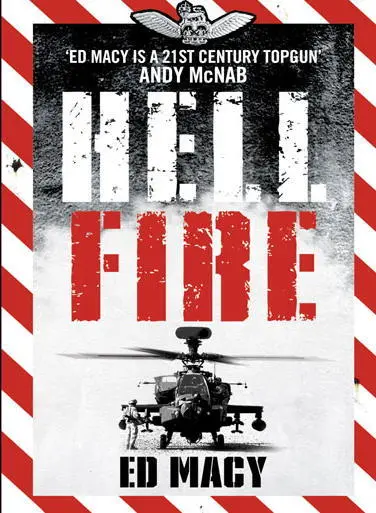
- Название:Hellfire
- Автор:
- Издательство:HarperPress
- Жанр:
- Год:2009
- Город:London
- ISBN:978-0-007-34292-1
- Рейтинг книги:3 / 5. Голосов: 1
-
Избранное:Добавить в избранное
- Отзывы:
-
Ваша оценка:
Hellfire: краткое содержание, описание и аннотация
Предлагаем к чтению аннотацию, описание, краткое содержание или предисловие (зависит от того, что написал сам автор книги «Hellfire»). Если вы не нашли необходимую информацию о книге — напишите в комментариях, мы постараемся отыскать её.
Ed Macy bent every rule in the book to get to where he wanted to be: on Ops in the stinking heat of the Afghan summer, with the world’s greatest weapons system at his fingertips. It’s 2006 and he is part of an elite group of pilots assigned to the controversial Apache AH Mk1 gunship programme. So far, though, the monstrously expensive Apache has done little to disprove its detractors. For the first month ‘in action’ Ed sees little more from his cockpit than the back end of a Chinook.
But everything changes in the skies over Now Zad. Under fire and out of options, Ed has one chance to save his own skin and those of the men on the ground. Though the Apache bristles with awesome weaponry, its fearsome Hellfire missile has never been fired in combat. Then, in the blistering heat of the firefight, the trigger is pulled.
It’s a split-second decision that forever changes the course of the Afghan war, as overnight the gunship is transformed from being an expensive liability to the British Army’s greatest asset. From that moment on, Ed and his squadron mates will face the steepest learning curve of their lives – fighting an endless series of high-octane missions against a cunning and constantly evolving enemy. Ed himself will have to risk everything to fly, fight and survive in the most hostile place on earth.
http://www.youtube.com/watch?v=LNP1lbLNKqA
Hellfire — читать онлайн ознакомительный отрывок
Ниже представлен текст книги, разбитый по страницам. Система сохранения места последней прочитанной страницы, позволяет с удобством читать онлайн бесплатно книгу «Hellfire», без необходимости каждый раз заново искать на чём Вы остановились. Поставьте закладку, и сможете в любой момент перейти на страницу, на которой закончили чтение.
Интервал:
Закладка:
‘Climbing… Levelling… And dropping.’ I glanced down. Simon still had his crosshair smack in the middle of the target. I looked back up.
‘Dropping,’ I confirmed. I watched the glow of its heat source shrink to a pinpoint as it sped towards Now Zad.
‘Three… Two… One… Impact…’
The whole MPD screen went white and Simon’s IAT gates lost their lock in the blossoming explosion.
Simon immediately zoomed the FLIR picture out to the widest field of view. All I could see was 500 metres of Now Zad town and this big ball of heat in front of it. A second later everything was black again.
I looked through the front of my window and saw an orange glow give way to darkness.
‘Breaking off,’ I called to Jake and the JTAC on the Mission Net. I threw the aircraft onto its right side and brought it round hard.
‘Wildman Five Zero and Wildman Five One are RTB, send BDA.’ Jake was all over it like a rash. He was keen to get out of there.
I could see Simon manually tracking the target for as long as he could to get the Battle Damage Assessment himself. As we passed 120 degrees, his TADS hit its left stop. He couldn’t get any further back. We’d lost it. The last image was of intense heat and a devastated building.
‘Widow Seven One – stand by.’
We were running back and once again the Apache told me exactly what speed to fly at to maximise our distance. Jon was forward and right of us by about four klicks. He’d set off before the impact so I could only guess he was on fumes.
‘Widow Seven One – Delta Hotel, Delta Hotel, firing point destroyed.’
I tried hard not to give out a whoop.
Jake asked: ‘Wildman Five Zero – was there any collateral to you?’
‘Widow Seven One – negative, just a bang.’
‘Wildman Five Zero – pass that information onto the rest of the JTACs and copy.’ He wanted tonight’s lessons identified to be lessons learned .
‘Copied – and I hope not to see you again tonight.’
Jake, ever the cool guy, replied: ‘Don’t hesitate if it kicks off again.’
We headed south over the desert and past the mountains. I felt fantastic. We’d fired our first Hellfire. But I also felt drained. We couldn’t go through this nightmare again. I resolved to go and debrief the Widow Tactical Operations Cell when we got back. We had to be clear about this on future sorties. The guys on the ground could say what effect they wanted: I want that man killed. I want that building destroyed. I want that area suppressed. But how any of those things were achieved had to be up to us. We were the only ones qualified to know which weapon matched the target. I didn’t ever want to go down this route again. We called it the long screwdriver; someone else, detached from us, tinkering with what we were doing in the cockpit, fine-tuning our attack.
We knew the risk to the troops on the ground and we’d tell the JTAC if it wasn’t safe to fire. Normally it was the JTAC’s responsibility to make sure there was separation and distance, but he worked with fast jets that dropped bombs. They had all the distances worked out – Apaches didn’t. We’d been firing just ten metres from our own troops this morning and we’d swapped initials, so surely they must know that if we were prepared to do that, we weren’t talking danger close?
I could understand this ground commander’s concerns. He’d never seen a Hellfire go off before.
I could understand the Widow’s concern too. Charlie Alpha had been out in Oman with us, staying miles away from the target in case something went wrong. Now all of a sudden he was just 200 metres from it, shitting himself.
The dropping of a bomb is a fine art. JTACs work with the expectation of a hit, so they have all the safety distances worked out. With an Apache, it was more fluid. We’d bring it as close as we needed to without killing our own troops. And we’d always let them know how bad it was going to get.
This was another evolution in the rules of engagement, in how we employed our weapons and integrated with the ground force with intimate fires. We could get in close, like we had in the run-in earlier, to narrow down our arcs. If need be, we’d fire 100 metres from them. We’d do whatever we could to help them, but they had to understand they couldn’t tell us which weapon to fire. They just had to tell us what the target was, what effect they wanted, and we would do the rest.
We were not Close Air Support. We were Intimate Support.
I admitted to Simon on the way back that I was dog tired. He was too. We weren’t getting much sleep, we weren’t eating regularly, and we were taking far too many risks. They were escalating with every sortie. No matter what we planned for, we would always get something blindside that we didn’t see coming.
We’d gone up there and we’d achieved our objective. Now Zad was resupplied with men and materials. Above all, they’d taken us on with a double A and we’d won.
We refuelled, rearmed with 30 mm and Hellfire, and called Ops for permission to shut down.
We were about to go in and debrief the sortie. As the Squadron Weapons Officer, I was becoming increasingly unpopular, debriefing every shot, but it was a very steep learning curve for everyone. I wasn’t there to be popular and I was going to have to tell our Apache pilots that they were responsible for their own weapons and there were no guidelines. We must have had the only weapon system in the UK arsenal that didn’t have any safety parameters.
I gathered them all before we went into our debrief to explain what I meant.
‘Simon. How close to our own troops can you fire a Hellfire?’
‘I’ve no idea,’ he said.
I asked a few others and they were just as stumped. I told them what we’d just done and explained about the angles we used to limit collateral.
‘In the end it’s down to you to decide what you think is safe,’ I said. ‘If you blow it, if you shoot too close and kill someone, the MoD will hang you out to dry. A board of inquiry will acknowledge that you didn’t have sufficient guidelines or safety distances in which to operate the weapon system. But it will find that the cause of death was aircrew error. No matter what the operational risk, you shouldn’t kill someone you are trying to protect.’
I asked the boss his position on the safety distances. His reply was typically politically correct. If in doubt, you don’t take the shot.
‘Then what is too close, sir?’ I pressed.
‘I don’t know, Mr Macy,’ he replied.
‘Two hundred metres, sir?’
No answer.
‘One hundred?’
Still no answer.
‘The pressure is on, lads. You need to be 100 per cent sure 100 per cent of the time, and that’s why every cannon, rocket and Hellfire shot will be viewed in slow time by everyone. Any questions?’
‘Yeah,’ Chris said. ‘So what are we going to do about the rockets?’
The rockets were notoriously inaccurate. I had a system of aligning them so they were absolutely smack on but couldn’t get permission to use it. I was using it on my own aircraft when the boss wasn’t around. I wasn’t going to fall foul of the system and didn’t care what he, the IPT, the JHC or the MoD thought. There was no way I was going to cause a blue-on-blue.
‘What do you think?’ I said.
‘Take ’em off and stick more Hellfires on instead. I won’t be using them.’
I could see the concern etched on everyone’s faces. We were weary, bone weary, and fighting a war with no umbrella to protect us from above. If we fucked up, shit would come up and shit would come down and we would be hung out to dry.
We went to watch the video of our weapon releases. Jake flung his arm over my shoulder and we walked in side by side. He gave me a manly hug.
Читать дальшеИнтервал:
Закладка:
Похожие книги на «Hellfire»
Представляем Вашему вниманию похожие книги на «Hellfire» списком для выбора. Мы отобрали схожую по названию и смыслу литературу в надежде предоставить читателям больше вариантов отыскать новые, интересные, ещё непрочитанные произведения.



Обсуждение, отзывы о книге «Hellfire» и просто собственные мнения читателей. Оставьте ваши комментарии, напишите, что Вы думаете о произведении, его смысле или главных героях. Укажите что конкретно понравилось, а что нет, и почему Вы так считаете.