Ed Macy - Hellfire
Здесь есть возможность читать онлайн «Ed Macy - Hellfire» — ознакомительный отрывок электронной книги совершенно бесплатно, а после прочтения отрывка купить полную версию. В некоторых случаях можно слушать аудио, скачать через торрент в формате fb2 и присутствует краткое содержание. Город: London, Год выпуска: 2009, ISBN: 2009, Издательство: HarperPress, Жанр: Биографии и Мемуары, nonf_military, на английском языке. Описание произведения, (предисловие) а так же отзывы посетителей доступны на портале библиотеки ЛибКат.
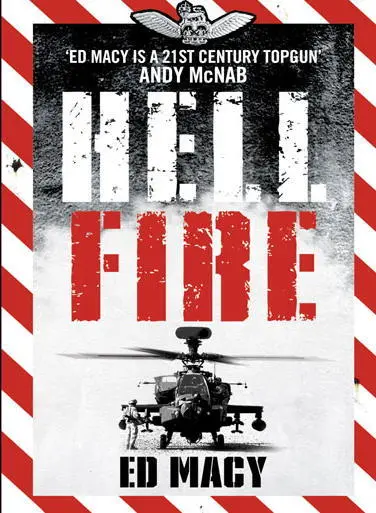
- Название:Hellfire
- Автор:
- Издательство:HarperPress
- Жанр:
- Год:2009
- Город:London
- ISBN:978-0-007-34292-1
- Рейтинг книги:3 / 5. Голосов: 1
-
Избранное:Добавить в избранное
- Отзывы:
-
Ваша оценка:
Hellfire: краткое содержание, описание и аннотация
Предлагаем к чтению аннотацию, описание, краткое содержание или предисловие (зависит от того, что написал сам автор книги «Hellfire»). Если вы не нашли необходимую информацию о книге — напишите в комментариях, мы постараемся отыскать её.
Ed Macy bent every rule in the book to get to where he wanted to be: on Ops in the stinking heat of the Afghan summer, with the world’s greatest weapons system at his fingertips. It’s 2006 and he is part of an elite group of pilots assigned to the controversial Apache AH Mk1 gunship programme. So far, though, the monstrously expensive Apache has done little to disprove its detractors. For the first month ‘in action’ Ed sees little more from his cockpit than the back end of a Chinook.
But everything changes in the skies over Now Zad. Under fire and out of options, Ed has one chance to save his own skin and those of the men on the ground. Though the Apache bristles with awesome weaponry, its fearsome Hellfire missile has never been fired in combat. Then, in the blistering heat of the firefight, the trigger is pulled.
It’s a split-second decision that forever changes the course of the Afghan war, as overnight the gunship is transformed from being an expensive liability to the British Army’s greatest asset. From that moment on, Ed and his squadron mates will face the steepest learning curve of their lives – fighting an endless series of high-octane missions against a cunning and constantly evolving enemy. Ed himself will have to risk everything to fly, fight and survive in the most hostile place on earth.
http://www.youtube.com/watch?v=LNP1lbLNKqA
Hellfire — читать онлайн ознакомительный отрывок
Ниже представлен текст книги, разбитый по страницам. Система сохранения места последней прочитанной страницы, позволяет с удобством читать онлайн бесплатно книгу «Hellfire», без необходимости каждый раз заново искать на чём Вы остановились. Поставьте закладку, и сможете в любой момент перейти на страницу, на которой закончили чтение.
Интервал:
Закладка:
Brief over, it was always the same routine on a changeover night. We had to load up the aircraft and check them over. Brew recharged, the four of us wandered down to the aircraft. It was still pitch-black, and there wasn’t a single light out towards the flight line because it fucked with our night vision goggles (NVG).
The Milky Way arced in front of me, a swathe of cosmic confetti. I stared open-mouthed at Orion’s Belt and every one of the Seven Sisters, stars I’d never seen with the naked eye before. A couple of satellites drifted across the heavens. It was breathtakingly beautiful.
I suddenly felt achingly lonely, and a long way from home. I’d have given anything at that precise moment to have been lying on my back with Emily and the kids, heads touching, gazing up at the night sky, making up our own star signs from the shapes we could see.
A stumble on a rock brought me back down to earth, literally. I was on my knees, mouth full of dust, vaguely aware of a tired chortle from Simon, Jon and Jake somewhere nearby.
A few minutes down a rough track brought us to the hangar. Only the duty technician was awake; all the rest were sound asleep in various odd corners. They worked longer hours than we did, with precious few breaks. They’d only just finished and would be up in a couple of hours, so we crept past them like cat burglars.
We headed for our F700 books and checked how many flying hours we had available, any new restrictions or limitations, and what faults the Apache was carrying.
I signed the aircraft out. It was now on my flick.
I placed my most recent letter from Emily in the drawer of my locker. I sanitised myself, searching every pocket for anything I shouldn’t be carrying. I took out my NVG-compatible torch. It took two runs to get all my kit to the aircraft.
The HRF aircraft was always in the second bay – Arming Bay Two – but I still checked the tail with my torch to make sure it was ZJ227. The IRT cab sat to our left in Arming Bay One; it saved time and confusion on a scramble.
I took the starboard side and Simon took the port as we walked around the fuselage. The inspection was essentially what Scottie had taught me back at Middle Wallop, but now, instead of just noting there was a gun under the chin of my chariot, I inspected it carefully – that it was clean, it moved okay, the electrical connections were made, and most important of all, that it had big, dark yellow-banded HEDP cannon rounds leading down the feed chute.
The Hellfire missiles always impressed me. The seeker on the front was a work of art; I could see the precision engineering through the glass I polished with my sweat-rag. ‘AGM-114K’ was stencilled in bright yellow down the side of each. I made sure they were securely latched down before moving on to the rocket launchers, checking that their black noses were securely in place. I shone my torch down each tube. There were twelve HEISAP rockets, with their tiny but unmistakable six-spoked silver tips, and seven Flechettes, which just had a plain nosecone to protect the darts. All the blast paddles were down at the back of the launcher. The rockets were held securely in place, electrical contacts made. The Hellfire’s strakes – that enabled it to climb, turn and dive – all moved freely.
I lifted the little triangular panel behind the APU to the rear of the starboard engine and checked the pressure. I unclipped the eighteen-inch pipe, stuck it onto the spigot and gave it about fifty pumps, adding more pressure to the accumulator. I wanted the needle deep in the green. Unlike other aircraft, the Apache started on air pressure; it didn’t need an external electrical source. No matter where we were in the world, you could start this aircraft. I replaced the pipe in its bracket and closed the panel.
I dropped to my knees and opened the bottom hatch, which we called the boot. I always had my kit set in the same order – chest webbing on the bottom, flak jacket next and battle bowler perched on the top – with a bungee stretched over the lot so it stayed exactly where I wanted it. If we crashed behind enemy lines, I’d go straight under the wing, wrench open the boot and cut the bungee. I’d remove my escape jacket, don the helmet, flak jacket, webbing and replace the escape jacket over the top. Then I’d be off.
The flare dispenser was packed full; I would have woken the boys up there and then if even one had been missing. Along with the Bitch, these puppies were top of the list of things keeping me alive at altitude.
I walked down the tail, scanning every square inch to make sure it hadn’t been bumped into. I made sure that the tail wheel was locked so the wind – if it ever got up at night – wouldn’t blow her around. The position of the huge horizontal stabilator was even more critical. We always forced the aircraft to leave it in the horizontal position before closing down; if we didn’t, it would drop down at the rear. The Americans had once had a bit of a problem in strong winds. The wind caught them and flipped over a whole row of aircraft.
‘Your side okay, Ed?’ Simon asked.
‘Yep. Just check my cowlings and catches on the way down. I’ll do yours.’ It was easy to leave a panel open so we always checked each other’s work after the inspection.
I opened the cockpit, attached my carbine to the seat bracket and put a magazine of tracer on it. I threw my grab bag – what I referred to as my ammo bag – next to the seat and jumped in. I pushed the Data Transfer Cartridge (DTC) into its housing, pulled on my helmet, and fired up the APU. I made sure the aircraft was set up for night, turning down all the levels so I could barely see a thing. I pulled forward the coaming cover on top of the dash, flipped up the left batwing and Velcroed it to the top of the cowling. No light would leak from the left of the cockpit. I couldn’t do the starboard side right now because I had to climb out of the door.
I uploaded my information from the DTC and checked that the new codes had uploaded into the radios. We couldn’t afford another cock-up like we had on Op Mutay. The Apache’s radios were temperamental and we were learning the hard way.
Jon was the comms guru and reckoned he’d now fixed the radio problems we’d been plagued with since our arrival. I set them up ready for him to put them through their paces.
‘Wildman Five One, Wildman Five Zero,’ he called.’Check on one…
‘On two…’
I followed him through each one, making sure I could hear him. I flipped to radio three.
‘On three…’
I heard the beep confirming that he had sent his aircraft’s position digitally via the Improved Data Modem over the fourth radio.
I looked down. His icon appeared next to mine on the MPD’s Tactical Situational Display (TSD) page, confirming the IDM and fourth radio both worked.
I called, ‘Good data’, meaning I could receive and had his icon, but we were only half done. The system was so complex that hearing and receiving data didn’t mean you could transmit and be heard. And we needed to prove my IDM could send too.
I repeated the procedure in reverse and pushed the Present Position button on my MPD.
‘Good data, closing down.’
Once I was sure we had no snags I set the stabilator to horizontal and powered everything down again. I wedged my Flight Reference Cards between the coaming and its cover, put one of my gloves on the cyclic to remind me not to touch it with a bare hand when it was hot, then put my helmet on the dash. I climbed out, threw my escape jacket back on the seat and closed the door.
Simon and I wandered back up to the Ops room and let them know we were off to bed. Then it was back across the road, kit off, and into our scratchers.
The four of us were in the Apache IRT tent instead of our normal accommodation. It was closer to the Ops room. The Chinook crews were next door. We had a couple of camp cots lashed together as a sofa in front of a big TV with magazines strewn all over the place. This was where the guys on IRT/HRF spent most of their down time. If you weren’t in there, you had to make sure the Ops room knew where you were going, and take a walkie-talkie with you.
Читать дальшеИнтервал:
Закладка:
Похожие книги на «Hellfire»
Представляем Вашему вниманию похожие книги на «Hellfire» списком для выбора. Мы отобрали схожую по названию и смыслу литературу в надежде предоставить читателям больше вариантов отыскать новые, интересные, ещё непрочитанные произведения.




Обсуждение, отзывы о книге «Hellfire» и просто собственные мнения читателей. Оставьте ваши комментарии, напишите, что Вы думаете о произведении, его смысле или главных героях. Укажите что конкретно понравилось, а что нет, и почему Вы так считаете.