Ed Macy - Hellfire
Здесь есть возможность читать онлайн «Ed Macy - Hellfire» — ознакомительный отрывок электронной книги совершенно бесплатно, а после прочтения отрывка купить полную версию. В некоторых случаях можно слушать аудио, скачать через торрент в формате fb2 и присутствует краткое содержание. Город: London, Год выпуска: 2009, ISBN: 2009, Издательство: HarperPress, Жанр: Биографии и Мемуары, nonf_military, на английском языке. Описание произведения, (предисловие) а так же отзывы посетителей доступны на портале библиотеки ЛибКат.
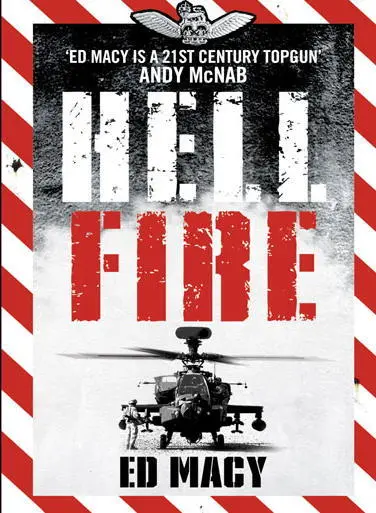
- Название:Hellfire
- Автор:
- Издательство:HarperPress
- Жанр:
- Год:2009
- Город:London
- ISBN:978-0-007-34292-1
- Рейтинг книги:3 / 5. Голосов: 1
-
Избранное:Добавить в избранное
- Отзывы:
-
Ваша оценка:
Hellfire: краткое содержание, описание и аннотация
Предлагаем к чтению аннотацию, описание, краткое содержание или предисловие (зависит от того, что написал сам автор книги «Hellfire»). Если вы не нашли необходимую информацию о книге — напишите в комментариях, мы постараемся отыскать её.
Ed Macy bent every rule in the book to get to where he wanted to be: on Ops in the stinking heat of the Afghan summer, with the world’s greatest weapons system at his fingertips. It’s 2006 and he is part of an elite group of pilots assigned to the controversial Apache AH Mk1 gunship programme. So far, though, the monstrously expensive Apache has done little to disprove its detractors. For the first month ‘in action’ Ed sees little more from his cockpit than the back end of a Chinook.
But everything changes in the skies over Now Zad. Under fire and out of options, Ed has one chance to save his own skin and those of the men on the ground. Though the Apache bristles with awesome weaponry, its fearsome Hellfire missile has never been fired in combat. Then, in the blistering heat of the firefight, the trigger is pulled.
It’s a split-second decision that forever changes the course of the Afghan war, as overnight the gunship is transformed from being an expensive liability to the British Army’s greatest asset. From that moment on, Ed and his squadron mates will face the steepest learning curve of their lives – fighting an endless series of high-octane missions against a cunning and constantly evolving enemy. Ed himself will have to risk everything to fly, fight and survive in the most hostile place on earth.
http://www.youtube.com/watch?v=LNP1lbLNKqA
Hellfire — читать онлайн ознакомительный отрывок
Ниже представлен текст книги, разбитый по страницам. Система сохранения места последней прочитанной страницы, позволяет с удобством читать онлайн бесплатно книгу «Hellfire», без необходимости каждый раз заново искать на чём Вы остановились. Поставьте закладку, и сможете в любой момент перейти на страницу, на которой закончили чтение.
Интервал:
Закладка:
I swung my head rapidly from left to right, searching for gunners and SAM operators and suspicious vehicles; anyone or anything that might take a shot at us.
I was also keeping my distance from Jon. Too close together and a missile would be spoilt for choice. The Bitch would spring into action, but if the missile was fitted with a proximity fuse, it didn’t even need to hit us; it would explode when it got within its prescribed distance and blow shrapnel into our airframe, blades and cockpits.
As it was, the SAM operator would be able to target only one of us. The other would be able to engage and kill him before he loosed off any more missiles.
That was the theory, anyway.
Though the Apache had a particularly low heat signature and was thus very hard to lock-on, the threat of a SAMbush – two or more operators working together – was always on my mind when we climbed or descended through their threat band.
We levelled off at 6,000 feet. I pulled in what remaining power we had until the Power Margin Indicator (PMI) warned me that I was within 10 per cent of an engine limit.
I selected the engine page on my MPD. The Number One engine on the port side was eating vigorously into its sixty-minute timer at this torque setting and Number Two on the starboard side was taking regular nibbles. Neither could be reset until we landed. Once I’d used up all sixty minutes, that power setting would not be accessible again without damaging the engines.
Did I keep the speed on and have nothing left for later? The decision was fairly straightforward on this sortie; the transit time to Now Zad was now fourteen minutes. Once there, I’d be slowing down and using less than half of what the engines could produce. For the return journey I would be a lot lighter – most of the fuel would have been burnt off – so as long as I saved twenty of my sixty-minute timers I could travel back at max chat. If they needed us somewhere else at short notice, I’d have to think again…
Fuck it. It was a no-brainer. We were going to Now Zad because our lads were being badly shot up. Nothing else in Helmand was going to be a higher priority. Not in the next few hours, anyway.
Watching the engine page like a hawk, I called, ‘Head’s in.’
Billy acknowledged. ‘My head’s out.’
Last thing we wanted was both of us looking in at the same time; that was how mid-air collisions and smacks into terra firma were triggered.
I pulled through gradually until the five-minute timers kicked off.
We couldn’t eat into these without fear of retribution. If we lost an engine, we’d need the five-minute margin to touch down and save the good engine for another day. To use it up now could mean trashing the thing on landing. Not something I fancied explaining to the brass, even in an emergency.
I backed off a fraction on the collective. I was now coaxing this puppy for all it could give without going into the red.
The Apache was cruising at 132 knots fully laden with munitions and fuel at 6,000 feet when Billy called, ‘Twelve minutes to run.’
North of Camp Bastion lay a huge expanse of nothingness we called the GAFA. The Great Afghan Fuck All was an ancient, rocky sea bed with a thick covering of salty sand as fine as talcum powder, saturated by the rains the last time there had been a wet season several years ago and now set solid. It was as flat as a pancake until it approached Now Zad, where the mountains began.
Nothing grew in this harsh terrain save the odd bush that had miraculously survived floods, sandstorms and salt. There was no shelter from the elements, no reason to live here even if you could. Only the nomads set up their temporary shelters here in the winter to feed the goats on the meagre green stubby bushes that popped up when the rains came. But now, in the height of summer, even the masters of survival found this place inhospitable.
No wonder they’d named it Dasht-e-Margo, the Desert of Death.
The mountains in the far north rose steeply towards the Hindu Kush, with little if any habitation away from the rivers that cut through them.
The foothills, on the other hand, had good access to water. For thousands of years they had supported life. The Afghans had once irrigated the desert for food crops, but drought had shrunk their fields by 90 per cent. Cultivated land no longer stretched far from the major river wadis before it became unsustainable.
The mountains meant the only way of travelling east or west at any speed in northern Helmand was south along the desert floor. A few miles north of Bastion was the only substantial east-west road, commonly known as Highway Zero One. The surrounding towns and villages needed to access it to get into the neighbouring provinces of Kandahar and Nimruz.
The surface was so compact there was no need to turn the steering wheel to get to Highway Zero One. You just had to point your vehicle in the direction of your destination – north or south – and drive in a straight line.
Two large hills stuck out of the desert floor in front and either side of us, like a pair of shark fins. The sea of sand just stopped at the foot of a sheer rock face which had been gouged into for shelter and to store the harvest. The big difference these days was that the caves and tunnels contained Taliban, weapons and ammunition.
As I scanned the barren, featureless landscape below us, an icon flashed across my monocle – a stationary wheeled vehicle icon 5,700 metres away, prioritised by the Forward Control Radar as the next target to shoot.
The powers – that-be had wanted to remove the Fire Control Radar to save weight. The Taliban didn’t drive about in armoured vehicles and tanks, they reasoned, so it would be of no use to us. Without it, they said, we could add more weapons and achieve a better performance. I begged to disagree; the best possible performance depended upon us detecting the Taliban as quickly as we could. The Longbow was proving to be a real winner in Afghanistan. It could even target a lone figure in the middle of a huge expanse of desert.
My right eye placed the icon in the crosshair of the monocle while my left scanned the real world.
Going by its size and shape, the vehicle was probably a 4x4.
‘Gunner – target – FCR – wheeled vehicle – stationary – range: five point seven – possible a 4x4.’
‘Stand by,’ Billy said. ‘Sensing.’
Less than four seconds later: ‘On.’ He had the target visual in sight and no longer needed the FCR.
I glanced at my right MPD. A white Toyota Landcruiser. Even at this range, it filled my five-inch black and white screen. It had stopped in the middle of the desert – not to launch a SAM but to change a punctured tyre. As Billy zoomed in a little closer we identified its occupants.
‘Good spot, Ed, disregard – 4x4 Landcruiser broken down with women and children in it.’
A good spot, indeed. The FCR had said it was a wheeled vehicle and that it was stationary, and it was right on both counts. When it came to finding needles in haystacks, the FCR was the king of kings.
On one of my first flights across the desert it had detected a camel. The classification it gave to these ships of the desert remains a closely guarded military secret.
The secure radio sparked up: ‘Wildman Five Zero Flight this is Wildman Five Two Flight. We are RTB.’
No longer could 3 Flight hold on.
‘We’re out of gas and I think the Taliban are onto us. They kicked off big style at our chicken fuel point. I think they may have been listening to the CTAF.’
Nick: ‘Copied.’
‘I can’t give you any grids because everyone is moving around so fast and the enemy are everywhere. They’ll be useless in the few minutes it’ll take you to get there. Good luck; we’ll be ready to RIP when you call for us.’
Читать дальшеИнтервал:
Закладка:
Похожие книги на «Hellfire»
Представляем Вашему вниманию похожие книги на «Hellfire» списком для выбора. Мы отобрали схожую по названию и смыслу литературу в надежде предоставить читателям больше вариантов отыскать новые, интересные, ещё непрочитанные произведения.




Обсуждение, отзывы о книге «Hellfire» и просто собственные мнения читателей. Оставьте ваши комментарии, напишите, что Вы думаете о произведении, его смысле или главных героях. Укажите что конкретно понравилось, а что нет, и почему Вы так считаете.