Ed Macy - Apache
Здесь есть возможность читать онлайн «Ed Macy - Apache» — ознакомительный отрывок электронной книги совершенно бесплатно, а после прочтения отрывка купить полную версию. В некоторых случаях можно слушать аудио, скачать через торрент в формате fb2 и присутствует краткое содержание. Город: London, Год выпуска: 2008, ISBN: 2008, Издательство: HarperPress, Жанр: Биографии и Мемуары, nonf_military, на английском языке. Описание произведения, (предисловие) а так же отзывы посетителей доступны на портале библиотеки ЛибКат.
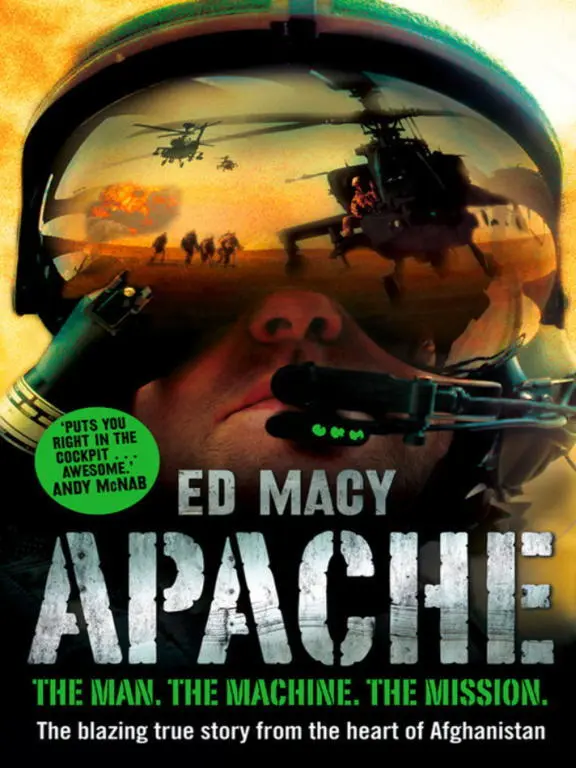
- Название:Apache
- Автор:
- Издательство:HarperPress
- Жанр:
- Год:2008
- Город:London
- ISBN:978-0007307470
- Рейтинг книги:5 / 5. Голосов: 1
-
Избранное:Добавить в избранное
- Отзывы:
-
Ваша оценка:
Apache: краткое содержание, описание и аннотация
Предлагаем к чтению аннотацию, описание, краткое содержание или предисловие (зависит от того, что написал сам автор книги «Apache»). Если вы не нашли необходимую информацию о книге — напишите в комментариях, мы постараемся отыскать её.
http://www.harperplus.com/apache
Apache — читать онлайн ознакомительный отрывок
Ниже представлен текст книги, разбитый по страницам. Система сохранения места последней прочитанной страницы, позволяет с удобством читать онлайн бесплатно книгу «Apache», без необходимости каждый раз заново искать на чём Вы остановились. Поставьте закладку, и сможете в любой момент перейти на страницу, на которой закончили чтение.
Интервал:
Закладка:
Billy and Carl were a safe distance in front of us to avoid collision. Billy came on the radio.
‘Ugly Five One, this is Ugly Five Zero. High-high, five-five and six-zero.’
‘High-high, five-five, six-zero copied.’
Billy wanted us to climb high. Him to 5,500 feet and us to 6,000 feet – always a small difference in height too, for safety. The Boss glanced up through the canopy’s bulletproof window.
‘Clear above.’
‘Copied. Climbing.’
I pulled back on the cyclic and hard on the collective while depressing my left pedal. We lost our stomachs and soared.
Despite its gargantuan combat weight, the Apache’s mighty Rolls Royce engines made it just as agile and manoeuvrable as any chopper the army had ever had. Turning at up to 38,300 rpm, they pumped out an incredible 2,240 shaft horse power – making the Apache twenty-two times more powerful than a Porsche 911.
The Apache could climb in excess of 5,000 feet a minute, including a one-off, ninety-degree, nose-up vertical climb of 1,000 feet. And it could do a 360-degree loop, barrel roll or a wing over nose dive – every stunt manoeuvre in the book. Not moves I’ve ever carried out, of course; heaven forbid – especially with Sky Cop as my wingman.
Sixty seconds or so later, we were at Billy’s nominated cruising altitude. It was a terrific feeling to be up there again, over that menacingly beautiful landscape, and in that extraordinary machine. Ten minutes into the flight, I felt as confident at the controls as I had on the day I left in August. I was right back in the zone again.
Despite the years of training, it had still taken me a good six weeks of hard fighting on the first tour before I really felt the exhilaration of being at one with the machine.
When you drive a new car, you’re slow and cautious. You need to think about every action, from where the indicators are to how far you are from the gatepost. After you’ve driven it for a while, you don’t have to think; you just end up at home without having thought of driving once.
It was the same with the Apache, but on a grander scale. Halfway through the first tour, whatever I wanted to do in the aircraft, I did. From that moment onwards I didn’t need to think how to fly and shoot because my fingers, arms and legs were already working in perfect harmony with my mind. I was no longer strapped to the Apache; the Apache was strapped to me.
Almost all of the pilots were there by the end of the tour. But none of that meant that we had lost respect for the daunting reality of having so much firepower at our finger tips. Not for one moment, then or since. Nobody in that war had more potential to do as much damage to human life. With that power came an equal amount of responsibility. We were fearful of being seen as gung-ho; US Apache pilots had that reputation and we didn’t want to follow suit. Every single round we put down we put down with good reason; killing someone was a serious business.
As we flew, I watched the Boss’s head dart from side to side as he fought to take everything in. ‘Amazing…’ he’d murmur every now and then. Occasionally, a swift question. ‘Jeez. What the hell do you call that?’
There were no more inspiring places to fly than in southern Afghanistan. It was unlike anywhere I had ever seen before and I was still captivated by it too. The landscape was both epic and primeval; everything about it was extreme. When it was flat, it was flat as a pancake. When it was hot, it was unbearably so. The rivers were never babbling streams but vast raging torrents, and the mountains climbed straight up to the heavens, often from a standing start.
The plan was to do an anticlockwise circuit of the four northern platoon houses where we’d spent most of the first tour: Sangin first, then Kajaki in the far north-east, Now Zad in the far north-west, and finally Gereshk, twenty kilometres shy of Camp Bastion, on the way back.
We stuck to the safety of the desert on the way up, keeping the Green Zone to our right. Immensely fertile before the Soviet invasion in 1978–79, Helmand province had been known as Afghanistan’s breadbasket. A decade of bitter fighting against the Red Army ended that. Russian bombers smashed much of Helmand’s irrigation system to smithereens. Yet the year-round supply of melted snow off the Hindu Kush was sufficient to keep the river valley’s fields and orchards lush enough for two full crops of opium poppies a year.
The vast majority of the province’s intensely conservative, desperately impoverished, million-strong, largely Pashtun, population were farmers – or worked the farmers’ land. The majority lived in single-storey houses fashioned from adobe and stone, often without electricity or piped water. It was an existence that hadn’t changed in a millennium.
The Green Zone only amounted to a tiny central slice of the province. It was bordered by two great deserts. To its west was the Desert of Death and Camp Bastion.
‘Dasht-e-Margo…’ The Boss practised his fledgling Pashtun.
‘Yeah. But aircrew generally call it the GAFA, Boss.’
‘GAFA?’
‘The Great Afghan Fuck All.’
The GAFA was an ancient, rocky seabed with a thick covering of sand as fine as dust. Nomads set up temporary shelters on it in the winter so their goats and camels could feed on the odd bush. In the summer it remained the exclusive preserve of the drug traffickers. They criss-crossed it south to Pakistan, or west to Iran, moving raw opium or freshly processed heroin to their consumers in the Middle East or Europe, leaving an endless mesh of tyre tracks behind them. It was so barren that you couldn’t tell if you were at 100 feet or 10,000.
‘What do you call the desert on the east side of the Green Zone, then?’
‘The Red Desert.’
‘Why?’
‘Because it looks red from up here.’
The Boss peered at our right horizon. ‘It’s actually worse. Makes the GAFA look like Kent.’
The Red Desert stretched all the way to Kandahar: 10,000 square miles of thin, Arabian-style sand, whipped by the wind over thousands of years into an endless succession of dunes. From 5,000 feet up, its surface looked like a sea of rippling red waves. Except by two well-known routes, the Red Desert was completely impassable, even by tracked vehicles. If you went in there, you didn’t come out again. That’s why nobody ever did. Not even the nomads.
As we moved further north and nearer to Sangin the topography ahead of us began to change. We could see the outlines of great ridges of rock rising from steep valleys to form the foothills of the Hindu Kush. Their peaks were as sharp as knife-blades and coloured seams cut through them as they climbed, indicating the different eras of their evolution. The mountains stretched all the way to Kabul, 300 miles to the north-east. They were almost impassable in the winter snows and boasted only one road flat enough for most vehicles to make the arduous journey during the rest of the year.
Many of the foothills had been tunnelled into, originally for protection from the wind and sandstorms and somewhere to store crops, but then, in the last few thousand years, for war. They provided an excellent defence against invaders since the time of Alexander the Great, and most recently, a haven to Osama bin Laden and al Qaeda.
Conventional British forces tried to stay out of the mountains. Our lesson had been learned 164 years before we got there, when General Elphinstone’s 16,000-man garrison was wiped out during the retreat from Kabul in 1842.
‘That’s Sangin ahead of us now, Boss.’
Sangin sat at the confluence of three green zones, and the District Centre was sited at the point the Helmand was joined by another river flowing from the northern hills. The Taliban had three different covered approaches from which to attack it.
Читать дальшеИнтервал:
Закладка:
Похожие книги на «Apache»
Представляем Вашему вниманию похожие книги на «Apache» списком для выбора. Мы отобрали схожую по названию и смыслу литературу в надежде предоставить читателям больше вариантов отыскать новые, интересные, ещё непрочитанные произведения.








Обсуждение, отзывы о книге «Apache» и просто собственные мнения читателей. Оставьте ваши комментарии, напишите, что Вы думаете о произведении, его смысле или главных героях. Укажите что конкретно понравилось, а что нет, и почему Вы так считаете.