Dale Brown - Puppet Master
Здесь есть возможность читать онлайн «Dale Brown - Puppet Master» весь текст электронной книги совершенно бесплатно (целиком полную версию без сокращений). В некоторых случаях можно слушать аудио, скачать через торрент в формате fb2 и присутствует краткое содержание. Город: New York, Год выпуска: 2016, ISBN: 2016, Издательство: William Morrow, Жанр: Триллер, на английском языке. Описание произведения, (предисловие) а так же отзывы посетителей доступны на портале библиотеки ЛибКат.
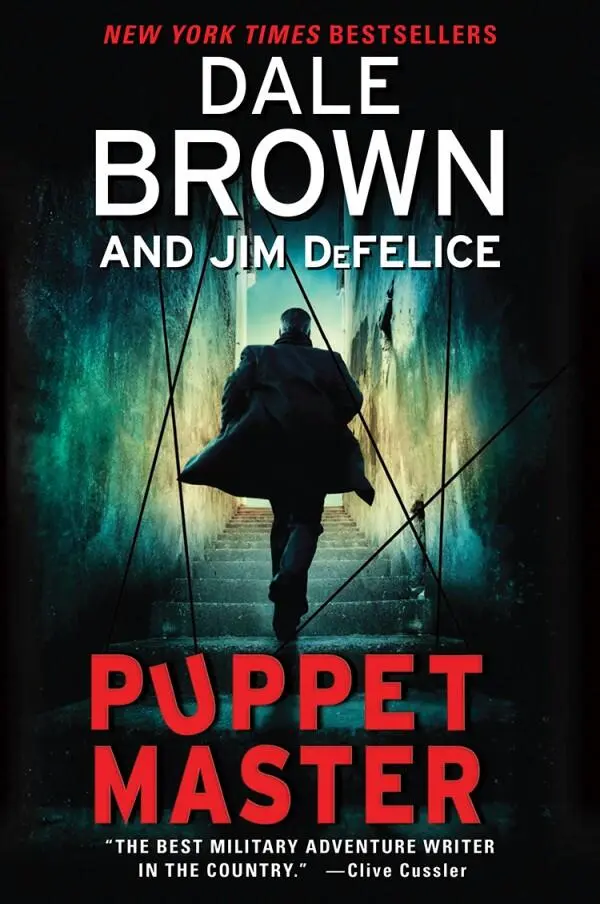
- Название:Puppet Master
- Автор:
- Издательство:William Morrow
- Жанр:
- Год:2016
- Город:New York
- ISBN:9780062411310
- Рейтинг книги:5 / 5. Голосов: 1
-
Избранное:Добавить в избранное
- Отзывы:
-
Ваша оценка:
Puppet Master: краткое содержание, описание и аннотация
Предлагаем к чтению аннотацию, описание, краткое содержание или предисловие (зависит от того, что написал сам автор книги «Puppet Master»). Если вы не нашли необходимую информацию о книге — напишите в комментариях, мы постараемся отыскать её.
, intelligent machines take center stage as America battles the Russian mafia in Eastern Europe
Louis Massina is revolutionizing the field of robotics. His technological wonders are capable of locating disaster survivors, preventing nuclear meltdowns, and replacing missing limbs. After one of Massina’s creations makes a miraculous rescue, an FBI agent recruits him to pursue criminals running a massive financial scam — and not coincidentally, suspected of killing the agent’s brother. Massina agrees to deploy a surveillance “bot” that uses artificial intelligence to follow its target. But when he’s thrust into a dangerous conspiracy, the billionaire inventor decides to take matters into his own hands, unleashing the greatest cyber-weapons in the world and becoming the Puppet Master.
Puppet Master — читать онлайн бесплатно полную книгу (весь текст) целиком
Ниже представлен текст книги, разбитый по страницам. Система сохранения места последней прочитанной страницы, позволяет с удобством читать онлайн бесплатно книгу «Puppet Master», без необходимости каждый раз заново искать на чём Вы остановились. Поставьте закладку, и сможете в любой момент перейти на страницу, на которой закончили чтение.
Интервал:
Закладка:
What was baffling, though, was the fact that the account didn’t seem to exist.
To make sure she understood the protocol and was therefore getting everything right, she canvassed the cafeteria for anyone who had an account at the same bank. She recorded a query with the card — that morning Massina had leased an ATM machine for the lobby, for research as well as his employees’ convenience — then replayed everything with the account information.
Nothing. Nada. The account didn’t exist.
Which a bank manager confirmed for her in person when she went to inquire about it, asking about a check supposedly written on it.
It had to have been erased. There were ways to get the information back — looking at backup files would be the easiest, but she’d need the bank’s cooperation. And if they weren’t going to cooperate with the FBI, they surely wouldn’t work with her. She didn’t bother asking.
Not sure what to do next, she went back to the lab and replayed the drone footage. It had taken the drone about ninety seconds to get over the site after receiving the command.
Which wasn’t all that much time, but it was certainly after the card had been used.
So why was the suspect facing in the direction of the ATM when the drone arrived?
At the time, they thought it was because he’d heard the boy on the bike behind him, but the more she considered it, the more Chelsea wondered. She went back to the drone’s video and zoomed in, looking at the scratchy images from the distance. The earliest image showed the suspect on the sidewalk alone, walking toward the ATM. It wasn’t until several frames later that the bike appeared.
Maybe nothing.
Or maybe they had gotten the wrong person.
The person on the bike was a girl. The drone had gotten a decent facial image, good enough to use for a search.
The computer system went to work, testing the image against a series of commercial identity databases, starting with anyone ever charged with a crime in Massachusetts — police mug shots had recently been declared public information. After the criminal databases turned up nothing, it began trolling through Facebook, Twitter, Instagram, paging through a mountain of selfies.
But it wasn’t until a full five minutes had passed — an eternity considering the computer resources Chelsea had at her command — that it found a hit on a picture that had appeared in a school newsletter the year before.
The girl’s name was Borya Tolevi.
Gabor Tolevi’s daughter.
Chelsea replayed the drone’s image, looking at the confrontation between the two. There was no sound, but it was clear that the two were having an argument.
What about, Chelsea wondered. But it wasn’t hard to guess.
45
Time for a run.
Johnny Givens stood at the end of the field, surveying the track. It was an old cinder-and-dirt affair, exactly a quarter mile, dating from the days that the grounds had belonged to a Catholic school. Never quite abandoned, it had recently been adopted by a local track club, whose members had smoothed out a decade’s worth of ruts and re-topped it with extremely fine gravel, donated by an area mining operation. It was even but hardly perfect, but that was fine as far as Johnny was concerned; he could run here without being bothered, and there would even be less shock to his stumps than on a “real” track.
Stumps. He was just getting used to the word.
“You don’t really think you’re going to be able to run this,” snarled Gestapo Bitch. She’d seen him in the hall and followed him out.
“I’ll walk it if I have to,” he told her.
“Are you trying to prove something?” she retorted. “You’re barely off the IV.”
Damn straight he was trying to prove something. Johnny took a breath, then leaned forward.
Suddenly he was running.
Not very fast, or very steadily. But with Gestapo Bitch watching him, he sure as hell wasn’t giving up.
The doctors were feeding him with some serious medicine, steroid concoctions, and a shelf full of vitamins. He was their guinea pig. But that was fine by him.
His heart pounded as he took the first turn. The weight on the side of his head grew. His arms weren’t keeping up with his legs.
The left one gave way. Johnny collapsed to the ground, face-first.
Damn! Damn!
Why does God hate me? Why is he doing this to me? Why?
Johnny pounded the ground. Tears rolled down his face.
Why?!
“I told you,” snickered Gestapo Bitch.
He slipped again getting up. Tiny stones were embedded in the palms of his hands. The front of his shirt was covered with dirt.
Run. Run!
Unsteady, he took a step to find his balance, then began running again.
More a trot, but he had to move.
Why is God doing this to me?
46
“Nice bike.”
Borya looked across at a short black woman. She had her own bike, a Trek Silque with custom red fade paint on a gray frame.
“So’s yours,” Borya said, tightening the strap on her backpack. She tried to puzzle out who the woman was.
Not a mom; more an older-sister type.
“What are you doing?” asked the woman.
“Riding home.”
“Want some company?”
Weird.
“Free country. I guess.”
“I’m Chelsea. Chelsea Goodman.” The woman stuck out her hand.
“You a lesbian?” asked Borya.
“No.” Chelsea laughed. “Why?”
Borya shrugged.
“I have a question for you,” said Chelsea, sliding her bike parallel to Borya’s. “What do you know about ATMs?”
Borya stabbed at the bike pedal, launching into a sprint. She charged down the block, wind whipping back her hair. She sped across the intersection, barely dodging a turning car, then crossed back and turned the corner.
She looked up. Chelsea was pedaling alongside.
“Nice bike,” she said again. “You change gears a little too much. You can pedal a little longer before shifting for better speed.”
Borya put her head down and pedaled furiously. Her legs were starting to tire, and as she felt the burn growing in the top of her thighs, she realized she would never be able to outrun the woman, who was still alongside her.
You’re an old suck. You should be tired!
Borya dropped to her usual pace. She thought of leading the woman across the city but decided she’d have a hard time losing her. Besides, her father had given her strict orders to check in with him from the house phone when she got home.
She narrowed her eyes as she rode the last block and a half to the house, practicing the glare she would greet the woman’s inevitable questions with. She felt as if she was putting on a costume, becoming someone else — a superhero tough girl, impervious to attack.
Pedaling around to the back, Borya hopped off the bike as she glided toward the back porch. She picked up the bike in one motion and carried it up the steps without stopping. The front wheel was still spinning when she began wrapping the chain through the frame to secure it.
“You’re still here?” she said nonchalantly, as if noticing for the first time that Chelsea was parked at the base of the steps.
“You never answered my question,” said Chelsea. “What do you know about ATMs?”
“They give you money.”
Borya turned to go inside, deciding it would be easiest simply to avoid talking to the woman. But Chelsea was quick, and prepared: she hopped off her bike and was at the door in a flash, pushing it closed as Borya reached her hand in with the key.
Читать дальшеИнтервал:
Закладка:
Похожие книги на «Puppet Master»
Представляем Вашему вниманию похожие книги на «Puppet Master» списком для выбора. Мы отобрали схожую по названию и смыслу литературу в надежде предоставить читателям больше вариантов отыскать новые, интересные, ещё непрочитанные произведения.












Обсуждение, отзывы о книге «Puppet Master» и просто собственные мнения читателей. Оставьте ваши комментарии, напишите, что Вы думаете о произведении, его смысле или главных героях. Укажите что конкретно понравилось, а что нет, и почему Вы так считаете.