Clare Mackintosh - I Let You Go
Здесь есть возможность читать онлайн «Clare Mackintosh - I Let You Go» весь текст электронной книги совершенно бесплатно (целиком полную версию без сокращений). В некоторых случаях можно слушать аудио, скачать через торрент в формате fb2 и присутствует краткое содержание. Год выпуска: 2014, Издательство: Little, Brown Book Group, Жанр: Триллер, на английском языке. Описание произведения, (предисловие) а так же отзывы посетителей доступны на портале библиотеки ЛибКат.
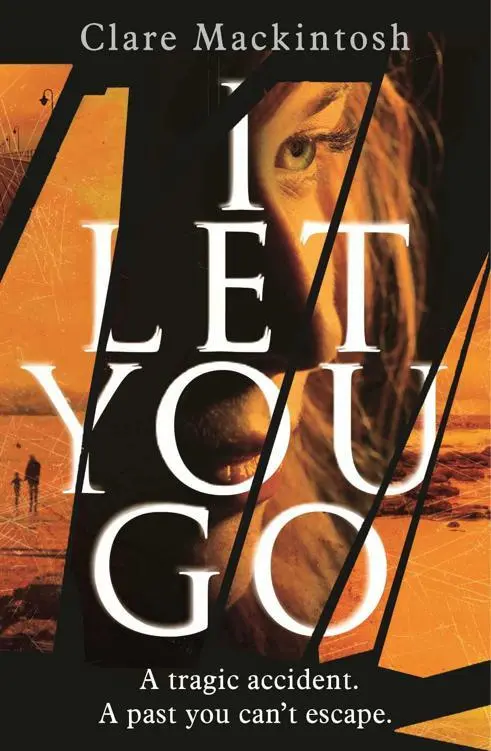
- Название:I Let You Go
- Автор:
- Издательство:Little, Brown Book Group
- Жанр:
- Год:2014
- ISBN:нет данных
- Рейтинг книги:3 / 5. Голосов: 1
-
Избранное:Добавить в избранное
- Отзывы:
-
Ваша оценка:
I Let You Go: краткое содержание, описание и аннотация
Предлагаем к чтению аннотацию, описание, краткое содержание или предисловие (зависит от того, что написал сам автор книги «I Let You Go»). Если вы не нашли необходимую информацию о книге — напишите в комментариях, мы постараемся отыскать её.
Slowly, Jenna begins to glimpse the potential for happiness in her future. But her past is about to catch up with her, and the consequences will be devastating...
I Let You Go — читать онлайн бесплатно полную книгу (весь текст) целиком
Ниже представлен текст книги, разбитый по страницам. Система сохранения места последней прочитанной страницы, позволяет с удобством читать онлайн бесплатно книгу «I Let You Go», без необходимости каждый раз заново искать на чём Вы остановились. Поставьте закладку, и сможете в любой момент перейти на страницу, на которой закончили чтение.
Интервал:
Закладка:
‘Of course!’ he said. He thought of the house in Grantham Street, with its multiple locks, and net curtains stopping anyone looking in. He thought of Jenna Gray, and the ever-present fear in her eyes, and slowly a picture began to emerge.
There was a sound on the stairs, and seconds later Tom appeared, looking apprehensive. Ray stared at him. For months he had seen his son as a victim, but it turned out he wasn’t the victim at all.
‘I’ve got it all wrong,’ he said out loud.
‘Got what all wrong?’ Mags said. But Ray had already gone.
43
The entrance to Bristol Crown Court is tucked away down a narrow road appropriately called Small Street.
‘I’ll have to drop you here, love,’ my taxi driver tells me. If he recognises me from today’s papers he isn’t showing it. ‘There’s something going on outside the court today – I’m not taking the cab past that lot.’
He stops at the corner of the street, where a collection of self-satisfied suits trickles out of All Bar One after a liquid lunch. One of them leers at me. ‘Fancy a drink, sweetheart?’
I look away.
‘Frigid cow,’ he mutters and his friends roar with laughter. I take a deep breath, fighting to keep my panic under control as I scan the streets for Ian. Is he here? Is he watching me right now?
The high buildings either side of Small Street lean towards each other, creating a shadowy, echo-filled walkway that makes me shiver. I haven’t walked more than a few paces when I see what the taxi driver was talking about. A section of the road has been cordoned off with roadside barriers, behind which thirty or so protesters are grouped. Several have placards resting against their shoulders, and a huge painted sheet is draped over the barrier immediately in front of them. The word MURDERER! is written in thick red paint, each letter dripping down to the bottom of the sheet. A pair of police officers in fluorescent jackets stand to the side of the group, seemingly unfazed by the repetitive chant I can hear from the other end of Small Street.
‘Justice for Jacob! Justice for Jacob!’
I walk slowly towards the court, wishing I had thought to bring a scarf, or some dark glasses. From the corner of my eye I notice a man on the opposite side of the pavement. He’s leaning against the wall but when he sees me he straightens and pulls a phone out of his pocket. I quicken my steps, wanting to get inside the court as soon as I can, but the man keeps pace with me on the other side of the street. He makes a call that lasts seconds. The pockets of the man’s beige waistcoat are rammed with what I now realise are camera lenses, and he has a black bag slung over his shoulders. He runs ahead, opening the bag and pulling out a camera; fitting a lens in a fluid movement born of years of practice; taking my picture.
I will ignore them, I think, my breath coming in hard lumps. I’ll simply walk into court as if they aren’t there. They can’t hurt me – the police are there to keep them behind those barriers – so I’ll just act as if they aren’t there.
But as I turn towards the entrance to the court, I see the reporter who accosted me as I left the Magistrates’ Court all those weeks ago.
‘Quick word for the Post , Jenna? Chance to put your story across?’
I turn away and freeze as I realise I’m now directly facing the protesters. The chanting dissolves into angry shouts and jeers, and there’s a sudden surge towards me. A barrier topples over and slams on to the cobbles, the sound ricocheting between the high buildings like a gunshot. The police move lazily across, their arms outstretched, ushering the protesters back behind the line. Some are still shouting but most are laughing, chatting with others as though they are going shopping. A fun day out.
As the group melts backwards, and the police replace the barriers around the designated protest area, one woman is left standing in front of me. She is younger than me – still in her twenties – and unlike the other protesters she holds no banner or placard, just something clutched in one hand. Her dress is brown and a little short, worn over black tights that end incongruously in grubby white plimsolls, and her coat flaps open despite the cold.
‘He was such a good baby,’ she says quietly.
At once I can see Jacob’s features in hers. The pale-blue eyes with their slight tilt upwards; the heart-shaped face ending in a small pointed chin.
The protesters fall silent. Everyone is watching us.
‘He hardly ever cried; even when he was sick he would just lie against me, looking up at me and waiting to get better.’
She speaks perfect English, but with an accent I can’t place. Something Eastern European, perhaps. Her voice is measured, as though she’s reciting something learnt by rote, and although she stands her ground I have the impression she is as frightened by this encounter as I am. Perhaps more so.
‘I was very young when I had him. Only a child myself. His father didn’t want me to keep the baby, but I couldn’t bring myself to have a termination. I already loved him too much.’ She speaks calmly, without emotion. ‘Jacob was all I had.’
My eyes fill with tears and I despise myself for such a response, when Jacob’s mother is dry-eyed. I force myself to stand still and don’t let myself wipe my cheeks. I know that, like me, she’s thinking of that night, when she stared at the rain-streaked windscreen, her eyes screwed up against the glare of the headlights. Today there is nothing between us, and she can see me as clearly as I can see her. I wonder why she doesn’t rush at me: punch or bite or claw at my face. I don’t know if I would have such self-restraint, were I in her shoes.
‘Anya!’ A man calls to her from within the crowd of protesters, but she ignores him. She holds out a photograph, thrusting it towards me until I take hold of it.
The picture isn’t one I have seen in the newspapers or online; that gap-toothed grin in the school uniform, head turned just so for the photographer. In this photo Jacob is younger – perhaps three or four. He nestles in the crook of his mother’s arm, both lying on their backs in long grass scattered with dandelion clocks. The angle of the photo suggests Anya took it herself: her arm is outstretched as though reaching right outside the picture. Jacob is looking at the camera, squinting against the sun and laughing. Anya is laughing too, but she’s looking at Jacob, and in her eyes are tiny reflections of him.
‘I’m so sorry,’ I say. I hate how weak the words sound, but I can’t find any others, and I can’t bear to offer only silence in response to her grief.
‘Do you have children?’
I think of my son; of his weightless body wrapped in its hospital blanket; of the ache in my womb that has never left. I think that there should be a word for a mother with no children; for a woman bereft of the baby that would have made her whole.
‘No.’ I search for something to say, but there is nothing. I hold the photograph towards Anya, who shakes her head.
‘I don’t need it,’ she says. ‘I carry his face in here.’ She places the flat of her palm against her chest. ‘But you,’ there is the briefest of pauses, ‘you, I think, must remember. You must remember that he was a boy. That he had a mother. And that her heart is breaking.’
She turns and ducks under the barrier, disappearing into the crowd, and I draw in air as though I’ve been held under water.
My barrister is a woman in her forties. She looks at me with calculated interest as she sweeps into the small consultation room, where a security officer stands outside the door.
‘Ruth Jefferson,’ she says, holding out a firm hand. ‘It’s a simple process today, Ms Gray. You’ve already entered a plea, so today’s hearing is merely for sentencing. We’re first up after lunch, and I’m afraid you’ve got Judge King.’ She sits opposite me at the table.
Читать дальшеИнтервал:
Закладка:
Похожие книги на «I Let You Go»
Представляем Вашему вниманию похожие книги на «I Let You Go» списком для выбора. Мы отобрали схожую по названию и смыслу литературу в надежде предоставить читателям больше вариантов отыскать новые, интересные, ещё непрочитанные произведения.







Обсуждение, отзывы о книге «I Let You Go» и просто собственные мнения читателей. Оставьте ваши комментарии, напишите, что Вы думаете о произведении, его смысле или главных героях. Укажите что конкретно понравилось, а что нет, и почему Вы так считаете.