James Ellroy - Silent Terror
Здесь есть возможность читать онлайн «James Ellroy - Silent Terror» весь текст электронной книги совершенно бесплатно (целиком полную версию без сокращений). В некоторых случаях можно слушать аудио, скачать через торрент в формате fb2 и присутствует краткое содержание. Город: Los Angeles, Год выпуска: 1987, ISBN: 1987, Издательство: Blood & Guts Press, Жанр: Триллер, Маньяки, на английском языке. Описание произведения, (предисловие) а так же отзывы посетителей доступны на портале библиотеки ЛибКат.
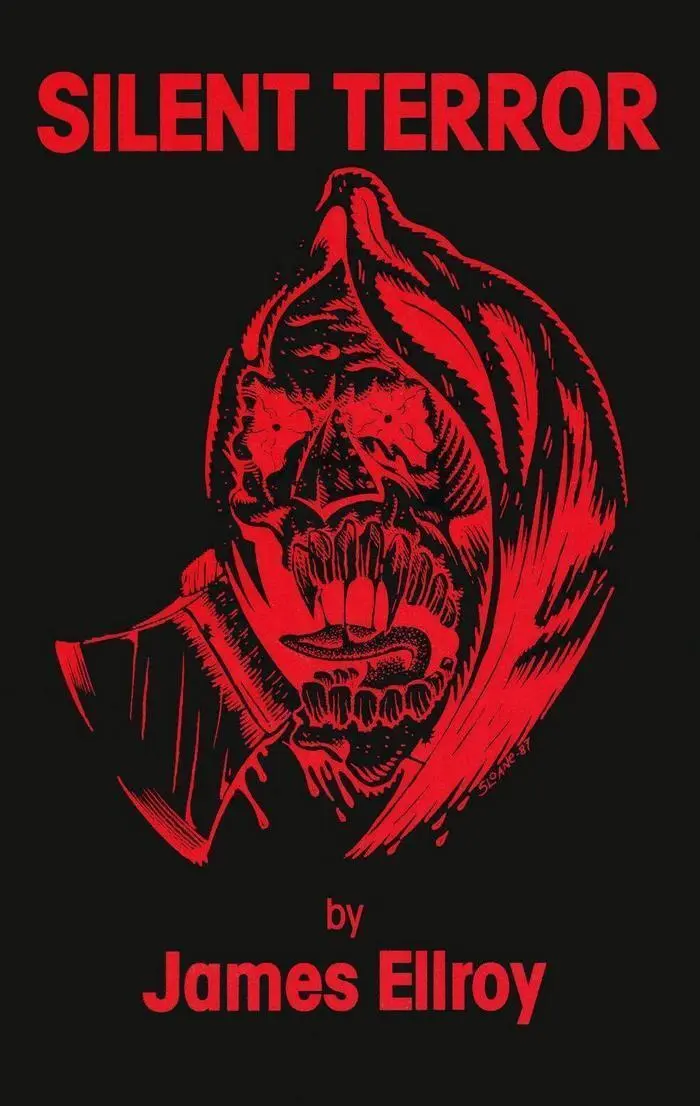
- Название:Silent Terror
- Автор:
- Издательство:Blood & Guts Press
- Жанр:
- Год:1987
- Город:Los Angeles
- ISBN:978-0-940941-00-7
- Рейтинг книги:5 / 5. Голосов: 1
-
Избранное:Добавить в избранное
- Отзывы:
-
Ваша оценка:
Silent Terror: краткое содержание, описание и аннотация
Предлагаем к чтению аннотацию, описание, краткое содержание или предисловие (зависит от того, что написал сам автор книги «Silent Terror»). Если вы не нашли необходимую информацию о книге — напишите в комментариях, мы постараемся отыскать её.
I clipped my self-sharpening, teflon-coated, brushed-steel axe and swung it at her neck. Her head was sheared cleanly off; blood burst from the cavity, her arms and legs twitched spastically, then her whole body crumpled to the floor. The force of my swing spun me around, and for one second my vision eclipsed the entire scene — blood spattered walls, the body shooting an arterial geyser out the neck, the heart still pumping in reflex...
Martin Plunkett has struck again.
Silent Terror — читать онлайн бесплатно полную книгу (весь текст) целиком
Ниже представлен текст книги, разбитый по страницам. Система сохранения места последней прочитанной страницы, позволяет с удобством читать онлайн бесплатно книгу «Silent Terror», без необходимости каждый раз заново искать на чём Вы остановились. Поставьте закладку, и сможете в любой момент перейти на страницу, на которой закончили чтение.
Интервал:
Закладка:
The hour stretched, and I knew that the sixty minutes had doubled and tripled, and that if I looked at my watch for corroboration I would lose every bit of my thirty-year cache of control. I thought of reaching for Shroud Shifter as a separate entity, and rejected the idea as naked regression; I began to fear that killing and holding in sex to the explosion point had somehow changed my blood type, and now I was going to be castrated for someone else’s crimes. The notion of foreign blood inside my own body brought me close to screaming, and I began cataloguing long, small in-between moments to prove to myself that I wasn’t going insane. I thought of every fleabag apartment I had lived in since leaving San Francisco; every stretch of desolate road where I never found anyone; every person I met who was too ugly, too poor, too well-connected and too uninteresting to kill. The litany had a salutary effect, and I looked at my watch and saw that it was 6:14 — my brain-tripping had eaten up over four hours. Then a voice outside the cell resounded softly. “Mr. Plunkett, I’m Sergeant Anderson.”
Before I could think, I blurted, “Was my blood all right?”
The voice said, “Red and healthy,” and the man it belonged to stepped into focus on the other side of the bars. My first impression was of looking at the most immaculate advertisement for authority I had ever seen. The man, clad in the Wisconsin State Police uniform of olive twill trousers, tan gabardine shirt and Sam Browne belt, was a perfect componentry of muscular litheness, bland good looks and something else that I couldn’t place. Standing up, I saw that he was just over six feet tall, and that his lank, reddish brown hair and toothbrush mustache gave him a youthful aura that his cold blue eyes played against — and lost. The exquisitely tailored uniform transformed his good looks into another something else I couldn’t decipher, and when we were face-to-face, with only the bars between us, it hit me. I was in the presence of an exceptionally powerful will. Regrouping, I said, “Red, healthy and O negative, right, Sergeant?”
The man smiled and patted a paper bag he was holding. “Right, O negative. I’m O positive myself, never made me more than a five-spot when I was broke in college.” Taking a key from his belt, he unlocked the door, and when I took a step forward, he blocked my path. For an instant the cold blue eyes fired up, then a lopsided grin nullified them, and Anderson said, “You ever notice how two people just getting acquainted talk about the weather, Martin?”
The softly enunciated “Martin” terrified me. I stepped back and said, “Yes.”
Anderson stroked the paper bag. “Well, we’ve got some real weather to talk about — twenty-six inches of snow expected by morning, tristate storm warning, roads closed within a five-hundred-mile radius. Look, I hope it wasn’t presumptuous, but Lieutenant Havermeyer got called up to Eau Claire, which makes me acting watch commander, and I took the liberty of booking you the very last available room in Huyserville.” He took a key from his back pocket and handed it to me, and when our fingers touched, I knew he knew.
“Martin? You feeling a little queasy?”
The soft, solicitous words went through me like a knife, and I started to weave on my feet. Anderson himself was a blur, but his hand on my shoulder was like a tree root holding me up, and his voice was perfect clarity. “Baaad weather. I was patrolling south of here this morning, saw this ’79 Caddy Eldo parked on the throughway, didn’t look nice, so I pushed it off the shoulder, probably covered with snow by now. Wonder what happened to the driver. He’ll probably end up in some timberwolf’s lunchbox, nice juicy humanburger. Don’t you want to know what’s in the bag?”
Shroud Shifter sent me flash-lines of asterisks, question marks and numbers, and when the numbers computed to 1948–1979, I tried to bring my hands up to Anderson’s throat. But I couldn’t; he was holding all two hundred and five strong pounds of me still with one firm hand on my shoulder and the admonishment, “Ssssh, ssssh, ssssh.”
Swaying underneath the trooper’s hand;
Adjusting to the rhythm and somehow liking it;
The cell about to tilt upside down, but saved at the last second by a choirboy voice: “I don’t think you can handle seeing it, so I’ll tell you. I’ve got a beautiful Colt Python with a pro-model suppressor, and some credit cards, and some of those True Detective magazines, and some ripped-up Polaroid photos, allll taped up and smeared with fingerprint powder, which reveals — you guessed it — two viable latents belonging to Martin Michael Plunkett, white male, D.O.B. 4/11/48, Los Angeles, California. Does it ever snow in California, Martin?”
The hand and voice let go, and my back hit the metal edge of the top bunk. The contact jarred me, and Anderson came into real focus — as an adversary. Straightening up, I began to sense the vaguest outlines of the game he was playing. I could still feel his hand and voice, but I was able to shake off their residual warmth and say, “What do you—”
I stopped when my voice came out an imitation of Anderson’s, softness wrapped in menace. Anderson smiled and said, “The sincerest form of flattery, so thanks. What do I want? I don’t know, you’re the Hollywood boy, you write the scenario.”
I made my voice grating — all hard baritone edges. “Suppose I walk out of here, get my van and just go?”
“Suppose you do? You’re free to. You won’t get far, though. That is a killer storm out there.”
“Do I get my—”
Anderson shook the paper bag. “No, you don’t. Don’t ask me again.”
The game’s outlines cleared a little more. It was coming down to a holding action. “What are you going to do with the things in that bag?”
“Keep them.”
“Why?”
“Because I like your style.”
“And when the storm cl—”
Anderson turned, his voice grating. “Clears, you’re free to go.”
I fingered the key in my pocket. Anderson said, “The hotel’s directly across the street and two doors down, and the Wisconsin State Police is picking up the tab because we inconvenienced an innocent man.”
I walked out of the cell and through the station and into the snow. It enveloped me, arid crossing to the hotel I saw my van parked at the curb, gone from silver to powdery white. I thought of heading into the storm, the Deathmobile as a vehicle of suicide; I thought of driving flat out, but cautious, moving. Panic was coming on, naked and ugly and picayune — and then I remembered how Anderson’s hand felt on my shoulder, and I knew that if I ran, he would never know that I was just as dangerous as he was.
Staying was the only way out.
I ran to the hotel, and got to the dilapidated coffee shop just as it was about to close. Ravenous, I ordered roast beef, hot rolls and potatoes, and wolfed them down. Then I went into the lobby and sat in a big chair by the fireplace to get up some guts.
My hours of waiting passed quickly this time; my fear was not steeped in malaise — it was edgy, masculine — like what bullfighters must feel before entering the ring. At 10:00 I took out my key, saw 311 embossed on it, walked up to the room and unlocked the door.
An overhead light had been left on, and it illuminated a dreary 20’s-vintage room — threadbare carpet, big spongy bed, battered desk and dresser. The plainness forced me backward, not in, and I knew that what I had been expecting was a naked man. The wish image vanished after a second, and I stepped into the four-walled time warp and shut and bolted the door.
Wind rattled the ice-rimmed windows, and a nauseating blast of heat came in through the vents. There were no chairs, so I moved to the bed. I was about to position myself on it when I saw that the coverlet was already occupied.
Читать дальшеИнтервал:
Закладка:
Похожие книги на «Silent Terror»
Представляем Вашему вниманию похожие книги на «Silent Terror» списком для выбора. Мы отобрали схожую по названию и смыслу литературу в надежде предоставить читателям больше вариантов отыскать новые, интересные, ещё непрочитанные произведения.








Обсуждение, отзывы о книге «Silent Terror» и просто собственные мнения читателей. Оставьте ваши комментарии, напишите, что Вы думаете о произведении, его смысле или главных героях. Укажите что конкретно понравилось, а что нет, и почему Вы так считаете.