James Ellroy - Silent Terror
Здесь есть возможность читать онлайн «James Ellroy - Silent Terror» весь текст электронной книги совершенно бесплатно (целиком полную версию без сокращений). В некоторых случаях можно слушать аудио, скачать через торрент в формате fb2 и присутствует краткое содержание. Город: Los Angeles, Год выпуска: 1987, ISBN: 1987, Издательство: Blood & Guts Press, Жанр: Триллер, Маньяки, на английском языке. Описание произведения, (предисловие) а так же отзывы посетителей доступны на портале библиотеки ЛибКат.
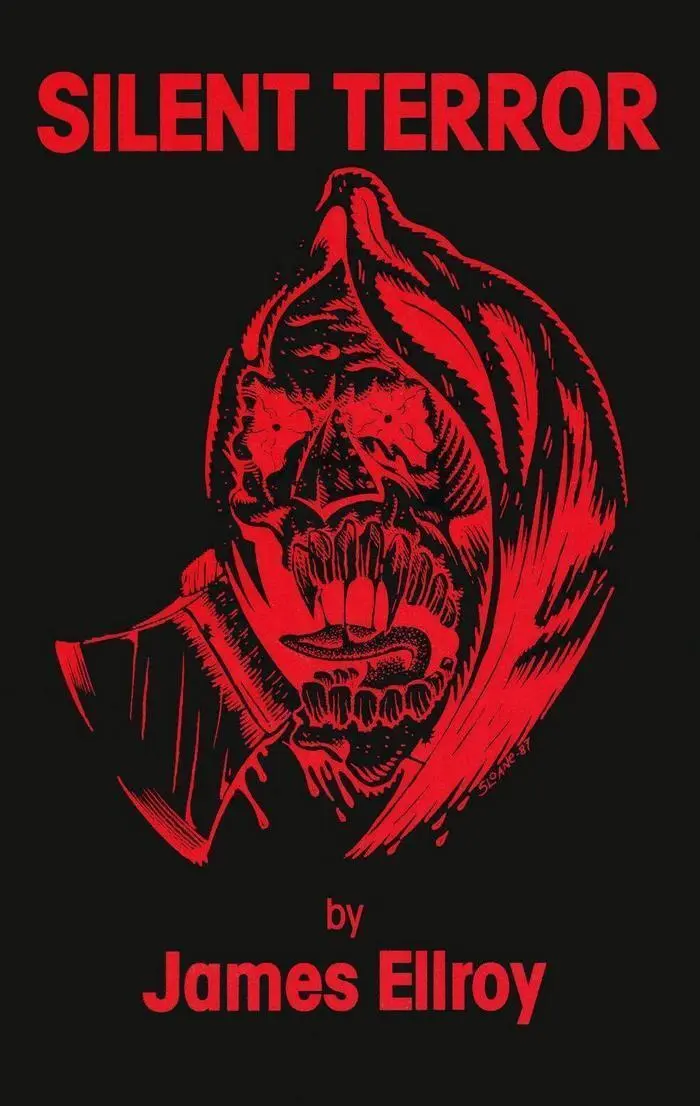
- Название:Silent Terror
- Автор:
- Издательство:Blood & Guts Press
- Жанр:
- Год:1987
- Город:Los Angeles
- ISBN:978-0-940941-00-7
- Рейтинг книги:5 / 5. Голосов: 1
-
Избранное:Добавить в избранное
- Отзывы:
-
Ваша оценка:
Silent Terror: краткое содержание, описание и аннотация
Предлагаем к чтению аннотацию, описание, краткое содержание или предисловие (зависит от того, что написал сам автор книги «Silent Terror»). Если вы не нашли необходимую информацию о книге — напишите в комментариях, мы постараемся отыскать её.
I clipped my self-sharpening, teflon-coated, brushed-steel axe and swung it at her neck. Her head was sheared cleanly off; blood burst from the cavity, her arms and legs twitched spastically, then her whole body crumpled to the floor. The force of my swing spun me around, and for one second my vision eclipsed the entire scene — blood spattered walls, the body shooting an arterial geyser out the neck, the heart still pumping in reflex...
Martin Plunkett has struck again.
Silent Terror — читать онлайн бесплатно полную книгу (весь текст) целиком
Ниже представлен текст книги, разбитый по страницам. Система сохранения места последней прочитанной страницы, позволяет с удобством читать онлайн бесплатно книгу «Silent Terror», без необходимости каждый раз заново искать на чём Вы остановились. Поставьте закладку, и сможете в любой момент перейти на страницу, на которой закончили чтение.
Интервал:
Закладка:
“Are they the ones...?”
“That’s right.”
“What do — did they look like?”
“She was a foxy brunette, about five-six, nice tits. You like tits?”
“Come on, Officer.”
“Okay, what about Steve Sifakis? Five-eleven, one-ninety, reddish brown hair with muttonchop sideburns. He was supposed to be hung like a mule. You dig big cocks?”
“Just my own.” I heard the two cops in the kitchen laugh, and turned around to look at them. One man was shaking his head and drawing a finger across his throat, the gesture obviously intended for Necktie. Turning back, I said, “Can we wrap this up? I have to go to work.”
“We may damn well wrap you up, Plunkett,” Necktie said slowly.
I went in for the kill, knowing I could outgame any machine in captivity. “This is getting old, so why don’t I wrap this up? Since I didn’t kill anybody, why don’t we all hotfoot it down to the station. You hit me with a lie-detector test, I pass it, you cut me loose. What do you say?”
Necktie looked past me to the leader cop. I resisted the urge to watch their signals, and concentrated on the stain that gave the cop his impromptu name. I had just decided it was chili when Necktie said, “Did you see anybody on the street when you came home Monday night?”
I considered my “victory” question for a moment, then said, “No.”
“Hear any strange noises?”
“No.”
“See any unfamiliar vehicles?”
“No.”
“Ever fuck Jill Eversall or score grass from Steve Sifakis?”
I gave Necktie a look of contempt that would have wilted the Pope. “Come on, man.”
“No, you come on. Answer my question.”
“All right. No, I never fucked Jill Eversall or scored grass from Steve Sifakis.”
One of the cops behind me cleared his throat; Necktie squared his shoulders and said, “We may be back.” The leader cop said “Stay clean” as he walked past me to the door, and the other one winked.
Of course they never came back, and I spent the next several weeks enjoying my anonymous fame as the “Richmond Ripper,” an appelation bestowed on me by an Examiner reporter. “Business as usual” were my watchwords, and I imagined myself under twenty-four-hour surveillance, my every move being scrutinized by equally anonymous forces anxious to bring me down. The conscious cultivation of paranoia kept me coming home at night when I wanted to be on the street listening to people talk about me; it kept me going to university job boards, searching out work, when I wanted to be spending the money I had hoarded on guns. It would not let me collect newspaper clippings on my crime, nor would it let me do what I most wanted to do — move on to other cities and see how they affected me. The regimen boiled down to asceticism in place of celebration, and the only thing emotionally satisfying about it was that I knew it was making me stronger.
Ten days after the killings, I found another “Heavy Labor” job — weeding an entire hillside on the edge of the U.C.-Berkeley campus. The work was tedious — exacerbated by the fact that I didn’t need the money — and eavesdropping on students’ conversations made me angry: Watergate and Nixon’s recent resignation were their favorite topics, and when they deigned to talk about me, I was dismissed as a “psycho” or “sick puppy.” I decided that on October 2, a month to the day from the murders, I would celebrate.
The time passed slowly.
I worked on the hillside, listened to students talk and read newspapers on my lunch hour. Reading the papers was like being dangled on an ego string. Articles comparing me to the Manson Family, “only smarter,” felt like yanks into the clouds; paragraphs attributing my murders to the “Zodiac” killer — a mystic psychopath who sent lurid communiques to the police — felt like being flung to the dirt. Eight straight days of no print space was the complete abandonment of a mother hurling an unwanted child into a garbage heap.
Nights were the slowest to pass.
On my way home, I would sometimes see cops rousting long-haired youths, and I would know, somehow, that I had been the catalyst of that minor chaos. Cutting a street-swath through people in my van was satisfying, because I knew they knew of my actions. But at home, in my cocoon of caution, there was only me. And though “you are a murderer, Martin,” was now my identity, I had not yet decided to stay yanked in the clouds through continuous killing.
By October 2, the Richmond Ripper case was stale media bread, and my instincts told me that the police had gone on to matters of more urgent priority. Logic joined my heart in telling me to celebrate, and I did.
It took me an entire day and night to find what I wanted, and the four-hundred-dollar price tag was infinitesimal compared to the effort of talking out of the side of my mouth to a long succession of South San Francisco hoodlums, exchanging “pedigrees” and criminal amenities, then going on a half-dozen wild-goose chases before connecting with a retired pawnshop broker looking to liquidate “hot stock.” The ultimate transaction was quick and effortless, and I was the unlawful owner of a brand-new, never-registered, untraceable Colt .357 magnum “Python” model revolver.
Now I had two talismans — one handcrafted, the other earned. At home I brought them together, threaded cylinder to muzzle. They fit perfectly, adding a tactile weight to my new identity. On my way to work the next morning I bought a box of hollow-point ammunition, and with the loaded and silencered hand cannon under my shirt, I dug weeds out of the soft dirt until dusk. Then, framed by dormitory lights and a starry night, I practiced.
Muzzle flash, recoil, the dull thuds of the silencer; slapping sounds as the bullets tore into the spade-furrowed dirt. Cordite and soil in my nostrils, and headlights from passing cars on the road above me momentarily illuminating the craters made by individual shots. My right wrist aching from the magnum’s internal combustion; emptying the spent shells into my pocket after every sixth explosion; reloading in the dark and firing, firing, firing until my box of hollow points was empty and the hillside smelled like a battlefield sans blood. Then the drive home, trembling inside, anxious to hit the open highway and just go.
But going was, at that point, inimical to business as usual, which meant “stay.” So I did stay, finishing my weeding job, but continuing at U.C.-Berkeley as a backup custodian, sweeping and mopping on the regular crew members’ staggered days off. I set my go day as Thanksgiving, November 24, and continued to live on the cheap, allowing myself one luxury: ammunition.
So as not to arouse suspicion by repeated purchases of single boxes, I drove to San Jose and bought a gross of them, a total of 7,200 rounds. I secreted the box in a heavily wooded area near the Berkeley side of the Bay Bridge, and every night after work I fired at imaginary targets on the water. Each muzzle burst/recoil/silencer thud/wave kick brought me closer to go, but I still didn’t know what it meant.
I found out the day before my departure.
My homemade silencer was virtually destroyed from overuse, so I drove to South San Francisco to find the pawnshop dealer who had sold me the Python, to see if he had connections who could sell me a professional replacement. The man smiled as I made my request, took a picture of saving ships from his wall and twirled the dial of the safe behind it. Within moments I was screwing a C.I.A. “Black Beauty” suppressor to the muzzle of my magnum and handing over five hundred dollars as payment. More than satisfied, I tucked the gun into my waistband, covered it with my shirttail and walked outside to my van. Seeing a coin-operated news rack filled with Chronicle s, I walked over to buy one, hoping for a back-page mention along the lines of “still no clues in Richmond Ripper case.” I was about to feed the machine my fifteen cents when I noticed a poster tacked to the telephone pole beside the rack.
Читать дальшеИнтервал:
Закладка:
Похожие книги на «Silent Terror»
Представляем Вашему вниманию похожие книги на «Silent Terror» списком для выбора. Мы отобрали схожую по названию и смыслу литературу в надежде предоставить читателям больше вариантов отыскать новые, интересные, ещё непрочитанные произведения.







Обсуждение, отзывы о книге «Silent Terror» и просто собственные мнения читателей. Оставьте ваши комментарии, напишите, что Вы думаете о произведении, его смысле или главных героях. Укажите что конкретно понравилось, а что нет, и почему Вы так считаете.