Lee Child - One Shot
Здесь есть возможность читать онлайн «Lee Child - One Shot» весь текст электронной книги совершенно бесплатно (целиком полную версию без сокращений). В некоторых случаях можно слушать аудио, скачать через торрент в формате fb2 и присутствует краткое содержание. Жанр: Триллер, на английском языке. Описание произведения, (предисловие) а так же отзывы посетителей доступны на портале библиотеки ЛибКат.
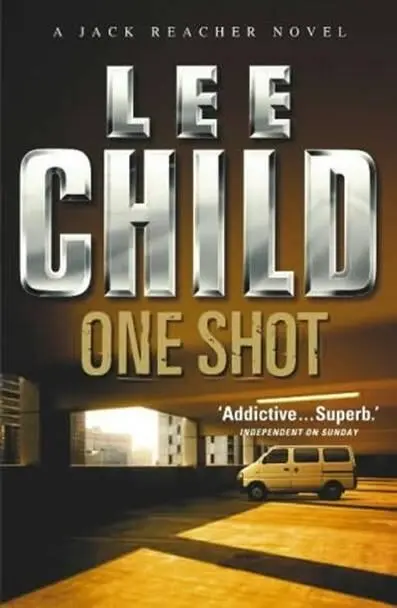
- Название:One Shot
- Автор:
- Жанр:
- Год:неизвестен
- ISBN:нет данных
- Рейтинг книги:4 / 5. Голосов: 1
-
Избранное:Добавить в избранное
- Отзывы:
-
Ваша оценка:
One Shot: краткое содержание, описание и аннотация
Предлагаем к чтению аннотацию, описание, краткое содержание или предисловие (зависит от того, что написал сам автор книги «One Shot»). Если вы не нашли необходимую информацию о книге — напишите в комментариях, мы постараемся отыскать её.
One Shot — читать онлайн бесплатно полную книгу (весь текст) целиком
Ниже представлен текст книги, разбитый по страницам. Система сохранения места последней прочитанной страницы, позволяет с удобством читать онлайн бесплатно книгу «One Shot», без необходимости каждый раз заново искать на чём Вы остановились. Поставьте закладку, и сможете в любой момент перейти на страницу, на которой закончили чтение.
Интервал:
Закладка:
“I would say we do.”
“Me too. But Helen needs to swallow that. She needs to agree. But she’s got that guy standing over her all the time, turning her head. I know her. She’s not going to suck it up until he’s out of the picture.”
“I don’t see what I can do.”
“I want you to bring him in.”
“I can’t,” Emerson said. “Not without a complaint.”
Rodin went quiet.
“Well, keep an eye on him,” he said. “He spits on the sidewalk, I want you to bring him in and do something to him.”
“This isn’t the Wild West,” Emerson said. “I can’t run him out of town.”
“An arrest might be enough. We need something that breaks the spell. He’s pushing Helen where she doesn’t want to go. I know her. On her own she’ll give Barr up, no question.”
Linsky was in pain on the way back to his car. An hour on his feet was about all he could take. A long time ago the bones in his spine had been methodically cracked with an engineer’s ball-peen hammer, one after the other, starting with the coccyx and moving upward through all the lower vertebrae, and not in rapid sequence. Generally one bone had been allowed to heal before the next was broken. When the last had healed, they had started over again. Playing the xylophone, they had called it. Playing scales. Ultimately he had lost count of how many scales they had played on him.
But he never spoke of it. Worse had happened to the Zec.
The Cadillac had a soft seat and it was a relief to get in. It had a quiet motor and a gentle ride and a nice radio. Cadillacs were the kind of things that made America such a wonderful place, along with the trusting population and the hamstrung police departments. Linsky had spent time in several different countries and there was no question in his mind about which was the most satisfactory. Elsewhere he had walked or run or crawled through dirt or hauled carts and sleds by hand. Now he drove a Cadillac.
He drove it to the Zec’s house, which stood eight miles north and west of town, next to his stone-crushing plant. The plant was a forty-year-old industrial facility built on a rich limestone seam that had been discovered under farmland. The house was a big fancy palace built a hundred years ago, when the landscape was still unspoiled, for a rich dry-goods merchant. It was bourgeois and affected in every way, but it was a comfortable house in the same way that the Cadillac was a comfortable car. Best of all it stood alone in the center of many acres of flat land. Once there had been beautiful gardens, but the Zec had razed the trees and leveled the shrubberies to create a completely flat and open vista all around. There were no fences, because how could the Zec bear to live another day behind wire? For the same reason there were no extra locks, no bolts, no bars. The openness was the Zec’s gift to himself. But it was also excellent security in its own right. There were surveillance cameras. Nobody could approach the house undetected. By day visitors were clearly visible at least two hundred yards away, and after dark night-vision enhancement picked them up only a little closer.
Linsky parked and eased himself out of the car. The night was quiet. The stone-crushing plant shut down at seven every evening and sat brooding and silent until dawn. Linsky glanced in its direction and walked toward the house. The front door opened before he got near it. Warm light spilled out and he saw that Vladimir himself had come down to welcome him, which meant that Chenko had to be there too, upstairs, which meant that the Zec had assembled all his top boys, which meant that the Zec was worried.
Linsky took a breath, but he walked inside without a moment’s hesitation. After all, what could be done to him that hadn’t been done to him before? It was different for Vladimir and Chenko, but for men with Linsky’s age and experience nothing was entirely unimaginable anymore.
Vladimir said nothing. Just closed the door again and followed Linsky upstairs. It was a three-story house. The first floor was used for nothing at all, except surveillance. All the rooms were completely empty, except one that had four TV screens on a long table, showing wide-angle views north, east, south, and west. Sokolov would be in there, watching them. Or Raskin. They alternated twelve-hour shifts. The second floor of the house had a kitchen, a dining room, a living room, and an office. The third floor had bedrooms and bathrooms. The second floor was where all the business was done.
Linsky could hear the Zec’s voice from the living room, calling him. He went straight in without knocking. The Zec was in an armchair with a glass of tea clamped between his palms. Chenko was sprawled on a sofa. Vladimir pushed in behind Linsky and sat down next to Chenko. Linsky stood still and waited.
“Sit, Grigor,” the Zec said. “Nobody’s upset at you. It was the boy’s failure.”
Linsky nodded and sat down in an armchair, a little closer to the Zec than Chenko was. That maintained the hierarchy in the proper order. The Zec was eighty, and Linsky himself was more than sixty. Chenko and Vladimir were both in their forties, important men for sure, but comparative youngsters. They didn’t have the history that the Zec and Linsky shared. Not even close.
“Tea?” the Zec asked in Russian.
“Please,” Linsky said.
“Chenko,” the Zec said. “Bring Grigor a glass of tea.”
Linsky smiled inside. Chenko being made to serve him tea was a statement of the greatest importance. And he noted that Chenko did it with no unwillingness. He just got up out of his slouch and went out to the kitchen and came back in with a glass of tea on a small silver tray. Chenko was a very small man, short, wiry, no bulk at all. He had coarse black hair that stuck up in all directions even though he kept it cropped short. Vladimir was different. Vladimir was very tall and heavy and blond. Unbelievably strong. It was entirely possible that Vladimir had German genes somewhere in his background. Perhaps his grandmother had picked them up back in 1941, like germs.
“We’ve been talking,” the Zec said.
“And?” Linsky said.
“We have to confront the fact that we made a mistake. Just one, but it could prove irksome.”
“The cone,” Linsky said.
“Obviously Barr isn’t on tape placing it,” the Zec said.
“Obviously.”
“But will it be a problem?”
“Your opinion?” Linsky asked politely.
“Significance is in the eye of the beholder,” the Zec said. “The detective Emerson and the DA Rodin won’t care about it. It’s a minor detail, one they won’t feel inclined to pursue. Why would they? They’re not looking to trip themselves up. And no case is ever a hundred percent perfect. They know that. So they’ll write it off as an inexplicable loose end. They might even convince themselves that Barr used a different vehicle.”
“But?”
“But it’s still a loose end. If the soldier tugs on it, something might unravel.”
“The evidence against Barr is indisputable.”
The Zec nodded. “That’s true.”
“So won’t that be enough for them?”
“Certainly it would have been. But it’s possible that Barr no longer exists. Not in the sense that he’s a legal entity accessible to their jurisprudence. He has permanent retrograde amnesia. It’s possible that Rodin won’t be able to put him on trial. If so, Rodin will be extremely frustrated about that. He’ll be expected to seek a consolation prize. And if the consolation prize were eventually to assume a higher profile than Barr himself, how could Rodin turn it down?”
Linsky sipped his tea. It was hot and sweet.
“All this from a videotape?” he said.
“It depends entirely on the soldier,” the Zec said. “It depends on his tenacity and his imagination.”
Читать дальшеИнтервал:
Закладка:
Похожие книги на «One Shot»
Представляем Вашему вниманию похожие книги на «One Shot» списком для выбора. Мы отобрали схожую по названию и смыслу литературу в надежде предоставить читателям больше вариантов отыскать новые, интересные, ещё непрочитанные произведения.



Обсуждение, отзывы о книге «One Shot» и просто собственные мнения читателей. Оставьте ваши комментарии, напишите, что Вы думаете о произведении, его смысле или главных героях. Укажите что конкретно понравилось, а что нет, и почему Вы так считаете.