Dan Simmons - The Terror
Здесь есть возможность читать онлайн «Dan Simmons - The Terror» весь текст электронной книги совершенно бесплатно (целиком полную версию без сокращений). В некоторых случаях можно слушать аудио, скачать через торрент в формате fb2 и присутствует краткое содержание. Жанр: Триллер, на английском языке. Описание произведения, (предисловие) а так же отзывы посетителей доступны на портале библиотеки ЛибКат.
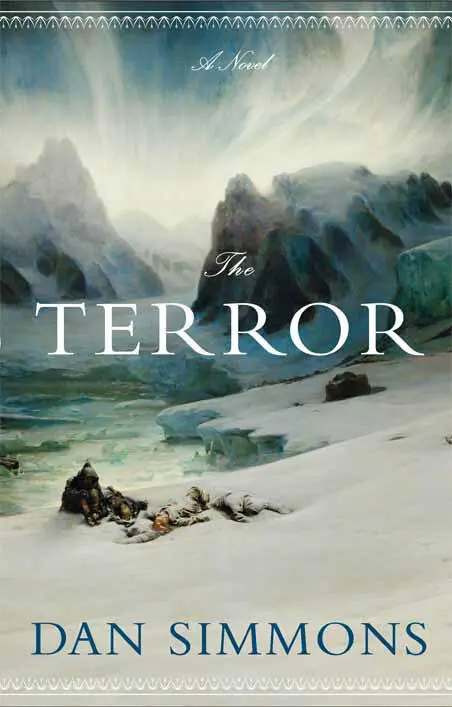
- Название:The Terror
- Автор:
- Жанр:
- Год:неизвестен
- ISBN:нет данных
- Рейтинг книги:3 / 5. Голосов: 1
-
Избранное:Добавить в избранное
- Отзывы:
-
Ваша оценка:
The Terror: краткое содержание, описание и аннотация
Предлагаем к чтению аннотацию, описание, краткое содержание или предисловие (зависит от того, что написал сам автор книги «The Terror»). Если вы не нашли необходимую информацию о книге — напишите в комментариях, мы постараемся отыскать её.
The Terror — читать онлайн бесплатно полную книгу (весь текст) целиком
Ниже представлен текст книги, разбитый по страницам. Система сохранения места последней прочитанной страницы, позволяет с удобством читать онлайн бесплатно книгу «The Terror», без необходимости каждый раз заново искать на чём Вы остановились. Поставьте закладку, и сможете в любой момент перейти на страницу, на которой закончили чтение.
Интервал:
Закладка:
Handford was attempting to retrieve his weapon in the snow with fingers that had obviously gone numb with cold.
“Where the hell are your mittens and gloves, man?” snapped Blanky.
Handford’s teeth were chattering too wildly for him to respond.
Blanky set his own weapon down, brushed the seaman’s arms aside, and lifted the man’s shotgun. He made sure the single barrel was not blocked with snow, then broke the breech and handed the weapon back to Handford. Blanky finally had to tuck it under the other man’s arm so he could cradle it with his two frozen hands. Setting his own shotgun under his left arm where he could shift it quickly, Blanky fumbled a shell out of his greatcoat pocket, loaded Handford’s shotgun, and clicked it shut for the man. “If anything larger than Leys or me comes out of that pile,” he said, almost shouting into Handford’s ear because of the wind roar, “aim and pull that trigger if you have to use your fucking teeth to do it.”
Handford managed a nod.
“I’m going forward to find Leys and help him open the forward hatch,” said Blanky. Nothing seemed to be moving downhill toward the bow amid the dark jumble of frozen canvas, dislodged snow, broken spars, and tumbled crates.
“I can’t…,” began Handford.
“Just stay where you are,” snapped Blanky. He set the lantern down next to the terrified man. “Don’t shoot me when I come back with Leys or I swear to God my ghost will haunt you ’til you die, John Handford.”
Handford’s pale blob of a face nodded again.
Blanky started toward the bow. After a dozen steps, he was beyond the glow of the lantern but his night vision did not return. The hard particles of snow struck his face like pellets. Above him, the rising wind howled in what little rigging and shrouds they’d left in place during the endless winter. It was so dark here that Blanky had to carry the shotgun in his left hand – his still-mittened hand – while feeling along the ice-encrusted railing with his right hand. As far as he could tell, the mainmast spar here on the forward side of the mast had also collapsed.
“Leys!” he shouted.
Something very large and vaguely white in the hurtling snow lumbered out of the heap of debris and stopped him in his tracks. The Ice Master couldn’t tell if the thing was a white bear or a tattooed demon or if it was ten feet in front of him or thirty feet away in the dark, but he knew that it had completely blocked his progress toward the bow.
Then the thing reared up on its hind legs.
Blanky could see only the mass of it – he sensed the dark bulk of it mostly through the amount of blowing snow it blocked – but he knew it was huge. The tiny triangular head, if that was a head up there in the darkness, rose higher than the space where the spars had been. There seemed to be two holes punched into that pale triangle of a head – eyes? – but they were at least fourteen feet above the deck.
Impossible , thought Thomas Blanky.
It moved toward him.
Blanky shifted the shotgun to his right hand, jammed the stock against his shoulder, steadied it with his mittened left hand, and fired.
The flash and explosion of sparks from the barrel gave the Ice Master a half-second’s glimpse of the black, dead, emotionless eyes of a shark staring into him – no, not a shark’s eyes at all, he realized a second later as the retinal afterimage of the blast blinded him, but two ebony circles far more frighteningly malevolent and intelligent than even a shark’s black-circle gaze – but also the pitiless stare of a predator that sees you only as food. And these bottomless black-hole eyes were far above him, set on shoulders wider than Blanky’s arms could spread, and were coming closer as the looming shape surged forward.
Blanky threw the useless shotgun at the thing – there was no time at all to reload – and leapt for the man lines.
Only four decades of experience at sea allowed the Ice Master to know, in the dark and storm and without even attempting to look, exactly where the icy man lines would be. He caught them with the crooked fingers of his mittenless right hand, flung his legs up, found the cross ropes with his flailing boots, pulled off his left mitten with his teeth, and began clambering upward while hanging almost upside down on the inside of the inward-slanting lines.
Six inches beneath his arse and legs, something cleaved the air with the power of a two-ton battering ram swinging at full extension. Blanky heard three thick vertical ropes of the man lines rip, tear… impossible!… and swing inward, almost throwing Blanky down to the deck.
He hung on. Flinging his left leg around the outside of those lines remaining taut, he found purchase on the icy rope and began climbing higher without pausing for a second. Thomas Blanky moved like the monkey he’d been as an unrated boy of twelve who thought the masts, sails, lines, and upperworks’ rigging of the three-masted warship on which he shipped had all been constructed by Her Majesty solely for his enjoyment.
He was twenty feet up now, approaching the level of the second spar – this one still set at the proper right angle to the length of the ship – when the thing below hit the base of the man-line rigging again, tearing wood and dowels and pins and ice and iron blocks completely free of the railing.
The web of climbing rope swung inward toward the mainmast. Blanky knew that the impact would knock him off and send him hurtling down into the thing’s arms and jaws. Still not able to see anything more than five feet away in the blowing dark, the Ice Master leapt for the shrouds.
His freezing fingers found the spar and its lines under them at the same instant one of his flailing feet caught a foot line. This shroud-line scuttle was best done barefoot, Blanky knew, but not tonight.
He heaved himself up over the second spar, more than twenty-five feet above the deck, and clung to the icy oak with legs and arms both, the way a terrified rider would cling to the body of a horse, wildly sliding his feet along the ice-hard shroud to find more purchase on the slippery shroud lines.
Normally, even in the darkness, wind, snow, and hail, any decent sailor could scramble another sixty feet higher into the upperworks and rigging here until he reached the mainmast crosstrees, from which point he could hurl down insults at his stymied pursuer like a chimpanzee in a tall tree throwing down fruit or feces from a point of perfect safety. But there were no upperworks or high rigging on HMS Terror this December night. There was no point of perfect safety up here when fleeing from something so powerful it could smash a main spar. And there was no upperworks rigging to which a man could flee.
A year ago September, Blanky had helped Crozier and Harry Peglar, Captain of the Foretop, as they prepared Terror for her wintering-over for the second time this expedition. It was not an easy job, nor one without danger. The yards and running rigging were struck down and stored below. Then the topgallant masts and topmasts were carefully struck down – carefully because a slip with winch or block or sudden tangle of tackle could have sent the heavy masts hurtling down through the top deck, lower deck, orlop deck, and hull bottom like a massive spear piercing wicker armour. Ships had sunk from such missteps while striking down upper masts. But if they’d remained up, too many tons of ice would accumulate during the endless winter. The ice would have provided a constant barrage of missiles for the men on watch or other duty on the deck and rigging below, but the weight of it also could capsize a ship.
With only the three stumps of the lower masts remaining – a sight as ugly to a seaman as a triple-amputee human being might be to a painter of pictures – Blanky had helped supervise the loosening of all remaining shrouds and standing rigging; overly taut canvas and ropes simply could not bear the weight of so much snow and ice. Even Terror ’s boats – the two large whaleboats and two smaller cutters, as well as the captain’s skiff, pinnaces, jolly boats, and dinghies, ten in all – had been taken down, inverted, lashed, covered, and stored on the ice.
Читать дальшеИнтервал:
Закладка:
Похожие книги на «The Terror»
Представляем Вашему вниманию похожие книги на «The Terror» списком для выбора. Мы отобрали схожую по названию и смыслу литературу в надежде предоставить читателям больше вариантов отыскать новые, интересные, ещё непрочитанные произведения.









Обсуждение, отзывы о книге «The Terror» и просто собственные мнения читателей. Оставьте ваши комментарии, напишите, что Вы думаете о произведении, его смысле или главных героях. Укажите что конкретно понравилось, а что нет, и почему Вы так считаете.