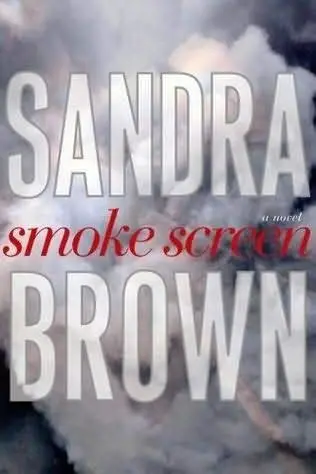
Sandra Brown - Smoke Screen
Здесь есть возможность читать онлайн «Sandra Brown - Smoke Screen» весь текст электронной книги совершенно бесплатно (целиком полную версию без сокращений). В некоторых случаях можно слушать аудио, скачать через торрент в формате fb2 и присутствует краткое содержание. Жанр: Триллер, на английском языке. Описание произведения, (предисловие) а так же отзывы посетителей доступны на портале библиотеки ЛибКат.
- Название:Smoke Screen
- Автор:
- Жанр:
- Год:неизвестен
- ISBN:нет данных
- Рейтинг книги:4 / 5. Голосов: 1
-
Избранное:Добавить в избранное
- Отзывы:
-
Ваша оценка:
Smoke Screen: краткое содержание, описание и аннотация
Предлагаем к чтению аннотацию, описание, краткое содержание или предисловие (зависит от того, что написал сам автор книги «Smoke Screen»). Если вы не нашли необходимую информацию о книге — напишите в комментариях, мы постараемся отыскать её.
When newswoman Britt Shelley wakes up to find herself in bed with Jay Burgess, a rising star detective in the Charleston PD, she remembers nothing of how she got there…or of how Jay wound up dead.
Handsome and hard-partying, Jay was a hero of the disastrous fire that five years earlier had destroyed Charleston 's police headquarters. The blaze left seven people dead, but the death toll would have been much higher if not for the bravery of Jay and three other city officials who risked their lives to lead others to safety.
Firefighter Raley Gannon, Jay's lifelong friend, was off-duty that day. Though he might not have been a front-line hero, he was assigned to lead the investigation into the cause of the fire. It was an investigation he never got to complete. Because on one calamitous night, Raley's world was shattered.
Scandalized, wronged by the people he trusted most, Raley was forced to surrender the woman he loved and the work to which he'd dedicated his life. For five years his resentment against the men who exploited their hero status to further their careers – and ruin his – had festered, but he was helpless to set things right.
That changes when he learns of Jay Burgess's shocking death and Britt Shelley's claim that she has no memory of her night with him. As the investigation into Jay's death intensifies, and suspicion against Britt Shelley mounts, Raley realizes that the newswoman, Jay's last sexual conquest, might be his only chance to get personal vindication – and justice for the seven victims of the police station fire.
But there are powerful men who don't want to address unanswered questions about the fire and who will go to any lengths to protect their reputations. As Raley and Britt discover more about what happened that fateful day, the more perilous their situation becomes, until they're not only chasing after the truth but running for their lives.
Friends are exposed as foes, heroes take on the taint of criminals, and no one can be trusted completely. A tale about audacious corruption – and those with the courage to expose it – Smoke Screen is Sandra Brown's most searing and intense novel yet.
Smoke Screen — читать онлайн бесплатно полную книгу (весь текст) целиком
Ниже представлен текст книги, разбитый по страницам. Система сохранения места последней прочитанной страницы, позволяет с удобством читать онлайн бесплатно книгу «Smoke Screen», без необходимости каждый раз заново искать на чём Вы остановились. Поставьте закладку, и сможете в любой момент перейти на страницу, на которой закончили чтение.
Интервал:
Закладка:
“I only saw the building as a pile of charred rubble,” she said. “But I understand that it was old. The department was mere months away from moving into new headquarters.”
“That’s right. The building was overcrowded, outdated, and in need of extensive repair. The insulation was old. There were holes in the ductwork. Old wood beams formed the infrastructure, and many were rotted. The wiring was faulty. It had a sprinkler system, but it was an antique, insufficient and unreliable on its best day. The day of the fire, it failed completely.
“But no one wanted to spend money on extensive repairs when the department would soon be vacating the place for the new facility. Repairs that were absolutely necessary were done hastily and sloppily. Band-Aids put on a massive hemorrhage. Unfortunately, all this was discovered during our inspection after the fire, not before. Even dust is flammable, and it had been accumulating in the structure since the turn of the last century. It was a disaster waiting to happen.”
“When the small trash can flame was sucked into the wall through the intake vent…”
Raley made a motion with his hands, indicating ignition. “It had a draft pulling it upward. It had more than enough flammable material and virtually nothing to impede its path through the walls. From the first spark, it was deadly.”
“Seven people,” she said, shaking her head sadly.
“Six.”
She gave him a sharp look. “What?”
“Six. Cleveland Jones didn’t die in the fire. He was dead before it started.”
Her lips parted in surprise. “How do you know?”
“Did you come across Jones’s autopsy report?”
“I did, yes. It’s here somewhere.” She shuffled through the documents scattered across the bed until she found that report and handed it to him. “It says his body was found on the floor of that locked room, curled inward, hands under the chin.”
“Which is typical. As a burning body dehydrates, the muscles contract and pull it into a fetal-like position. That doesn’t mean the victim burned to death. Cleveland Jones didn’t. His cause of death was blunt trauma to the head.”
He flipped over a few pages of the autopsy report to a page on which there was a diagram of a human male body. He pointed to the head, where the coroner had made markings. “Skull fractures. Both significant.”
Britt read out loud what the coroner had written. “Fatal.” She looked up at Raley. “A falling beam? Collapsing ceiling?”
He shook his head. “If that was the case, the fire would have been raging for some time. Jones’s lungs would have shown significant soot and smoke inhalation. There would have been a high level of carbon monoxide.” He held up the report. “That’s not what the ME found. As soon as he made these determinations, he called Brunner and told him that one of the victims was dead before the fire started. Brunner asked me to inform detectives that they had a possible homicide. I was to work with them on the investigation. That’s what I was doing when Jay called to invite me to his party.”
She exhaled deeply, readily seeing the import of that.
“As soon as I started asking questions about Jones and his arrest, I began to get the runaround. Jay claimed not to remember the details of Jones’s arrest. It wasn’t his case, he said, but he promised to find out what he could.
“Keep in mind that the PD was in chaos. Construction on the new building was still months away from completion, so they were working out of temporary headquarters. Jay’s procrastination made sense. Now, I see it as avoidance. He didn’t want me to know anything about Cleveland Jones, other than that he was the firebug. And that’s another thing. Jones had committed a wide range of crimes, but arson wasn’t one of them. I learned that from his rap sheet, which I had to obtain from the state.”
Tiredly, he rolled his shoulders. He was tempted to save some of this until tomorrow, but he knew Britt wouldn’t let him stop until she had the whole story, so he continued. “After repeated calls, Jay finally sent me a message through a PD secretary, telling me that Jones’s blows to the head had been sustained prior to his arrest. The arresting officers-never identified-didn’t realize how serious the injuries were until Jones began behaving irrationally while under interrogation.
“He was left alone while arrangements were being made to transfer him to the hospital. Apparently that’s when he started the fire. Jay’s message went on to say that he was sorry, that was all he knew, but he was checking into it and when he had further details he would get back to me. He didn’t, of course.”
“What about Brunner? After you were ousted, didn’t he pursue the matter of Jones’s death?”
“In the final report, he went with Jay’s explanation. The paperwork regarding Cleveland Jones’s arrest had been destroyed in the flames, so there was no documentation, but Jay was a hero, so Brunner didn’t doubt his word. You and the other media were so swept up in my story, so busy extolling the heroes, that the small footnote about Jones faded into obscurity. And anyway, he was the arsonist who’d caused death and destruction. Who cared how he’d died?”
“Brunner might now. If you went to him-”
“Can’t. He died. About six months after the fire. Cardiac arrest.”
“Oh.”
“In a way I’m glad he won’t be here to experience the shakedown. Whatever form it ultimately takes, a lot of blame would fall on him. I don’t think he was corrupt. A bit tired and lazy, maybe. Or just unwilling to rock the boat.”
She thought this over for several seconds, then said, “What about Cleveland Jones’s family?”
“A father. I called him, hoping to get some background information. The guy was hostile, said he didn’t want to talk about his wayward son. I stayed after him and finally wore him down. He agreed to meet with me. But when I got to his place, he wasn’t there. I went back several times. Called. Never could contact him again.”
“You know no more details than you did the night you went to the party.”
“No.”
“Did you ever learn why Jones was arrested?”
“Assault. Conveniently, no one could remember the nature of his crime, or where it was committed, or what time of day he was brought into the station. Amid all this hazy information, there was one fact of which everyone was absolutely certain: Jones’s fatal head injuries hadn’t been inflicted by anyone within the CPD.”
“Hmm. Just a tad suspicious.”
“You think?”
“Jay promised he’d have the arrest report to you by Monday.”
“It was an easy promise for him to make. He knew that by Sunday morning I’d have a dead girl in bed with me.”
He went to the window and parted the faded orange curtains, which matched the ugly carpet. Satisfied that no one was about to ambush them, he turned back into the room. “There was another unanswered question, and it was a dilly. How did Jones start the fire? With what? When he was arrested, his pockets would have been emptied, right?”
She shrugged. “He sneaked something past.”
“I’d buy that, except that no accelerants were found in that room.”
“They would have burned up.”
“Gasoline, kerosene leak into cracks and corners. It would have been detected even in that devastation. Anyway, Jones couldn’t have carted a gas can in there.”
“Matchbook?” she suggested. “Something that small would have been easy for him to conceal. In his sock or something. He could have lit one match, then thrown the book of them into the trash can, maybe saving some to light debris inside the air vent.”
Long before she finished, he was shaking his head. “No silica. It’s a compound found on match heads. It can withstand a fire. There was none.”
Читать дальшеИнтервал:
Закладка:
Похожие книги на «Smoke Screen»
Представляем Вашему вниманию похожие книги на «Smoke Screen» списком для выбора. Мы отобрали схожую по названию и смыслу литературу в надежде предоставить читателям больше вариантов отыскать новые, интересные, ещё непрочитанные произведения.









Обсуждение, отзывы о книге «Smoke Screen» и просто собственные мнения читателей. Оставьте ваши комментарии, напишите, что Вы думаете о произведении, его смысле или главных героях. Укажите что конкретно понравилось, а что нет, и почему Вы так считаете.