William Lashner - Bitter Truth
Здесь есть возможность читать онлайн «William Lashner - Bitter Truth» весь текст электронной книги совершенно бесплатно (целиком полную версию без сокращений). В некоторых случаях можно слушать аудио, скачать через торрент в формате fb2 и присутствует краткое содержание. Жанр: Триллер, на английском языке. Описание произведения, (предисловие) а так же отзывы посетителей доступны на портале библиотеки ЛибКат.
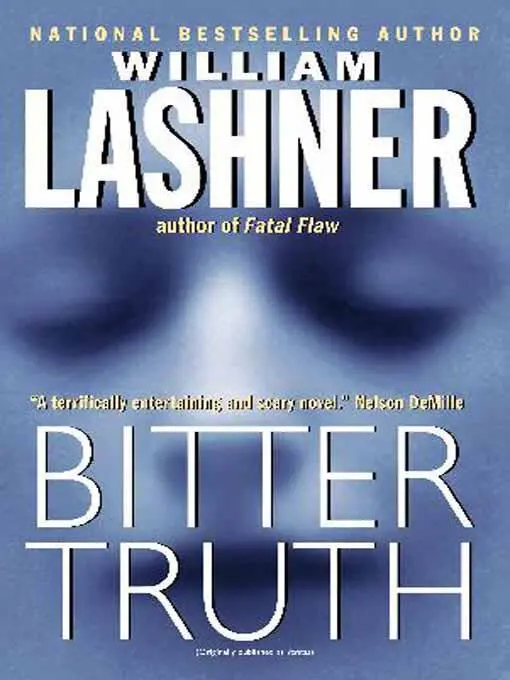
- Название:Bitter Truth
- Автор:
- Жанр:
- Год:неизвестен
- ISBN:нет данных
- Рейтинг книги:3 / 5. Голосов: 1
-
Избранное:Добавить в избранное
- Отзывы:
-
Ваша оценка:
Bitter Truth: краткое содержание, описание и аннотация
Предлагаем к чтению аннотацию, описание, краткое содержание или предисловие (зависит от того, что написал сам автор книги «Bitter Truth»). Если вы не нашли необходимую информацию о книге — напишите в комментариях, мы постараемся отыскать её.
Bitter Truth — читать онлайн бесплатно полную книгу (весь текст) целиком
Ниже представлен текст книги, разбитый по страницам. Система сохранения места последней прочитанной страницы, позволяет с удобством читать онлайн бесплатно книгу «Bitter Truth», без необходимости каждый раз заново искать на чём Вы остановились. Поставьте закладку, и сможете в любой момент перейти на страницу, на которой закончили чтение.
Интервал:
Закладка:
“You ever see this before?” I asked.
“No,” she said, backing away from it as if it were a cat. “Never.”
“I can’t believe there was something actually here.”
Staring, as if transfixed by the sight of that box, she said, “My grandmother put that there.”
“Looks like it.”
“Open it,” she said.
“I don’t think I can.”
“Knock it open,” she said. “Now.”
As I carefully laid the box on the ground I glanced up at her. She stared down at the box as if it were something alive that needed killing. I took a breath, raised the shovel, and slammed the edge into the lock. It held. I raised the shovel again and slammed it again, and then again, and each time the padlock jumped in its frame and then sat back again, whole and tightly shut. I went at it a few times more, waiting for the padlock to explode, but they don’t make things like they used to because they used to make them pretty damn well. The padlock held.
I swore as I swung futilely, the clangs of the shovel against the metal rising above the night calls of the crickets.
“You’re making too much noise,” she said.
I stopped, leaned over to gasp for air, turned my face to her. “You wanted me to open it. I don’t think asking it nicely to unlock itself is going to work.”
“You don’t have to be nasty.”
“We’ll take it with us,” I said. “You want me to fill in the hole?”
“Not yet,” she said. “There might be something else down there.”
“What else would be down there?”
“I don’t know, but we’ve gone this far.”
She took the shovel from me and hopped into the hole. She was trying harder now than before, as if some weakness of resolve had been strengthened by the sight of that box, by the knowledge that there were indeed secrets to be unearthed, but even so she was still making little progress. This far down the earth was hard-packed. I didn’t expect she’d find anything else, but it was boring just to watch.
“Let me try,” I said.
I stepped in the hole and took the shovel and ignored the pain in my hands as I went at it. A half an hour later my hair was wet with sweat, my tee shirt was soaked through, my hands were bleeding where the blisters had rubbed off. I was just about to give up when I jabbed the shovel into the earth and the ringing of the metal blade was strangely muffled. I tried it again and again heard the same soft sound.
“What’s that?” I said.
I cleared as much dirt as I could and saw a piece of something rising from the packed earth, something folded and soft. I looked up at her as she stood over me and I shrugged.
“It’s a piece of canvas or something,” she said. “It almost looks like a sail.”
“What’s it doing there?”
“Who knows,” she said.
I scraped some more around it and cleared the dirt away. A long ridge of a darkened fabric was rising from the floor of the pit.
“I’m going to pull it to see what it is,” I said.
The fabric was thick and still strong within my fingers. Pulling at it was like pulling at time itself. Nothing moved, nothing budged. I jerked and pulled and made no progress. I moved around to get a better grip and started yanking again. Nothing, no shift, no budge, nothing. Caroline jumped down and took hold and helped me pull, but there was still no movement, still nothing – and then something. The ridge of cloth lengthened, dirt started shifting. A dark smell, ancient and foul, slipped from the ground.
“It’s coming,” I said. We pulled hard and yanked again and more of the cloth started coming free.
“On the count of three,” I said as we both tightened our grips. “One, two, three.”
I put my weight into it and yanked back, pressing with my legs against the dirt, and Caroline did the same and suddenly the cloth gave and there was a cracking sound and we both fell flat onto our backs and that ancient ugly scent covered us like a noisome blanket.
Caroline was the first to scamper up and so I was still on my back when I heard her breath stop as if blocked by a chunk of half-chewed meat. I looked up at her. Her hands were pressed against her face and her eyes were screaming even though her throat was making not a sound.
I pulled myself to my feet and took hold of her and shook her until she started breathing once again. While she was gasping for air she pointed to the other side of the pit and I looked to where she was pointing and there I saw it, lit by the white light of the lantern, and my breath caught too.
A hand, its fingers outstretched, reaching out of the ground from among the folds of what looked now to be an old cloth coat, reaching up to the unblinking stars, a human hand but not one that had seen the softness of the sweet night sky for scores of years. It stuck out of the dirt, pointing up as if in accusation, and from the white light of the lantern came the gleam of a gold ring still riding a finger of bone, the flesh and muscle having long been devoured by the foul creeping life that prowls the loam for death.
The first thought that came to my mind upon seeing that skeleton hand with a ring on its finger was that maybe now it was time to call in my private investigator, Morris Kapustin.
Part 3. Faith
Those who set out to serve both God and Mammon soon discover there isn’t a God .
– LOGAN PEARSALL SMITH
30
Belize City to San Ignacio, Belize
WHAT HAD BEEN MERELYrumors of dark doings in the Reddman past were absolutely confirmed by our finding of the corpse with the gold ring behind Veritas. I was certain when we found it that the root of the evil from which redemption had been sought by Grammy Shaw was buried beneath the dead woman’s garden, but I was wrong. That death was an offshoot of some older, more primal crime, and only when that crime was discovered could we begin to unravel the mystery of what had murdered Jacqueline Shaw and threatened the destruction of all traces of the Reddman line. It was that discovery that led me, ultimately, to Belize, where a killer awaits.
I am sitting with my cases on the steps outside the guest house in Belize City, waiting for Canek Panti to take me to San Ignacio. Before me is a guard of low palms and then the unpaved road and then the Caribbean, turning from gray to a brilliant turquoise in the distance. It is five minutes after nine and already the sun is broiling. I look down both sides of Marine Parade but do not see my guide. Sweat is dripping down my shirt and I am thirsty, even though I drank an entire bottle of water at breakfast.
There is a grinding of gears and a hoot and the shaking sound of doubtful brakes. I look up and see Canek Panti leaping out of a battered brown Isuzu Trooper, rushing to grab hold of my bags. He is hatless today, wearing serious black shoes, a clean shirt, his work clothes, I suppose. His face is solemn. “I am sorry I am late, Victor,” says Canek.
“You’re right on time,” I say as I grab my briefcase and take it into the front seat with me. Canek hauls my suitcase into the rear and then jumps back up into the driver’s seat.
“You have a lot to see today,” he says.
“Well, let’s have at it. San Ignacio or bust.”
“Or bust what?”
“It’s an American expression. It means it’s time to go.”
“San Ignacio or we bust apart, then,” he says, nodding seriously, as he grinds the gears and the engine whines and the car shoots forward. He jerks the wheel to the left and the car takes a sharp leaning turn and we are now heading away from the Caribbean.
Canek honks the horn repeatedly on the narrow roads as he edges our way out of the city. He doesn’t talk, concentrating on his maneuvering, biting his lip as he works past the crowds, children wearing maroon or blue or white school uniforms, women with baskets of laundry on their heads, panhandlers and artisans, Rastafarians striding purposefully, thin men, in short sleeves and ties, riding to work on their too-small bicycles. Finally we reach a long narrow road lined with cemeteries. The ground around us is littered with shallow stone tombs, bleached white or dusty black, covered with crosses, guarded by little dogs staring at us impassively as we pass. Once past the cemeteries we begin to speed through the mangrove swamps that grow like a barrier around Belize City and onward along the Western Highway.
Читать дальшеИнтервал:
Закладка:
Похожие книги на «Bitter Truth»
Представляем Вашему вниманию похожие книги на «Bitter Truth» списком для выбора. Мы отобрали схожую по названию и смыслу литературу в надежде предоставить читателям больше вариантов отыскать новые, интересные, ещё непрочитанные произведения.








Обсуждение, отзывы о книге «Bitter Truth» и просто собственные мнения читателей. Оставьте ваши комментарии, напишите, что Вы думаете о произведении, его смысле или главных героях. Укажите что конкретно понравилось, а что нет, и почему Вы так считаете.