William Lashner - Bitter Truth
Здесь есть возможность читать онлайн «William Lashner - Bitter Truth» весь текст электронной книги совершенно бесплатно (целиком полную версию без сокращений). В некоторых случаях можно слушать аудио, скачать через торрент в формате fb2 и присутствует краткое содержание. Жанр: Триллер, на английском языке. Описание произведения, (предисловие) а так же отзывы посетителей доступны на портале библиотеки ЛибКат.
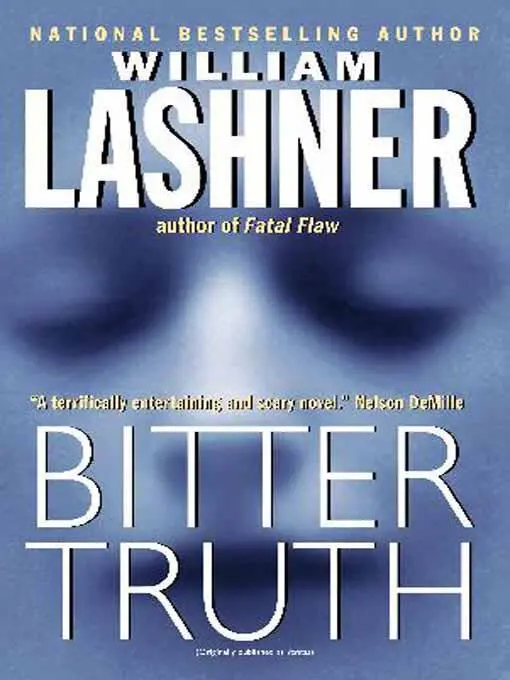
- Название:Bitter Truth
- Автор:
- Жанр:
- Год:неизвестен
- ISBN:нет данных
- Рейтинг книги:3 / 5. Голосов: 1
-
Избранное:Добавить в избранное
- Отзывы:
-
Ваша оценка:
Bitter Truth: краткое содержание, описание и аннотация
Предлагаем к чтению аннотацию, описание, краткое содержание или предисловие (зависит от того, что написал сам автор книги «Bitter Truth»). Если вы не нашли необходимую информацию о книге — напишите в комментариях, мы постараемся отыскать её.
Bitter Truth — читать онлайн бесплатно полную книгу (весь текст) целиком
Ниже представлен текст книги, разбитый по страницам. Система сохранения места последней прочитанной страницы, позволяет с удобством читать онлайн бесплатно книгу «Bitter Truth», без необходимости каждый раз заново искать на чём Вы остановились. Поставьте закладку, и сможете в любой момент перейти на страницу, на которой закончили чтение.
Интервал:
Закладка:
While he examined the photos I examined his eyes. I could see their gaze pass over the photos one after another and then stop at the picture in the bottom left-hand corner. He stared at it for a while and then moved his eyes around, as if to cover the tracks of his stare, but he had recognized the face in the bottom left-hand corner, just as I suspected he would. I had received the spread in discovery in one of my prior cases and that figure on the bottom left had a face you wouldn’t forget, dark, sculpted, Elvesine. A guy like Peckworth would never forget the likes of Peter Cressi or his freshly pressed brown uniform. I wondered if he had made him an offer for the uniform instantly upon seeing it on him.
Peckworth handed me back the spread. “I don’t recognize anyone.”
“You’re sure?”
“Perfectly. I’m sorry that you wasted so much of your time.” He reached for the phone console beside him and pressed a button. “Burford, Mr. Carl is ready to leave.”
“Who told you to change your story, Mr. Peckworth? That’s what I’m really interested in.”
“Burford will show you out.”
“Someone with power, I bet. You don’t seem the type to scare easy.”
“Have a good day, Mr. Carl.”
Just then the door behind me opened and Burford came in, smiling his smile, and behind Burford was some gnomelike creature in a blue, double-breasted suit. He was short and flat-faced and impossibly young, but with the shoulders of a bull. I must have been a foot and a half taller than he but he outweighed me by fifty pounds. Look in the dictionary under gunsel.
“Come, come, Mr. Carl,” said Burford. “It’s time to leave. I’m sure you have such important things to do today.”
I nodded and turned and made my careful unbalanced way across the great water mattress. When I reached the wraparound steps leading to the door I turned around again. “An operation like this, as strange as it would appear to authorities, must pay a hefty street tax. Probably cuts deeply into your profits.”
“Let’s go, Mr. Carl,” said Burford. “No time for nonsense. Time to leave. Everett, give Mr. Carl a hand.”
The gunsel skipped by Burford with an amazing grace and grabbed hold of my arm before I could grab it away. His grip was crushing.
“I might be able to do something about the tax,” I said. “I have certain contacts in the taxing authority that might be very grateful for your information.”
Everett gave a tug that nearly separated my arm from its socket and I was letting him pull me up and out of that room when Peckworth said, “Give us a minute.”
After Burford and Everett closed the door behind them, Peckworth asked me, “What could you do about it?”
“How much are you paying?”
“Too much.”
“If the information proves as valuable as I expect, I might be able to convince my contacts to reduce your tax substantially.”
“Is that so? And do we even know who is in charge after yesterday’s dance macabre on the expressway?”
“I’m betting the old bull holds his ground.”
“And if he does, and you get me the break you say you can get me, what do you get out of it?”
I was about to say nothing, but then realized that nothing wouldn’t satisfy the suspicions of a man like Peckworth. There had to be an angle to it for him to buy in. “I get twenty percent of the reduction.”
“That seems steep.”
“My normal contingency fee is a third, but I’m giving you a break out of the goodness of my heart.”
Peckworth nodded and said, “I understand.” They always know you have an angle when you say you’re doing something out of the goodness of your heart. “You must understand something, Mr. Carl. We don’t choose the things that give us pleasure in this life, we only choose whether or not to pursue them. I have chosen to pursue my pleasures and with the money I earn in my side enterprise I am able to do just that. But the life is more precarious than you can imagine and those thugs are killing my cash flow.”
“Well, that’s the deal,” I said. “Take it or leave it.”
He thought about it for a moment, I could tell, because his brow knitted.
“I had some visitors,” he said, finally. “Two men, one very well dressed, short and dapper. The other a stooge in an impossible maroon suit. They suggested that I was mistaken as to the date I saw the UPS man outside Miss Shaw’s door. After they explained it all to me I realized that I must have been.”
“Did they give you their names?”
“No, but they did give me the names of a few of my suppliers.”
“You mean from the auctions.”
“Yes.”
“And that troubled you.”
“Yes.”
“Let me guess,” I said. “Were these suppliers maybe under a certain legal age?”
“Never underestimate the delicate piquancy of the young, Mr. Carl.”
“So suddenly the entirety of your pleasure quotient was at risk.”
“Exactly, Mr. Carl. You’re very quick for a lawyer.”
“Any idea who these men were, or who they represented?”
“None, but I knew enough to step away. There is an aroma that follows particularly dangerous men.”
“And the stooge smelled bad, huh?”
“Not the stooge, Mr. Carl. They are a dime a dozen. Beside being monstrously strong, Everett is very loyal and can handle those that come my way with relative ease. It was the well-dressed man, extremely handsome, with even white teeth and groomed gray hair. There was something frightfully languorous about him, but even that languor couldn’t hide the scent of danger he carried.”
“What did he look like, an accountant?”
“Oh no, Mr. Carl. If he was anything he was a funeral director, but one who never had to worry about supply.” He leaned forward and said, “If your friends can lower my tax and take care of these men for me, Mr. Carl, you can take your full one third.”
“That’s very generous of you,” I said. I reached for the door and then stopped reaching and turned around. “Bottom left picture was your UPS guy, wasn’t it?”
“There was a brutality to his native good looks that I found unforgettable.”
“Mr. Peckworth, I hope you don’t mind my saying so, but for someone who has chosen to pursue his pleasures with such devotion, you don’t seem so very happy.”
“Mr. Carl,” he said, with a straight, stolid face, “I’m so happy I could burst.”
25
EVERETT LUGGED ME THROUGHthe apartment and spun me into the hallway. Burford blew me a kiss before he closed the door. A fond farewell, I’m sure, but I was glad to be left alone in the hallway. I didn’t take the elevator down, instead I went into the emergency exit. The stairwell was ill lit and smelled furry. The door hissed slowly shut on me. When I tried to open it again I discovered, as I had expected, that it was locked.
I started climbing up the stairwell, twisting around the landings as I rose. I tried each door on my ascent and discovered each to be locked, until the last. This one I opened, slowly, and found myself on the roof. It was flat and tarred, with assorted risers here and there, and a three-foot ledge all the way around. Scattered about were plastic lounge chairs, which I imagined were used by bare-chested sunbathers on hot summer afternoons. The knob on the outside of the door wouldn’t turn, but all those melanoma seekers would need a way to get back inside once the sun dimmed. I searched the floor and found a wooden wedge, well worn, which I jammed into the crack. With the door stuck open I stepped onto the roof.
I wasn’t really concerned with the roof of the Cambium. What I wanted to see were the surrounding roofs. The building fronted on the park and one side bordered on Nineteenth Street, as the road continued its way south after being interrupted by Rittenhouse Square. Behind the Cambium was a building three flights shorter, so that was probably out. But to the side opposite Nineteenth Street was another fancy-pantsed doorman building, whose roof was roughly the same level, separated only by a six-foot gap. The drop between the two was deadly enough, but six feet was not too long a jump for an athlete with a brave heart. Too long for me, of course, as I was no athlete, which I learned painfully enough in junior high gym class, and my heart was more timorous than brave, but not too long for a committed gunman out to kill an heiress, for my client Peter Cressi.
Читать дальшеИнтервал:
Закладка:
Похожие книги на «Bitter Truth»
Представляем Вашему вниманию похожие книги на «Bitter Truth» списком для выбора. Мы отобрали схожую по названию и смыслу литературу в надежде предоставить читателям больше вариантов отыскать новые, интересные, ещё непрочитанные произведения.



Обсуждение, отзывы о книге «Bitter Truth» и просто собственные мнения читателей. Оставьте ваши комментарии, напишите, что Вы думаете о произведении, его смысле или главных героях. Укажите что конкретно понравилось, а что нет, и почему Вы так считаете.