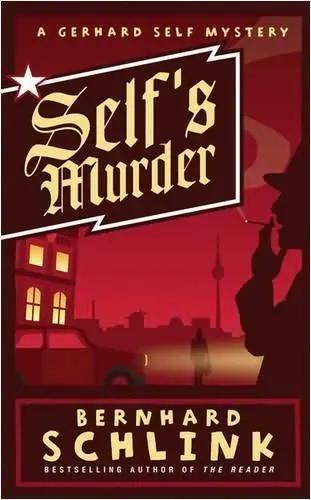
Bernhard Schlink - Self’s Murder
Здесь есть возможность читать онлайн «Bernhard Schlink - Self’s Murder» весь текст электронной книги совершенно бесплатно (целиком полную версию без сокращений). В некоторых случаях можно слушать аудио, скачать через торрент в формате fb2 и присутствует краткое содержание. Жанр: Триллер, на английском языке. Описание произведения, (предисловие) а так же отзывы посетителей доступны на портале библиотеки ЛибКат.
- Название:Self’s Murder
- Автор:
- Жанр:
- Год:неизвестен
- ISBN:нет данных
- Рейтинг книги:5 / 5. Голосов: 1
-
Избранное:Добавить в избранное
- Отзывы:
-
Ваша оценка:
Self’s Murder: краткое содержание, описание и аннотация
Предлагаем к чтению аннотацию, описание, краткое содержание или предисловие (зависит от того, что написал сам автор книги «Self’s Murder»). Если вы не нашли необходимую информацию о книге — напишите в комментариях, мы постараемся отыскать её.
When Gerhard Self happens upon one of the most intriguing cases of his career, he can't resist. From the start, the job is an unusual one: Herr Welker, partial owner of the German bank Weller and Welker desperately wants to write a history of his bank, but he has one problem – a silent partner, whose name does not appear anywhere in the bank's records. Welker wants Self to track this silent partner down. Shortly after he takes the job, Self is accosted by a man who frantically hands him a suitcase full of money and speeds off in a car, only to crash into a tree, dying instantly. Perplexed, but more determined than ever, Self follows the money. Soon he finds himself traveling to eastern Germany – shortly after the fall of communism – battling Nazi youth, and closing in on a money laundering ring with connections to the Russian mafia.
Self’s Murder — читать онлайн бесплатно полную книгу (весь текст) целиком
Ниже представлен текст книги, разбитый по страницам. Система сохранения места последней прочитанной страницы, позволяет с удобством читать онлайн бесплатно книгу «Self’s Murder», без необходимости каждый раз заново искать на чём Вы остановились. Поставьте закладку, и сможете в любой момент перейти на страницу, на которой закончили чтение.
Интервал:
Закладка:
Nägelsbach was waiting in his Audi inside the yard of the police station. I gave him the attaché case and he put it on the floor by the front seat. Then he helped me climb into the trunk. “My wife’s put a blanket in there-do you think you’ll manage?”
When he let me out at the airport parking lot at Neuostheim, he was certain nobody had followed him. He was also certain that nobody had seen me climb out of the trunk.
“Do you want me to come along with you?”
“Are you already at loose ends at home, with all that free time on your hands?”
“Not at all. I’ve been conscripted into cleaning up after yesterday’s party.” But he stood there, hesitant and somewhat despondent. “Well, then.”
A little later I was in the air, looking down at Mannheim, keeping my eyes peeled for beige Fiestas and blue Mercedes.
18 Fear of flying
The woman next to me was afraid of flying. She asked me to hold her hand, and I did. As we were taking off, I reassured her with the information that most airplane accidents occur not during takeoff but during landing. An hour and a half later, when our plane began to descend, I confessed that I had not been all that honest with her. The truth is that most airplane accidents do in fact occur during takeoff, not when the plane is landing. We had taken off quite a while ago, so she could sit back and relax. But she didn’t, and at Berlin Tempelhof she rushed off without so much as a good-bye.
I hadn’t been in Berlin since 1942, and I wouldn’t have been tempted to come if the fastest route to Cottbus hadn’t been by plane via Berlin. I knew that the five-story house in which I had grown up had been destroyed in 1945, along with all the neighboring houses, and replaced in the fifties by a six-story apartment block. My parents had died in the attack. Klara’s parents had moved out of their villa near Wannsee to a villa on Lake Starnberg shortly before the end of the war. The friends of my childhood and youth had dispersed in all directions. In the seventies we had a class reunion. I didn’t go. I don’t want to remember.
I found a cheap hotel at the intersection of Friedrichstrasse and Unter den Linden. As I stood by the window, looking down at the traffic, I got the urge to go out and take a look around and perhaps find a restaurant where the food tastes like it used to, like it did at home. I went to the Brandenburg Gate, saw the buildings rising on the Pariser Platz, the cranes towering into the skies. On the Potsdamer Platz they had sawed open the city’s torso and were conducting open heart surgery: floodlights, excavations, cranes, scaffolding, and building skeletons, sometimes already floor after floor with finished masonry, balconies, and windows. I walked on and recognized the Ministry of Aviation and the remains of the Anhalter train station, and on Tempelhofer Ufer the building where I had worked as a junior clerk for a lawyer. I avoided the street where I had been a child.
I didn’t find a restaurant whose food promised to taste the way it used to. But I found an Italian restaurant where the perch and the crème caramel were the way they ought to be, and the carafe of Sardinian white wine overshadowed all the Frascati, suave, or pinot grigios. I was content, asked where the nearest metro station was, and set out for my hotel.
I wanted to transfer at the Hallesches Tor, but as I got off the last car I came face-to-face with seven or eight young men with shaved heads, black jackets, and military boots, standing there as if they’d been waiting for me.
“Hey! Granddad!”
I wanted to keep going but they wouldn’t let me through, and when I tried to sidestep them they wouldn’t let me pass. They forced me back toward the outer edge of the platform. The metro line here crosses the Landwehr Canal like an elevated railway, and I could see the dark water beneath me.
“Where are you heading, Grandpa?”
On the opposite platform I saw some youths who were looking at us with interest. Otherwise the platforms were empty. “To my hotel and to bed.”
They laughed as if I’d just uttered the greatest one-liner. “To his hotel!” one of them hooted, leaning forward and slapping his thighs. “To bed!” Then he said: “You were there, right?”
“Where?”
“With the Führer, where else? Did you ever get to see him?”
I nodded.
“Give Grandpa some of your beer; he saw the Führer.” The leader of the pack nudged the young man next to him, and he offered me his can of beer.
“Thank you, but I’ve already drunk enough this evening.”
“Did you hear that? He got to see the Führer!” the leader announced to his pack; he also yelled it out to the youths on the opposite platform. Then he asked me: “And how did you greet him?”
“Come on, surely you know that.”
“Show me, Grandpa!”
“I don’t want to do that.”
“You don’t want to show us? Then do as I do!” He clicked his heels together, flung his right arm into the air, and yelled: “Heil Hitler!” The others didn’t utter a sound. He brought his arm down. “So?”
“I don’t want to.”
“You’d rather take a swim down there?”
“No, I just want to go-to my hotel, and to bed.”
This time nobody laughed. The leader came closer and I edged back until I felt the railing against my spine. He raised his hands and patted me down, as if he were searching for weapons. “You’re not wearing a life jacket, Grandpa. You might drown. If you get water in your nose-” With a jolt he jammed his index and middle fingers into my nostrils and pushed my head backward until I was at the point of losing my balance. “So?” He let go of me.
My nose was smarting. I was frightened. I couldn’t think fast enough: Should I play along? Would that be cleverer? Was that cowardly? Was it some sort of betrayal? Was this and what it symbolized worth getting hurt or getting pneumonia? They grabbed hold of me and I stuttered out a “Heil Hitler.” The leader of the pack told me to say it louder and I said it louder, and when he again said, “Louder!” and they let go of me, I stood on the platform and shouted as loud as I could: “Heil Hitler!”
Now they were laughing again and clapping. “Bravo, Granddad! Bravo!” But their leader shook his head silently until all the others fell silent and then said: “He didn’t raise his arm, though, did he? It doesn’t count without the arm.” They stared at him and then at me and then at him, and they understood before I did. They grabbed me by the arms and legs, hooted, and swung me back and forth-“one, two, three”-and as the metro came thundering into the station, they flung me over the railing into the canal. When I surfaced, I could still hear them hooting.
The stone embankment on the near side was too steep, but I made it to the other side and managed to climb onto the street across a wooden landing. Two taxis didn’t stop, but the third driver had plastic covers on his seats, so twenty minutes later I was back at my hotel and under a hot shower.
I hadn’t come to any great harm. The following morning, the side of my body that had hit the water was a single big bruise. I also had a runny nose and a slight fever. But my injury was elsewhere. I’d had a chance to make up for the wrongs I had done in the old days. And when does one ever get such a chance? But I’d done it wrong again.
19 Everything comes together
The Sorbian Cooperative Bank is on the old market square in Cottbus. I went inside and took a look around until I ran the risk of being noticed. Then I went to the teller and got 91.50 marks for the fifty-dollar bill I’d just purchased across the street at the Deutsche Bank for 99.50 marks.
It was like any other bank. The modern furnishings were of wood and steel, the walls covered with large abstract paintings. What was different was the life-sized wood relief of Hans Kleiner by the door, guarding the entrance. Also different was that Vera Soboda, the manager, had her desk right in the main hall, which was either a legacy of the Socialist past or state-of-the-art management and administration. If the woman sitting at the desk was Vera Soboda, then the Sorbian Cooperative Bank had a manager of middle years, somewhat plump, somewhat tough, more tractor driver on a Socialist farming cooperative than banker. But the staff going up to her from other desks interacted with her with such deference and speed that I concluded she must have given them the best of training.
Читать дальшеИнтервал:
Закладка:
Похожие книги на «Self’s Murder»
Представляем Вашему вниманию похожие книги на «Self’s Murder» списком для выбора. Мы отобрали схожую по названию и смыслу литературу в надежде предоставить читателям больше вариантов отыскать новые, интересные, ещё непрочитанные произведения.










Обсуждение, отзывы о книге «Self’s Murder» и просто собственные мнения читателей. Оставьте ваши комментарии, напишите, что Вы думаете о произведении, его смысле или главных героях. Укажите что конкретно понравилось, а что нет, и почему Вы так считаете.