Jonathan Kellerman - Monster
Здесь есть возможность читать онлайн «Jonathan Kellerman - Monster» весь текст электронной книги совершенно бесплатно (целиком полную версию без сокращений). В некоторых случаях можно слушать аудио, скачать через торрент в формате fb2 и присутствует краткое содержание. Жанр: Триллер, на английском языке. Описание произведения, (предисловие) а так же отзывы посетителей доступны на портале библиотеки ЛибКат.
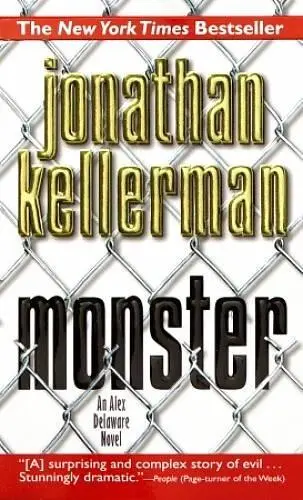
- Название:Monster
- Автор:
- Жанр:
- Год:неизвестен
- ISBN:нет данных
- Рейтинг книги:5 / 5. Голосов: 1
-
Избранное:Добавить в избранное
- Отзывы:
-
Ваша оценка:
Monster: краткое содержание, описание и аннотация
Предлагаем к чтению аннотацию, описание, краткое содержание или предисловие (зависит от того, что написал сам автор книги «Monster»). Если вы не нашли необходимую информацию о книге — напишите в комментариях, мы постараемся отыскать её.
As they slowly unravel the strands of their lies another, truly monstrous, character emerges: a man who gains his pleasure not from mere mutilattion and murder but from making his victims watch their own forthcoming death on film. And somehow he has control over some of the Claire Argent's patients, apparently securely behind bars.
In one of the most complex plots he has yet devised, Jonathan Kellerman has created a devastating mystery thriller.
Monster — читать онлайн бесплатно полную книгу (весь текст) целиком
Ниже представлен текст книги, разбитый по страницам. Система сохранения места последней прочитанной страницы, позволяет с удобством читать онлайн бесплатно книгу «Monster», без необходимости каждый раз заново искать на чём Вы остановились. Поставьте закладку, и сможете в любой момент перейти на страницу, на которой закончили чтение.
Интервал:
Закладка:
Itatani said, "Cat pee. I was able to scrub some of it off."
"What did it look like before you cleaned it?"
"A little darker."
Milo got up and walked along the back wall very slowly. Stopped a few feet down, wrote in his pad. Another splotch, smaller.
"What?" said Itatani.
Milo didn't answer.
"What?" Itatani repeated. "Oh-you don't- Oh, no…" For the first time, he was sweating.
Milo cell-phoned the crime-scene team, apologized to Itatani for the impending disruption, and asked him to stay clear of the garage. Then he got some yellow tape from the unmarked and stretched it across the driveway.
Itatani said, "Still looks like cat dirt to me," and went to sit in his Oldsmobile.
Milo and I walked over to the south-side neighbor. Another Spanish house, bright white. The mat in front of the door said
GO AWAY. Very loud classical music pounded through the walls. No response to the doorbell. Several hard knocks finally opened the door two inches, revealing one bright blue eye, a slice of white skin, a smudge of red mouth.
"What?" a cracked voice screeched.
Milo shouted back, "Police, ma'am!"
"Show me some I.D."
Milo held out the badge. The blue eye moved closer, pupil contracting as it confronted daylight.
"Closer," the voice demanded.
Milo put the badge right up against the crack. The blue eye blinked. Several seconds passed. The door opened.
The woman was short, skinny, at least eighty, with hair dyed crow-feather black and curled in Marie Antoinette ringlets that reminded me of blood sausages. A face powdered chalky added to the aging-courtesan look. She wore a black silk dressing gown spattered with gold stars, three strings of heavy amber beads around her neck, giant pearl drop earrings. The music in the background was assertive and heavy-Wagner or Bruckner or someone else a goose-stepper would've enjoyed. Cymbals crashed. The woman glared. Behind her was a huge white grand piano piled high with books.
"What do you want?" she screamed over a crescendo. Her voice was as pleasing as grit on glass.
"George Orson," said Milo. "Is it possible to turn the music down?"
Cursing under her breath, the woman slammed the door, opened it a minute later. The music was several notches lower, but still loud.
"Orson," she said. "Scumbag. What'd he do, kill someone?" Glancing to the left. Itatani had come out of his car and was standing on the lawn of the green house.
"Goddamn absentee landlords. Don't care who they rent to. So what'd that scumbag do?"
"That's what we're trying to find out, ma'am."
"That's a load of double-talk crap. What'd he doT' She slapped her hands against her hips. Silk whistled and the dressing gown parted at her neckline, revealing powdered wattle, a few inches of scrawny white chest, shiny sternal knobs protruding like ivory handles. Her lipstick was the color of arterial blood. "You want info from me, don't hand me any crap."
"Mr. Orson's suspected in some drug thefts, Mrs.-"
"Ms.," she said. "Sinclair. Ms. Marie Sinclair. Drugs. Big boo-hoo surprise. It's about time you guys caught on. The whole time that lowlife was here there'd be cars in and out, in and out, all hours of the night."
"Did you ever call the police?"
Marie Sinclair looked ready to hit him. "Jesus Almighty- only six times. Your so-called officers said they'd drive by. If they did, lot of good it accomplished."
Milo wrote. "What else did Orson do to disturb you, Ms. Sinclair?"
"Cars in and out, in and out wasn't enough. I'm trying to practice, and the headlights keep shining through the drapes. Right there." She pointed to her front window, covered with lace.
"Practice what, ma'am?" said Milo.
"Piano. I teach, give recitals." She flexed ten spidery white fingers. The nails were a matching red, but clipped short.
"I used to do radio work," she said. "Live radio-the old RKO studios. I knew Oscar Levant, what a lunatic-another dope fiend, but a genius. I was the first girl pianist for the Co-coanut Grove, played the Mocambo, did a party at Ira Gershwin's up on Roxbury Drive. Talk about stage fright- George and Ira listening. There were giants back then; now it's only mental midgets and-"
"Orson told Mr. Itatani he was a film director."
"Mr. Itawhosis"-she sneered-"doesn't give a damn who he rents to. After the scumbag moved out, I got stuck with two sloppy kids-real pigs-then a fag cosmetologist. Back when I bought this house-"
"When Orson lived here, did you ever see any filming next door?" said Milo.
"Yeah, he was Cecil B. DeMille-no, never. Just cars, in and out. I'm trying to practice and the damn headlights are glaring through like some kind of-"
"You practice at night, ma'am?"
"So what?" said Marie Sinclair. "That's against the law?"
"No, ma'am, I was just-"
"Look," she said. Her hands separated from her hips, clamped down again. "I'm a night person, as if it's any of your business. Just woke up, if it's any of your business. Comes from all those years of clubbing." She stepped onto the porch, advanced on Milo. "Nighttime's when it comes alive. Morning's for suckers. Morning people should be lined up and shot."
"So your basic complaint against Orson was all the traffic."
"Dope traffic. Those kinds of lowlifes, what was to stop someone from pulling out a gun? None of those idiots can shoot straight, you hear about all those colored and Mexican kids getting shot in drive-bys by accident. I could've been sitting in there playing Chopin, andpow!"
She squeezed her eyes shut, punched her forehead, jerked her head back. Black ringlets danced. When her eyes opened, they were hotter, brighter.
Milo said, "Did you ever get a good look at any of Orson's visitors?"
"Visitors. Hah. No, I didn't look. Didn't want to see, didn't want to know. The headlights were bad enough. You guys never did a damn thing about them. And don't tell me to turn the piano around, because it's a seven-foot-long Steinway and it won't fit in the room any other way."
"How many cars would there be on an average night, Ms. Sinclair?"
"Five, six, ten, who knows, I never counted. At least he was gone a lot."
"How often, ma'am?"
"A lot. Half the time. Maybe more. Thank God for small blessings."
"Did you ever talk to him directly about the headlights?"
"What?" she screeched. "And have him pull out a gun?
We're talking scumbag. That's your job. I called you. Lot of good it did."
"Mr. Itatani said Orson had a machine shop out in the garage. Did you ever hear sawing or drilling?"
"No," she said. "Why? You think he was manufacturing the dope back there? Or cutting it, whatever it is they do to that crap?"
"Anything's possible, ma'am."
"No, it's not," she snapped. "Very few things are possible. Oscar Levant will not rise from the dead. That cancer in George Gershwin's genius brain will not- Never mind, why am I wasting my time. No, I never heard drilling or sawing. I never heard a damn thing, because during the day, when I sleep, I keep the music on-got one of those programmable CD players, six discs that keep repeating. It's the only way I can go to sleep, block out the damn birds, cars, all that daytime crap. It was when I was up that he bothered me. The lights. Trying to get through my scales and the damn headlights are shining right on the keyboard."
Milo nodded. "I understand, ma'am."
"Sure you do," she said. "Too late, too little."
"Anything else you can tell us?"
"That's it. Didn't know I was going to be tested."
Milo showed her Claire's picture. "Ever see her with Orson?"
"Nope," she said. "She looks like a schoolteacher. Is she the one he killed?"
The crime-scene crew arrived ten minutes later. Itatani sat in his Oldsmobile, looking miserable. Marie Sinclair had gone back inside her house, but a few other neighbors had emerged. Milo asked them questions. I followed as he walked up and down the block, knocking on doors. No new revelations. If George Orson had been running a dope house, Marie Sinclair had been the only one to notice.
Читать дальшеИнтервал:
Закладка:
Похожие книги на «Monster»
Представляем Вашему вниманию похожие книги на «Monster» списком для выбора. Мы отобрали схожую по названию и смыслу литературу в надежде предоставить читателям больше вариантов отыскать новые, интересные, ещё непрочитанные произведения.






Обсуждение, отзывы о книге «Monster» и просто собственные мнения читателей. Оставьте ваши комментарии, напишите, что Вы думаете о произведении, его смысле или главных героях. Укажите что конкретно понравилось, а что нет, и почему Вы так считаете.