Jonathan Kellerman - Monster
Здесь есть возможность читать онлайн «Jonathan Kellerman - Monster» весь текст электронной книги совершенно бесплатно (целиком полную версию без сокращений). В некоторых случаях можно слушать аудио, скачать через торрент в формате fb2 и присутствует краткое содержание. Жанр: Триллер, на английском языке. Описание произведения, (предисловие) а так же отзывы посетителей доступны на портале библиотеки ЛибКат.
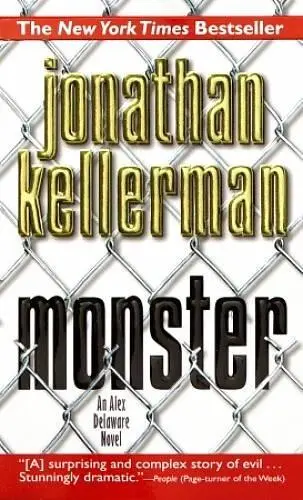
- Название:Monster
- Автор:
- Жанр:
- Год:неизвестен
- ISBN:нет данных
- Рейтинг книги:5 / 5. Голосов: 1
-
Избранное:Добавить в избранное
- Отзывы:
-
Ваша оценка:
Monster: краткое содержание, описание и аннотация
Предлагаем к чтению аннотацию, описание, краткое содержание или предисловие (зависит от того, что написал сам автор книги «Monster»). Если вы не нашли необходимую информацию о книге — напишите в комментариях, мы постараемся отыскать её.
As they slowly unravel the strands of their lies another, truly monstrous, character emerges: a man who gains his pleasure not from mere mutilattion and murder but from making his victims watch their own forthcoming death on film. And somehow he has control over some of the Claire Argent's patients, apparently securely behind bars.
In one of the most complex plots he has yet devised, Jonathan Kellerman has created a devastating mystery thriller.
Monster — читать онлайн бесплатно полную книгу (весь текст) целиком
Ниже представлен текст книги, разбитый по страницам. Система сохранения места последней прочитанной страницы, позволяет с удобством читать онлайн бесплатно книгу «Monster», без необходимости каждый раз заново искать на чём Вы остановились. Поставьте закладку, и сможете в любой момент перейти на страницу, на которой закончили чтение.
Интервал:
Закладка:
The suspect, Denton Ray Argent, 19, was found crouching near the furnace, still clutching the murder weapons and drenched with blood. Argent, who lived with his parents and a younger sister three doors down from the Brownlees, was termed odd and reclusive, a high school dropout whose personality had changed several years before.
"He was around fourteen when it started," said a woman who declined to be identified. "Even before then, he wasn 't very social-quiet, but the whole family was, they kept to themselves. But when he got to be a teenager he stopped taking care of himself, real sloppy. You 'd see him walking around, talking to himself, waving his hands around. We all knew he was strange, but no one thought it would ever come to this."
Reports that Denton Argent had worked briefly as a gardener for the Brownlees have not been confirmed. Argent was taken into custody at central jail, pending booking and further investigation.
Plugging Denton Argent's name into the computer pulled up several more stories that reiterated the crime. Then nothing for a month until a page-three item appeared:
FAMILY KILLER COMMITTED TO HOSPITAL
Alleged mass murderer Denton Argent has been judged legally insane and incapable of assisting in his own defense by three court-appointed psychiatrists. Argent, accused of slaying Mr. and Mrs. James Brownlee and their two small children in a homicidal spree that shocked the quiet Oakland neighborhood and the entire city, was evaluated by doctors hired by both the prosecution and the defense.
"It was pretty clear," said Assistant District Attorney Stanley Rosenfield, assigned to prosecute the case. "Argent is severely schizophrenic and completely out of touch with reality. No purpose would be served by going to trial."
Rosenfield went on to say that Argent would be committed to a state hospital for an indefinite term. "Should he ever regain competence, we 'II haul him into court."
One week after that:
MURDERER'S FAMILY STAYS PUT-AND MUM
The parents of family killer Denton Argent have no plans to move from the Chestnut Street address where, three doors from their well-kept house, their son slew all four members of a neighboring family.
Argent, 19, was judged criminally insane and incapable of assisting in his own defense against the charges of murdering James and Margaret Brownlee and their two young children, Carlo, 5, and Cooper, 2. His parents, Robert Ray and Ernestine Argent, owners of a local gift shop, have refused to talk to the press, but neighbors report they have stated an unwillingness to "run from what Denton did." Their shop was closed for three weeks but later reopened, reportedly with a substantial drop in business. But the general attitude of the neighborhood was charitable.
"These are decent people," said another neighbor, Roland Danniger. "Everyone knew Denton was strange, and maybe they should ve tried to help him more, but how could they know he 'd turn violent? If I feel sorry for anyone, it's the little sister; she's always kept to herself, now you don't see her at all."
The reference was to Argent s younger sister, Claire, 12, who was removed from her public junior high school and is reportedly being tutored at home.
Five years later:
FAMILY SLAYER DIES IN ASYLUM
Mass murderer Denton Argent has died of a brain seizure in his cell at Farview State Hospital, authorities reported today.
Argent, 24, murdered an entire family during a bloody early-morning spree five years ago. Judged mentally incompetent, he was committed to the state facility, where he has resided without incident. The seizure, possibly due to a previously undiagnosed epileptic condition, or to psychiatric medication, caused Argent to pass out in his locked cell and to choke on his own vomit in the middle of the night. His body was discovered the following morning. Hospital authorities report no suspicions of foul play.
"Harry never found out until Claire's last year in grad school," Eileen Racano had said. "It was a shock. The poor thing, carrying around that burden."
"How did she bring it up?"
"It was during the time she was working on the final draft of her dissertation. That's always a stressful period, but Claire seemed to be having an especially hard time. Writing didn't come easily to her, and she was a perfectionist, drafting and redrafting. She told Harry she was worried she wouldn't pass her orals."
"Was that a possibility?" I said.
"Her grades were excellent and her research was solid."
I let the unspoken "but" hang in the air.
"Back then, personality issues couldn't be considered," she said.
"So your husband had reservations about Claire's temperament."
"He thought she was a sweet young woman, but… too closed off. And to grow up under a shadow like that… Harry felt she hadn't dealt with it. That it might cause her problems later on."
"How exactly did he find out?" I said.
"One morning he came in to the lab and found Claire there. She looked awful; it was obvious she'd been working all night. Harry asked her why she was driving herself so hard and she said she had no choice, she just had to pass, it was everything she'd lived for. Harry said something to the effect that there was life beyond grad school, and Claire fell apart- sobbing, telling Harry he didn't understand, that becoming a psychologist was all that mattered, she had to do it, she wasn't like other students. Harry asked in what way, and that's when it all came out. Afterward, Claire just curled up on the chair, shivering. Harry gave her his jacket and stayed with her until she calmed down. After that, we reached out more to Claire, invited her over for dinner. Harry was a wonderful man. His students all loved him. Years after he went emeritus, we'd still get letters and cards and visits. Not from Claire, though. After that one episode, she closed up, refused to talk about it. Harry couldn't demand that she receive therapy, but he suggested it strongly. Claire promised she would, but she never confirmed that she had."
"So she passed her exams, received her doctorate, and went her own way."
"Believe me," she said, "it troubled Harry. He even debated holding her up-he was in real conflict, Dr. Delaware. But ethically, he knew he couldn't. Claire had fulfilled all the requirements for graduation, and he felt she'd never trust anyone again if he went public with her story. The funny thing was, at her orals, she was the picture of confidence. Charming, in control, as if nothing had ever happened. Harry chose to take that as a sign that she'd gotten help. But once she had her degree in hand, she shut us out completely. Even after she received the fellowship right here at Case Medical School we never heard from her. A year later, we heard she got a job in Los Angeles. Harry said, 'Claire's going off to the Wild West.' The whole incident bothered him. He wondered if he should've been more forceful in getting her to deal with the guilt."
"She felt guilty about what her brother had done?"
"Unjustified guilt, but yes, that's the way Harry saw it, and his insights were almost always correct. He saw neuropsy-chology as an escape for Claire. Testing, numbers, lab work, no need to get into feelings. He wondered if she'd ever leave the field, and now you tell me she did."
"Her brother died of a seizure," I said. "Did your husband wonder if Claire's career choice might have been related to her seeking an organic basis for Denton's crimes?"
"That, too. But he worried that someday that defense would crumble. Because she wouldn't find any simple answers, might grow disillusioned. Harry was a neuropsycholo-gist himself, but he was also a master psychotherapist. Along with his alcoholism research, he worked with MADD, treating the families of drunk-driving victims. He tried to teach his students the value of maintaining emotional balance."
Читать дальшеИнтервал:
Закладка:
Похожие книги на «Monster»
Представляем Вашему вниманию похожие книги на «Monster» списком для выбора. Мы отобрали схожую по названию и смыслу литературу в надежде предоставить читателям больше вариантов отыскать новые, интересные, ещё непрочитанные произведения.






Обсуждение, отзывы о книге «Monster» и просто собственные мнения читателей. Оставьте ваши комментарии, напишите, что Вы думаете о произведении, его смысле или главных героях. Укажите что конкретно понравилось, а что нет, и почему Вы так считаете.