Robin Cook - Critical
Здесь есть возможность читать онлайн «Robin Cook - Critical» весь текст электронной книги совершенно бесплатно (целиком полную версию без сокращений). В некоторых случаях можно слушать аудио, скачать через торрент в формате fb2 и присутствует краткое содержание. Жанр: Триллер, на английском языке. Описание произведения, (предисловие) а так же отзывы посетителей доступны на портале библиотеки ЛибКат.
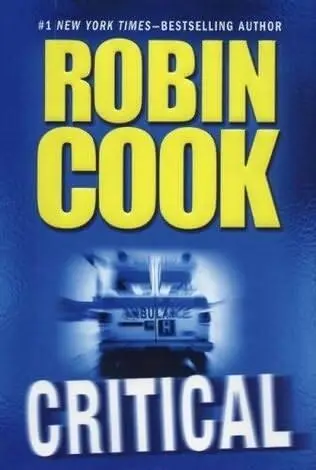
- Название:Critical
- Автор:
- Жанр:
- Год:неизвестен
- ISBN:нет данных
- Рейтинг книги:3 / 5. Голосов: 1
-
Избранное:Добавить в избранное
- Отзывы:
-
Ваша оценка:
Critical: краткое содержание, описание и аннотация
Предлагаем к чтению аннотацию, описание, краткое содержание или предисловие (зависит от того, что написал сам автор книги «Critical»). Если вы не нашли необходимую информацию о книге — напишите в комментариях, мы постараемся отыскать её.
Then a surge of drug-resistant staph infections in all three hospitals devastates Angela's carefully constructed world. Not only do the infections result in patient deaths, but the fatalities also cause stock prices to tumble, leaving market analysts wondering if Angela will be able to hold her empire together.
New York City medical examiners Laurie Montgomery and Jack Stapleton are naturally intrigued by the uptick in staph-related post-procedure deaths. Aside from their own professional curiosity, there's a personal stake as well: Laurie and Jack are newly married, and Jack is facing surgery to repair a torn ligament at Angels Orthopedic Hospital. Despite Jack's protests, Laurie can't help investigating-opening a Pandora's box of corporate intrigue that threatens not just her livelihood, but her life with Jack as well.
Critical — читать онлайн бесплатно полную книгу (весь текст) целиком
Ниже представлен текст книги, разбитый по страницам. Система сохранения места последней прочитанной страницы, позволяет с удобством читать онлайн бесплатно книгу «Critical», без необходимости каждый раз заново искать на чём Вы остановились. Поставьте закладку, и сможете в любой момент перейти на страницу, на которой закончили чтение.
Интервал:
Закладка:
Dr. Flanagan and Dr. Ravelo turned and walked back to the central desk, where they got Ramona Torres's chart to write their final notes.
"Do you think we should have done anything differently?" Dr. Ravelo asked as they took seats side by side.
Dr. Flanagan shook his head. "We followed the newer protocol to a T, so I don't think so. Hell, we gave her everything we've got, including the activated protein C and corticosteroids. Equally as important, you changed the antibiotics the instant we knew we were again dealing with MRSA, so we can be confident we had the right cocktail. And remember her APACHE II score was off the charts when she arrived, so we didn't have much to work with."
"Why can't we get Angels hospitals to send these patients sooner?"
"That's a damn good question. What I'm guessing is these patients' infections develop just too damn quickly postsurgery. I mean, this woman was operated on just this morning at seven-thirty a.m. In her chart, it says the first nonspecific symptoms started a little after four p.m. That's one hell of a rapid course."
"With all the nasty toxins potentially at staphylococcus's disposal, it's understandable. I'd be willing to put some money on this patient's bug to have the Panton-Valentine leukocidin, or PVL, gene."
"Does it surprise you that the Angels hospitals are having so many MRSA cases?" Dr. Flanagan asked.
"Yes and no. Staph is the most common surgical site pathogen, and whereas MRSA comprised only two percent back in the nineteen seventies, today it is sixty percent and rising all the time."
"Actually, what bothers me most about these cases is the whole specialty hospital dilemma. They don't have the resources for this kind of case, and they have to outsource it. In fact, in one specialty hospital, I think it was also an orthopedic hospital, a patient had a heart attack. And you know how they dealt with it?"
"No."
"They called nine-one-one."
"You are kidding!" Dr. Ravelo blurted in total disbelief.
"They didn't have any doctors on duty. Can you believe it?"
"Did the patient survive?"
"I don't think so."
"That's a travesty."
"I agree, but what can you do? Are you aware of the specialty hospital debate in general?"
"I know a little about it, I suppose. It's one of the advantages of being in academic medicine. We don't have to get so involved in various private-sector squabbles."
"I would not be so sure. It might eventually influence our salaries. The biggest problem most people see in these private specialty hospitals is that they are only interested in the cream of the patients: i.e., the healthy, well-insured who come in to have a quick procedure and then are out. It's really a moneymaking machine, because they get paid the same as the university gets paid, but because they don't have ICUs like ours or an ER like ours, which are not moneymakers, their costs are significantly less."
"I heard the government had a moratorium against them for a while. Was that the reason?"
"No," Dr. Flanagan said. "The government was against them for a time, actually from late 2003 to late 2006, because the specialty hospitals involve some level of physician ownership to guarantee a continual flow of patients. There is an existing ban in Medicare law for physicians to refer patients to medical service organizations in which they have ownership interest, like imaging centers or clinical laboratories or the like. But there is a loophole as far as a whole hospital is concerned. Ownership in that situation was not banned because it was thought that in a whole hospital, there would be little risk of a conflict of interest."
"But a specialty hospital is not a whole hospital!" Dr. Ravelo said indignantly. "They only do a very limited number of services."
"Exactly! Yet it is by claiming they are a whole hospital that they are taking advantage of the loophole."
"Why was the moratorium lifted then?"
"I haven't the foggiest idea. There were a number of hearing on the issue in which all these points were clearly raised. Most people familiar with the debate, who'd either attended the hearings or read about them, thought for sure the moratorium should be sustained and actually strengthened because the existing moratorium was only against new specialty hospitals getting Medicare provider numbers, which are necessary for reimbursement."
"What happened?"
"Suddenly, the moratorium was lifted with little explanation. My guess is that it was a behind-the-scenes lobby competition with the lobbyists from the AMA pitted against the lobbyists for the AHA, or American Hospital Association, and the FAH, or Federation of American Hospitals. I guess the doctors spent more money than the hospital admin groups."
"That's awful. Everything comes down to money. I'm embarrassed for our profession."
"Well, it's not all bad. Patients generally like specialty hospitals, and for routine procedures, they are certainly more comfortable.
"Maybe we should ask Ramona Torres," Dr. Ravelo said. "Maybe she'd have an opinion about which is best: a specialty hospital and its comforts or a truly full-service hospital. If she'd been here from the start, from our statistics, she would have had a significantly higher chance of surviving her infection."
"Good point," Dr. Flanagan said. "A very good point."
16
"Hey, asshole!" Carlo called while giving Brennan's shoulder a sudden forceful shake.
Brennan, who'd fallen asleep and had slowly slipped down in his seat until his knees were pressing against the dash, overreacted to being awakened so roughly by sitting bolt upright. Frantically, he searched the immediate area outside the windshield for a beast or foe. As soon as he heard Carlo begin to chuckle in the darkness of the car's interior, he became oriented to time, place, and person. And just when he was about to say he'd had quite enough of Carlo for one night, Carlo pointed out something beyond the windshield.
"I think our charges are returning to port," Carlo said. "Front and center!" He'd spent a year and a half in the armed forces before earning a dishonorable discharge. He'd hated the regimented experience, but he still indulged in the phraseology on occasion.
Brennan had to squint into the distance beyond the pier. A sliver of a moon had arisen over the New York City skyline, throwing a limpid line of reflections toward them across the Hudson River. Brennan and Carlo were still in Carlo's Denali parked high on the hill at the very back of the marina's parking lot, waiting for Franco and Angelo's return.
"I don't see them," Brennan said. Hardly had the words escaped his mouth before a sizable yacht silently slipped through the moon's reflection. "Okay. I see a boat. How do you know it's them?"
"How many boats have we seen go in and out tonight?"
"You still don't know it's them," Brennan said, as he raised his binoculars. With the magnification, the boat looked ghostly as it slipped through the mist suspended over the water's surface. "Aren't they supposed to have some lights on?"
"How do I know?"
"What are we going to do?"
"We're going to sit here and watch them leave and see if they are still accompanied by the young lady. Then we are going to take a look at their boat."
It seemed to take forever as the boat backed into its slip and Franco and Angelo made it secure. When it was finally done, the two men walked along the pier toward dry land.
Carlo put down his window. Even from the distance, Carlo and Brennan could hear that Franco and Angelo were carrying on as if they'd been to a party. They were laughing as they climbed into Franco's finned Cadillac, slammed the doors, and drove away.
"It must have been quite a boat ride."
"At the girl's expense," Carlo commented as he started the car. "What a couple of pigs."
Читать дальшеИнтервал:
Закладка:
Похожие книги на «Critical»
Представляем Вашему вниманию похожие книги на «Critical» списком для выбора. Мы отобрали схожую по названию и смыслу литературу в надежде предоставить читателям больше вариантов отыскать новые, интересные, ещё непрочитанные произведения.

Обсуждение, отзывы о книге «Critical» и просто собственные мнения читателей. Оставьте ваши комментарии, напишите, что Вы думаете о произведении, его смысле или главных героях. Укажите что конкретно понравилось, а что нет, и почему Вы так считаете.