Jonathan Kellerman - Therapy
Здесь есть возможность читать онлайн «Jonathan Kellerman - Therapy» весь текст электронной книги совершенно бесплатно (целиком полную версию без сокращений). В некоторых случаях можно слушать аудио, скачать через торрент в формате fb2 и присутствует краткое содержание. Жанр: Триллер, на английском языке. Описание произведения, (предисловие) а так же отзывы посетителей доступны на портале библиотеки ЛибКат.
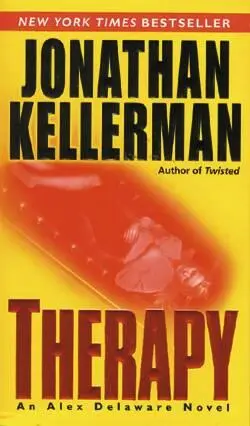
- Название:Therapy
- Автор:
- Жанр:
- Год:неизвестен
- ISBN:нет данных
- Рейтинг книги:3 / 5. Голосов: 1
-
Избранное:Добавить в избранное
- Отзывы:
-
Ваша оценка:
Therapy: краткое содержание, описание и аннотация
Предлагаем к чтению аннотацию, описание, краткое содержание или предисловие (зависит от того, что написал сам автор книги «Therapy»). Если вы не нашли необходимую информацию о книге — напишите в комментариях, мы постараемся отыскать её.
Therapy — читать онлайн бесплатно полную книгу (весь текст) целиком
Ниже представлен текст книги, разбитый по страницам. Система сохранения места последней прочитанной страницы, позволяет с удобством читать онлайн бесплатно книгу «Therapy», без необходимости каждый раз заново искать на чём Вы остановились. Поставьте закладку, и сможете в любой момент перейти на страницу, на которой закончили чтение.
Интервал:
Закладка:
“The first thing that comes to mind,” I said, “is basic fraud- overbilling insurance or the state. The easiest target would be the state- some kind of government contract. Sonny would know how to work that angle. He gets the government to finance his halfway houses and his senior citizen housing. He claims the halfway houses were Mary Lou and Larsen’s idea. Maybe that’s true, but if owning halfways helped plug Sonny into a subsidized treatment plan, that would appeal to his business sense.”
“Therapy for cons,” he said.
“A built-in supply of patients. Patients they could bill for whether or not they treated them because who’s going to complain?”
“Sonny and Mary Lou and Larsen. And Gavin saw some kind of staff meeting.”
“Gavin didn’t copy down Gull’s license number,” I said. “So maybe Gull missed the meeting. Or he wasn’t involved. He’s got personal problems, and he sweats too much. If I were setting up a slick criminal enterprise, I’d view him as a poor risk.”
“I’d still like to know why Gavin ditched him as a therapist.” He paced some more. “For a guy like Sonny to get involved in a scam, it would have to be big money.”
“Maybe not,” I said. “Sonny claims he’s not into accumulating stuff. That seems to be true, meaning he’s turned on by the game- the process of making money.”
“Soaking the government.”
“Or Sonny did figure out a way to make some serious money. He claims he was holding the ground floor open until Koppel and the others decided about group therapy. If they were setting up some sort of parolee treatment that brought in big bucks, that would justify leaving the Charitable Planning suite vacant. I got into the space, yesterday. They were cleaning the carpets, and I was able to walk in. Empty, except for a small office for Sonny and a big room with some folding chairs. Why would Sonny need chairs if all he did was come in and sign checks? But they’d be useful if someone checked and you were claiming to be running groups. Of course if the person checking was your pal, you wouldn’t need to put up much of a front.”
“Bennett Hacker,” he said. “There’s some deal with the parole board, and Hacker’s the overseer.”
“A guy in Hacker’s position could also supply names in return for kickback. And Raymond Degussa, being a wily, dominant con- someone who pulled off robberies using intimidation alone- could convince the patients to cooperate.”
“Headshrinking for parolees,” he said. “Something like that could really bring in serious money?”
“If there were enough parolees,” I said. “Let’s do the math. Private practice group therapy can run between fifty and a hundred bucks an hour. Medi-Cal reimburses for much less- fifteen, twenty. But there are all sorts of other things you can bill Medi-Cal for. Individual treatment, initial intakes, follow-ups, testing, case conferences-”
“Case conferences. As in getting together, after hours, at the building. How much does Medi-Cal pay for that?”
“Thirty-six bucks for thirty minutes. If these people have hooked on to some supplemental program that adds to the Medi-Cal billing- something Sonny wangled- the fee could be substantially higher. But let’s be conservative and assume the core is group therapy at twenty dollars per patient per session. I saw at least two dozen folding chairs. If they’re running groups of twenty- or claiming to be- each group session would bring in four hundred bucks an hour. Running six groups a day five times a week would bring in twelve thousand dollars. That alone would be six hundred grand a year. Add more patients, toss in additional fees, and it could get interesting. Especially if you’re not really doing any work.”
“Millions,” he said.
“It’s not inconceivable.”
“Each con gets daily group therapy… how many groups could you justify for a single patient?”
“If you’ve set up an immersion model, you could treat him all day.”
“What, like that deal where you sat all day and some guy yelled at you for being weak-willed and wouldn’t let you pee?”
“Est, Synanon,” I said. “There’s plenty of precedent, particularly with substance abuse. A case could be made for immersion for cons, because the aim would be large-scale change on several dimensions. The answer to an inquiring skeptic would be that it was still cheaper than keeping them in prison. And that if it really straightened them out, it was a giant money saver .”
“Mary Lou and her rehab kick,” he said. “Going on the radio- she and Larsen.” He laughed. “The government pays to shrink bad guys. I’m in the wrong business. So are you, for that matter.”
I said, “How many parolees live in Sonny’s halfway houses?”
“Three houses? I’d guess a couple of hundred.”
“Think about the income if everyone got on the rolls.”
“Hundred bucks a week per con- five grand a year. A million bucks for group therapy alone.”
“Plus other charges.”
“The only problem is, Alex, a couple of shrinks doing all that billing would be physically impossible.”
“So they use assistants- peer counselors. And they flat out lie, bill for sessions that never take place.”
“Peer counselors,” he said. “Meaning other cons? Yeah, that’s the rage, ain’t it? Ex-gangbangers become facilitators, junkies go the drug-counseling route. That’s where a guy like Degussa would fit in… scumbags doing therapy. That’s legal?”
“Everything depends how the contract’s written,” I said. “And a guy like Sonny would know how to get a juicy government contract.”
“All those billable hours,” he said. “The place would be jumping. But it’s not.”
“Maybe that discrepancy occurred to Gavin.”
“Brain-damaged ace reporter ferrets out fraud,” he said. He drank juice, put the carton down, wiped his lips with his sleeve. “All you need is a room and some chairs to make a million. Yeah, it’s a fat scam, but Sonny gives away a million a year. Why would he mess with this? The game?”
“Maybe something else,” I said.
“What’s that?”
“Making Mary Lou happy.”
“She didn’t end up too happy,” he said.
“Maybe something went wrong.”
“So they were cleaning the carpet. The day after we spoke to Sonny. Who was doing it, scuzzbags like Roland Kristof?”
“Didn’t appear to be,” I said. I gave him the name of the company, and he copied it down.
“A rehab scam,” he said. “But we’re back to the same question: Where does Jerry Quick fit in?”
“That office of his,” I said. “Not much business goes on there.”
“A front.”
“Maybe his real job’s working for Sonny.”
He frowned. “This whole scenario, it makes Quick more than just a sleazy bastard. It means he knows why his son was killed and instead of telling us, he cleans out the room.”
“That could’ve been fear,” I said. “First Gavin, then Mary Lou Koppel. That’s why Quick left town. When you called the office, no one answered. Maybe Quick told Angie to take some time off.”
“He splits… leaves his wife behind… because they don’t get along anyway. He doesn’t give a damn about her.”
“That would also explain the daughter- Kelly- not coming home after Gavin’s death. Quick wants her out of the way.”
“The scam crumbling… if it really exists.”
“A scam would explain Flora Newsome, too. While she was working in the parole office, she learned something she shouldn’t have. Maybe Mary Lou got greedy and wanted a bigger cut. Or Gavin’s getting killed changed her perspective.”
“What, she suddenly developed moral fiber?”
“Money games are one thing, murder’s another. Perhaps Koppel panicked and wanted out. Or she tried to lean on Sonny.”
Читать дальшеИнтервал:
Закладка:
Похожие книги на «Therapy»
Представляем Вашему вниманию похожие книги на «Therapy» списком для выбора. Мы отобрали схожую по названию и смыслу литературу в надежде предоставить читателям больше вариантов отыскать новые, интересные, ещё непрочитанные произведения.










Обсуждение, отзывы о книге «Therapy» и просто собственные мнения читателей. Оставьте ваши комментарии, напишите, что Вы думаете о произведении, его смысле или главных героях. Укажите что конкретно понравилось, а что нет, и почему Вы так считаете.