Nevada Barr - Winter Study
Здесь есть возможность читать онлайн «Nevada Barr - Winter Study» весь текст электронной книги совершенно бесплатно (целиком полную версию без сокращений). В некоторых случаях можно слушать аудио, скачать через торрент в формате fb2 и присутствует краткое содержание. Жанр: Триллер, на английском языке. Описание произведения, (предисловие) а так же отзывы посетителей доступны на портале библиотеки ЛибКат.
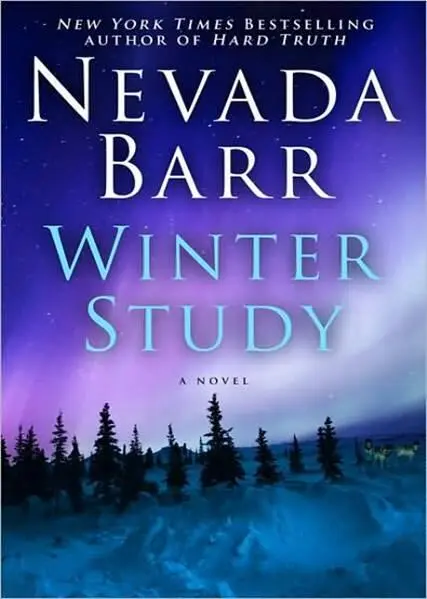
- Название:Winter Study
- Автор:
- Жанр:
- Год:неизвестен
- ISBN:нет данных
- Рейтинг книги:3 / 5. Голосов: 1
-
Избранное:Добавить в избранное
- Отзывы:
-
Ваша оценка:
Winter Study: краткое содержание, описание и аннотация
Предлагаем к чтению аннотацию, описание, краткое содержание или предисловие (зависит от того, что написал сам автор книги «Winter Study»). Если вы не нашли необходимую информацию о книге — напишите в комментариях, мы постараемся отыскать её.
Winter Study — читать онлайн бесплатно полную книгу (весь текст) целиком
Ниже представлен текст книги, разбитый по страницам. Система сохранения места последней прочитанной страницы, позволяет с удобством читать онлайн бесплатно книгу «Winter Study», без необходимости каждый раз заново искать на чём Вы остановились. Поставьте закладку, и сможете в любой момент перейти на страницу, на которой закончили чтение.
Интервал:
Закладка:
Anna wished she were in Natchez, Mississippi, cutting back the roses in Paul’s front yard.
Paul’s front yard. Anna had been on her own so long she wondered if she would ever lose the mental habit of thinking of “Paul’s” and “hers,” never “ours.” When she referred to “his” house, he would invariably take her in his arms and say “our house.” When they married, Paul truly did give “all that he had and all that he was” to her. Much as she would have liked to do the same, Anna was not made that way. A core of her remained unshared, a fortress she retreated to when she needed to marshal her internal forces.
The outer shell of her parka was dry to the touch. She lifted it off the rack. Turning the coat inside out to dry the lining, she felt a lump in the pocket. The vial of wolf’s blood; she’d forgotten to put it in the toolbox evidence locker. By now, it would have thawed. Stowing it beneath the carpenter’s shop would only serve to refreeze it and what little value it might have would be lost. She left it where it was.
The blood samples Katherine had carried with her to the cedar swamp stuck in Anna’s brain: burrs under her saddle, stones in her shoe. Crimes – or accidents – told a story. The protagonist did something for a reason and the result was the incident. When an action occurred that didn’t fit in the logical unfolding of the story, Anna couldn’t leave it alone. People who lied were invariably caught eventually because the lie never completely worked with the rest of the story.
It was possible that the blood samples didn’t fit into the story because they had no relevance. Katherine might have pocketed them with the intention of doing tests when she returned to her kitchen/ lab.
Katherine had fiddled with wolf parts nonstop for the better part of two days. The kitchen was filled with racks of vials containing samples of tissue, blood, bone, stomach contents, hair, ticks, mites and other marvelous things. What tests could be left to do? Why not use the blood she’d taken before the wolf was moved to the carpenter’s shop?
Leaving the heat of the stove and the oppressive peopled emptiness of the common room, Anna went to Katherine’s makeshift DNA lab. With its single bed shoved in a corner and the haphazard piles of a storeroom used by many and organized by none, the kitchen was bleak.
The PCR was in its travel case on the counter, the record book beside it. Anna opened the log and read what she could understand of Katherine’s notes. The researcher had not written anything she’d not discussed with the rest of them, no illuminating secrets.
As Anna closed the log, The Shining unreeled behind her frontal lobe, the scenes where Jack Nicholson grinned his I-am-one-crazy-bastard grin. Was she growing paranoid and delusional in a snow-bound building? No secrets, no plots, no ulterior motives or sinister intent, just a mix of strange bedfellows trapped in a very strange bed with one claustrophobic hypervigilant law enforcement ranger?
Anna put the book back precisely the way she’d found it. The log’s owner would never be back to notice; she did it from habit. Methodically she checked each of the various samples in their vials and packets. No seals were broken, no envelopes slit open, no papers in disarray.
Wog DNA wasn’t what triggered Katherine. For a scientist, a find at that level of idiosyncratic bizarreness was tantamount to a cat finding a real live mouse full of catnip. Something she’d discovered during the necropsy precipitated her mad dash into the woods. Anna walked to the window and stared past her reflection in the dark glass, trying to see around the corners of memory to that precise moment.
Ridley’s hand was cut and bleeding. Anna handed Katherine the chunk of meat from the wolf’s throat. Katherine mewled like a newborn kitten lost in its mother’s fur. Shortly thereafter, according to Jonah, the researcher pocketed the blood samples and ran out of the shop.
Jonah said she’d pocketed the samples and run out.
Feeling anxious but not knowing why till she realized she was half expecting another message to appear on the window glass in spectral words, Anna wondered what Jonah had to gain by the lie. He could have slipped the vials into Katherine’s pocket; he could have said she’d run out when she’d merely strolled, but Anna couldn’t come up with one moderately rational reason why he would do so.
The old pilot was as attached to Ridley as a father to a beloved son. Lately he had been watching Adam the way he’d watch a dog bitten by a rabid skunk. Jonah had no use whatsoever for Bob but didn’t appear to harbor the hatred of him Ridley did or the schizophrenic anger and obsequiousness Adam displayed toward the man.
Anna gave up. She took the tube of blood from her pocket and stared at it. It was just a sample from a dead wolf, and there were plenty more where this came from.
Maybe.
Maybe the importance of the vials was in the fact that there weren’t more. Would Jonah have reason to tamper with vials of blood, then switch the doctored versions for the real samples when Katherine wasn’t paying attention?
“You’re reaching,” Anna chided herself. Even a diabolical, dyed-in-the-wool, honest-to-comic-book professional nemesis had to have means, motive and opportunity. Unless Jonah was the great professor he played at being when on a roll, such a convoluted methodology was uncharacteristic.
Anna decided to quit stirring in her brain and Katherine’s lab before she began making up crimes just to keep herself amused. What she needed was a good book.
“Hey, Ridley.” Anna leaned in the doorway of his room. His back was to her, his long, delicate fingers poised on the keyboard of his laptop, hair loose and shining around his shoulders. He looked the very image of Christ Jesus without the halo and the white nightgown.
When he turned, the renaissance artists’ vision of Jesus vanished. Rings of purple beneath his eyes had deepened since breakfast and his winter-white skin looked coarse and loose. “Hey,” he replied. Weariness flattened his voice. Anna snuck a look past his shoulder to see what he was working on. Unoffended, he followed her gaze. “Yeah,” he said. “Yet one more defense of the study. Fifty years we’ve been at it. Fifty years of watching and what we know is, we don’t even begin to know what we don’t know about wolves and their relationship to their prey. Yet every bozo with a dog and a high school diploma knows it all. David Mech says one thing, Rolf Peterson agrees; I back it, and some NPS brass says: ‘But the girl who sits next to me in homeroom thinks…’”
“‘You’ve got vision, and the rest of the world wears bifocals.’” Anna quoted Butch Cassidy.
Ridley’s eyes went hard, and it occurred to her he would have been five or six years old when the movie came out. Chances were good he’d never seen it. And he certainly hadn’t memorized the good parts, as a percentage of her generation had. As far as he was concerned, he’d offered her a glimpse of himself and she’d mocked him. Anna wished it wasn’t so but knew if she tried to explain herself it would make things worse. It always did.
“I need the key to the ranger station,” she said instead.
“Sure. The lights aren’t on. The generator serves only the housing area. What do you need?”
“A book,” Anna replied. “The Visitors Center must have a library of some kind.” The Visitors Center and the rangers’ offices were located in the same building, the beautiful new facility overlooking Washington Harbor.
“Not much of one,” Ridley said as he rummaged through the top drawer of his desk. It was full of pens, paper clips and other detritus that Anna thought would have taken more than a couple weeks to amass. “Reference stuff, is about all there is there.”
Читать дальшеИнтервал:
Закладка:
Похожие книги на «Winter Study»
Представляем Вашему вниманию похожие книги на «Winter Study» списком для выбора. Мы отобрали схожую по названию и смыслу литературу в надежде предоставить читателям больше вариантов отыскать новые, интересные, ещё непрочитанные произведения.



Обсуждение, отзывы о книге «Winter Study» и просто собственные мнения читателей. Оставьте ваши комментарии, напишите, что Вы думаете о произведении, его смысле или главных героях. Укажите что конкретно понравилось, а что нет, и почему Вы так считаете.