Dan Simmons - Drood
Здесь есть возможность читать онлайн «Dan Simmons - Drood» весь текст электронной книги совершенно бесплатно (целиком полную версию без сокращений). В некоторых случаях можно слушать аудио, скачать через торрент в формате fb2 и присутствует краткое содержание. Год выпуска: 2009, ISBN: 2009, Жанр: Триллер, на английском языке. Описание произведения, (предисловие) а так же отзывы посетителей доступны на портале библиотеки ЛибКат.
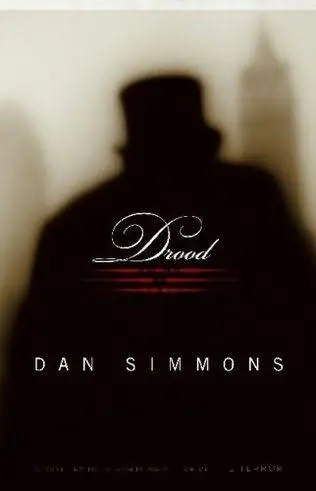
- Название:Drood
- Автор:
- Жанр:
- Год:2009
- ISBN:978-0-316-04068-6
- Рейтинг книги:3 / 5. Голосов: 1
-
Избранное:Добавить в избранное
- Отзывы:
-
Ваша оценка:
Drood: краткое содержание, описание и аннотация
Предлагаем к чтению аннотацию, описание, краткое содержание или предисловие (зависит от того, что написал сам автор книги «Drood»). Если вы не нашли необходимую информацию о книге — напишите в комментариях, мы постараемся отыскать её.
Did Dickens begin living a dark double life after the accident? Were his nightly forays into the worst slums of London and his deepening obsession with corpses, crypts, murder, opium dens, the use of lime pits to dissolve bodies, and a hidden subterranean London mere research… or something more terrifying?
Just as he did in
, Dan Simmons draws impeccably from history to create a gloriously engaging and terrifying narrative. Based on the historical details of Charles Dickens's life and narrated by Wilkie Collins (Dickens's friend, frequent collaborator, and Salieri-style secret rival),
explores the still-unsolved mysteries of the famous author's last years and may provide the key to Dickens's final, unfinished work:
. Chilling, haunting, and utterly original,
is Dan Simmons at his powerful best.
Drood — читать онлайн бесплатно полную книгу (весь текст) целиком
Ниже представлен текст книги, разбитый по страницам. Система сохранения места последней прочитанной страницы, позволяет с удобством читать онлайн бесплатно книгу «Drood», без необходимости каждый раз заново искать на чём Вы остановились. Поставьте закладку, и сможете в любой момент перейти на страницу, на которой закончили чтение.
Интервал:
Закладка:
“In a very real sense, our Mr Field’s life does depend on discovering whether Mr Drood is real and where to find him if he is,” said Dickens. “And you notice that I refer to our blackmailing friend as Mr Field, not Inspector Field.”
“Yes,” I said as we stepped gingerly from stone to stone in an especially swampy part of the path. “Field mentioned to me that his title was honourary now that he does his detective work in private life.”
“A self-appointed honour that the Detective Bureau of Scotland Yard and of the Metropolitan Police do not appreciate, my dear Wilkie. I’ve kept some tabs on our Mr Field since I—if you forgive the immodesty—immortalised him as Inspector Bucket in Bleak House or even earlier, in my admiring little essay about him, “On Duty With Inspector Field,” in our Household Words in 1851. He left his official capacity shortly after that, you know… 1853, I do believe.”
“But you admired him then,” I said. “At least enough to create a fascinating character out of him.”
Dickens laughed again as we turned back around the marsh towards distant Gad’s Hill. “Oh, I admire many people for their potential as characters, my dear Wilkie, yourself not excluded. How else could I have suffered the Podsnapperies of Forster all these years? But there has always been the pungent scent of the schoolhouse bully hovering about our dear Mr Field, and bullies always tend to overreach and be called to task.”
“You’re saying that he is out of favour with Scotland Yard and the Metropolitan Police,” I said.
“Quite so, Wilkie. Did you happen to follow the notorious Palmer poisoning case some time ago… my, a decade ago now. How time, to coin a phrase, does fly. At any rate, did you follow that in the papers or at the Club?”
“No. I can’t say that I did.”
“No matter,” said Dickens. “Let us just say that our retired Inspector Field was involved with the sensational murder case, was quite popular with the press, and insisted on using the title Inspector Field. In truth, Wilkie, I believe our corpulently digited friend actively encouraged the press and populace to believe that he was still affiliated with the Metropolitan Police. And his successors there, the real police detectives and inspectors, did not appreciate it, Wilkie. Not one small smattering did they appreciate it. So they stopped his pension.”
I stopped in my tracks. “His pension? ” I cried. “His bloody pension? The man interrogates you and tries to blackmail me, all for a… bloody… pension? ”
Dickens obviously was irked to be thrown off his walking rhythm, but he stopped, hacked at some weeds with his blackthorn, and actually smiled. “Yes, for his pension. Our faux inspector acquaintance has his Private Enquiry Bureau and makes some money through it—indeed, I paid a pretty penny for our hulking friend Hatchery’s one night of effort on our behalf—but you may remember me once telling you, Wilkie, how… avaricious is not too strong a word, I think… avaricious this former policeman named Field was, is, and ever shall be. He cannot abide not receiving his pension. I do believe he would murder to get it back.”
I blinked at that. “But why Drood?” I asked at last. “What will it gain him if he finds this phantom Drood?”
“It may gain him his pension,” said Dickens as we resumed our walk. “Or so he thinks. At this very moment, Home Secretary Sir George Grey is reviewing Field’s suspension of payments, after the long growling from Field’s solicitor—not a cheap undertaking that, I can assure you! — and I am quite sure that Mr Field, in his aged delusions…”
I did not interrupt here to remind him that Charles Frederick Field was only some seven years older than Dickens himself.
“… has concocted a deus ex machina plot in his own mind in which, when he tracks down and captures this criminal mastermind Drood… a spectral figure who evaded Chief Inspector Field some twenty years ago… the Home Secretary and Scotland Yard Detective Bureau and all of his former friends and indifferent successors at the Metropolitan Police shall not only forgive him, and reinstate his pension, but be forced to crown him with laurel leaves and carry him to Waterloo Station on their burly shoulders.”
“And is he a criminal mastermind?” I asked softly. “This Drood? Field told me last night that Drood murdered some three hundred persons over the years…”
Dickens glanced at me again. I noticed that the wrinkles and furrows in his face had grown deeper over the summer. “Do you believe that figure to be reliable, my dear Wilkie?”
“I… have no idea,” I said. “It does sound preposterous, I admit. I do not remember hearing of any three hundred unsolved murders, in Whitechapel or anywhere else. But that was an uncanny place we went to, Dickens. Uncanny. And you never told me what occurred after you left me in that absurd boat.”
“No, I have not,” said Dickens. “And I promised you that night that I would tell you someday soon, my friend. And two months have passed. I am sorry for that delay.”
“The delay is no matter,” I said. The headache was returning even as the laudanum glow around everything faded. “But I would like to know what occurred that night. I would like to know what you have learned about this Drood we spent the night chasing.”
Dickens glanced at me again. “And I would have no concern about our mutual friend Field blackmailing this information out of you?”
I stopped. “Dickens!”
He did not stop with me, but he walked backwards, twirling his blackthorn and smiling. “I am joking, my dear Wilkie. Joking. Come… catch up to me; don’t falter our pace at this advanced point. Catch up to me and walk alongside and pray quiet your wheezing to a mere bellows roar and I shall tell you all about that night after I left you on the brick quay in the sewers beneath the catacombs in Undertown.”
CHAPTER NINE
After I left you sitting there on the quay,” said Dickens, “I attempted to pay some attention to that rather absurd little boat I was in.
“The craft rather reminded me of my character Hexam Gaffer’s miserable little boat from which he tows corpses and other found things from the Thames, but in this case as if some demented carpenter had decided to turn it into a parody of a Venetian gondola. As I studied the two tall, silent figures, one at the tiller or sweep in the stern, the other poling from the raised bow, they became less and less attractive to me, Wilkie. Their gold-dust-bedangled domino masks and smoked glasses disguised little more than their eyes, so I could tell they were male, but only nominally so. You know how angels portrayed in frescoes in the great Papist cathedrals on the Continent are disturbingly androgynous, my dear Wilkie? Well, my companions in this tiny boat were decidedly more so, and that androgyny was emphasised rather than diminished by the absurd medieval tights and tunics they were wearing. I decided to think of the castrato in the bow as Venus and the eunuch at the stern as Mercury.
“We poled down the broad stream of sewage for some hundred yards or more. I glanced back, but I do not believe you ever looked my way before our gondola-scull went around a bend and we were lost to each other’s view, you and I. The small lanterns dangling from iron rods near the bow and stern did little to illuminate the rushing waterway. My primary impression was of lantern light reflected from the moist and dripping arch of bricks above us.
“I dare say I do not have to remind you, Wilkie, of the terrible stench of that first tributary. I was not sure that I could tolerate it for long without becoming physically sick. But luckily, after a few hundred yards of that reeking Styx, the masked form at our tiller turned us into a side tunnel so narrow that I was sure it was nothing more than a sewer pipe. Both Mercury and Venus had to bow low—I did as well—as they moved us along by pressing their gloved palms to the bricks of the low ceiling and encroaching sides. Then the way opened into a wider stream—and I say ‘stream’ advisedly, Wilkie, since this was less a sewer than a bricked and contained underground river, as wide as any aboveground tributary to the Thames. Did you know that some rivers have been partially or completely covered over in London… the Fleet, for instance? Of course you did. But one never thinks of their subterranean sections.
Читать дальшеИнтервал:
Закладка:
Похожие книги на «Drood»
Представляем Вашему вниманию похожие книги на «Drood» списком для выбора. Мы отобрали схожую по названию и смыслу литературу в надежде предоставить читателям больше вариантов отыскать новые, интересные, ещё непрочитанные произведения.





Обсуждение, отзывы о книге «Drood» и просто собственные мнения читателей. Оставьте ваши комментарии, напишите, что Вы думаете о произведении, его смысле или главных героях. Укажите что конкретно понравилось, а что нет, и почему Вы так считаете.