David Hosp - Among Thieves
Здесь есть возможность читать онлайн «David Hosp - Among Thieves» весь текст электронной книги совершенно бесплатно (целиком полную версию без сокращений). В некоторых случаях можно слушать аудио, скачать через торрент в формате fb2 и присутствует краткое содержание. Жанр: Триллер, на английском языке. Описание произведения, (предисловие) а так же отзывы посетителей доступны на портале библиотеки ЛибКат.
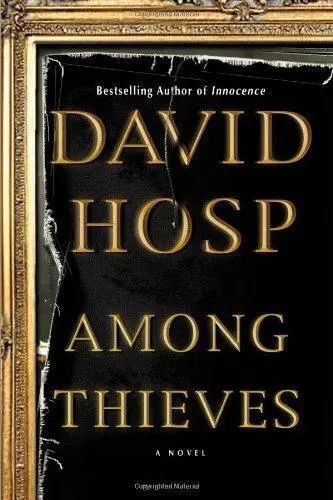
- Название:Among Thieves
- Автор:
- Жанр:
- Год:неизвестен
- ISBN:нет данных
- Рейтинг книги:5 / 5. Голосов: 1
-
Избранное:Добавить в избранное
- Отзывы:
-
Ваша оценка:
Among Thieves: краткое содержание, описание и аннотация
Предлагаем к чтению аннотацию, описание, краткое содержание или предисловие (зависит от того, что написал сам автор книги «Among Thieves»). Если вы не нашли необходимую информацию о книге — напишите в комментариях, мы постараемся отыскать её.
AMONG THIEVES
In 1990, $300 million worth of paintings were stolen from Boston 's Isabella Stewart Gardner Museum in what remains one of the greatest unsolved art thefts of the twentieth century. Now, nearly twenty years later, the case threatens to break wide open. Members of Boston 's criminal underground are turning up dead. But these are no ordinary murders. The M.O. of the attacks suggests the involvement of someone trained by the IRA. But when Scott Finn learns that one of his clients, Devon Malley, was part of the heist, he's quickly drawn into the crossfire, and into the renewed hunt for the missing artwork-a hunt that may cost Finn and his colleagues their lives.
Among Thieves — читать онлайн бесплатно полную книгу (весь текст) целиком
Ниже представлен текст книги, разбитый по страницам. Система сохранения места последней прочитанной страницы, позволяет с удобством читать онлайн бесплатно книгу «Among Thieves», без необходимости каждый раз заново искать на чём Вы остановились. Поставьте закладку, и сможете в любой момент перейти на страницу, на которой закончили чтение.
Интервал:
Закладка:
She shook her head in frustration, but picked up the phone and punched in three digits. She turned away from the two of them as she spoke, and her voice was swallowed up in the enormity of the marble lobby. Then she turned around and hung up the phone. “It will be a few minutes,” she said. “He’s very busy.”
“I’m sure, ma’am.”
“He said you can wait for him up in the Dutch Room, if you wish.”
“The Dutch Room,” Kozlowski repeated. He turned and looked at Finn. “The Dutch Room.”
Finn gave him a blank stare.
The woman let out a condescending sigh. “Up the stairs to the right,” she said. “It’s where the Rembrandts and the Flinck used to hang before they were stolen.”
“Ah, the Dutch Room,” Kozlowski said.
Finn nodded. “Of course, the Dutch Room.”
“Thanks very much.”
She was still shaking her head as the two of them walked up the stairs. She probably would have been muttering as well, if it wouldn’t have struck her as an unpardonable breach of etiquette.
The second floor was just as breathtaking as the first. It, too, was built around the huge courtyard, and it consisted of a series of gallery rooms lined up one after another, each looking out through ornate balconies down to the garden below.
They turned right at the top of the stairs and walked along the hallway to a large arched doorway that led into a huge room paneled in dark wood. It had towering ceilings and antique chairs upholstered in heavy fabric. The walls were covered in green silk and lined with large dark oil paintings, many of them portraits. The faces of the long-dead peered out from their places on the walls. For some reason, Finn felt as though they were judging him; it made him feel depressed.
In a few spots there were empty frames hanging on the walls. The frames were, admittedly, works of art in and of themselves. They were heavy, ornately carved works painted in gold leaf. And yet, left alone, without the canvas and paint, they seemed sad and out of place.
Finn was about to ask Kozlowski about the empty frames when he noticed a man sitting in the corner of the room. He was propped up in a wooden chair, his head leaning against the wall, his eyes closed. Finn looked at Kozlowski and motioned toward the man. He wondered whether the man was dead, and walked over quietly to take a look.
He was old-Finn was guessing in his seventies-and his clothes were battered. His jacket was heavy wool, a half season too late, and the threads were fraying at the lapels. The elbows looked shot through. The man’s face was gray and his eyes were sunken back into their sockets, surrounded by dark skin. It took a moment for Finn to see the man’s chest moving ever so slightly, giving at least the suggestion of life. Finn waved his hand a few feet in front of the man’s face.
“He’s fine,” a voice said behind Finn. He turned to see a tall, trim man in his late fifties. He was wearing a tailored suit of charcoal-gray, a bright white shirt, and an azure tie with a matching pocket square. “Detective Kozlowski?” he asked, looking back and forth between the two visitors.
“I’m Kozlowski.” He extended his hand.
The man shook it, though there was a look of reluctance on his face. “I’m Paul Baxter. I am the director of the museum, as well as the chief curator.” Finn thought he detected a hint of the Old World in the accent. It could have been an affectation of the Boston Brahmin many well-heeled New Englanders took to, but Finn thought there was hint of Irish to it as well.
“Thank you for talking to us, Mr. Baxter,” Kozlowski said. He motioned to Finn. “This is Scott Finn, my partner.”
Baxter nodded to Finn, but didn’t walk over to shake his hand. “Is there news? We haven’t heard anything for days.”
Kozlowski and Finn exchanged a look. “What was the last update you received?” Kozlowski asked.
“Nothing. No update. The only information we’ve had was from the call I got from the FBI last week.”
Kozlowski frowned. “You’ve heard nothing since then?”
Baxter shook his head. “Nothing.”
“Who did you speak with the first time?”
“Special Agent Porter.”
“How much information did he give you?” Finn noted the care with which Kozlowski crafted his questions.
“Not much,” Baxter scoffed. “Just that Interpol had received word that someone was trying to fence the paintings. That was it. No further information; just the request that we give them any information that we came into possession of to them. Honestly, I don’t know how you law-enforcement types keep your jobs. Twenty years, and I’m supposed to run this place effectively without basic information? I haven’t even told the board about this because there have been so many disappointments in the past. If they find out that I’m keeping this from them, I can’t even imagine the fallout.”
Finn looked at Kozlowski with admiration. He’d been a great police officer, but his talents would also have made him formidable on the other side of the law. Without lying, he’d pulled an enormous amount of confidential information from Baxter.
“I understand your frustration,” Kozlowski said. He looked at the man sleeping in the corner. “Would you prefer to discuss this someplace else?”
Baxter glanced briefly at the zombie, then shook his head. “No, that’s fine. That’s Sam. Sam Bass. He was an assistant here forever. The museum gave him a pension two years ago, but he has no place else to go during the day, so we let him have the run of the place. He wouldn’t mention anything to anyone, even if he was awake; he knows that if he causes any trouble I won’t let him back in the place.” He raised his voice slightly. “Isn’t that right, Sam?”
The old man snorted and shifted his head; then he settled back into his slumber.
Baxter ignored him. “What else can you tell me?”
Kozlowski shook his head. “Not much. This is ultimately the FBI’s jurisdiction. Did they mention anything to you about a possible Irish connection?”
Baxter looked unnerved. “No,” he said. “Why? Do they think there is some connection to Ireland?”
“I’m sorry,” Kozlowski said. “If they didn’t talk with you about their information, I certainly can’t. As I told the woman downstairs at the desk, we are technically only investigating a different crime-the assault of a woman in South Boston. There is some suspicion that the assailant may be connected in some way with those who committed the theft here. Is there anything you can tell us that might help?”
Baxter looked offended. “No. Of course not. If there was anything I could do to help, don’t you think I would have done it already? I had only been here at the museum for a few weeks when the theft occurred. It remains the only stain on my reputation.”
The man’s tone was defensive, and Kozlowski’s eyes narrowed on Baxter. “You’d tell us if you had any additional information, wouldn’t you, Mr. Baxter?”
The director looked as if he might swallow his tongue. His face nearly turned purple. “Don’t think I’m unaware of the speculation, Detective Kozlowski. Your colleagues on the police force and in the FBI have never been subtle in hinting that they believe that I might somehow be involved. I consider these speculations slander.” He took a deep breath and composed himself. Looking at both Kozlowski and Finn, he did his best to affect an air of dignity. “Now, Detectives, unless you have any additional information you can share with me, I have a great deal of work to do.”
Kozlowski looked at him for a long moment. “Of course,” he said at last. “We’ll be in touch if there is anything else we can share with you.”
“I look forward to it.” Baxter turned on his heels and left the room.
Читать дальшеИнтервал:
Закладка:
Похожие книги на «Among Thieves»
Представляем Вашему вниманию похожие книги на «Among Thieves» списком для выбора. Мы отобрали схожую по названию и смыслу литературу в надежде предоставить читателям больше вариантов отыскать новые, интересные, ещё непрочитанные произведения.





Обсуждение, отзывы о книге «Among Thieves» и просто собственные мнения читателей. Оставьте ваши комментарии, напишите, что Вы думаете о произведении, его смысле или главных героях. Укажите что конкретно понравилось, а что нет, и почему Вы так считаете.