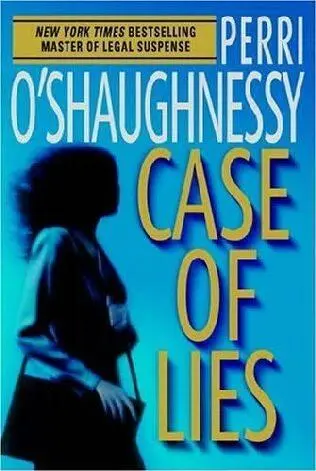
Perri O'Shaughnessy - Case of Lies
Здесь есть возможность читать онлайн «Perri O'Shaughnessy - Case of Lies» весь текст электронной книги совершенно бесплатно (целиком полную версию без сокращений). В некоторых случаях можно слушать аудио, скачать через торрент в формате fb2 и присутствует краткое содержание. Жанр: Триллер, на английском языке. Описание произведения, (предисловие) а так же отзывы посетителей доступны на портале библиотеки ЛибКат.
- Название:Case of Lies
- Автор:
- Жанр:
- Год:неизвестен
- ISBN:нет данных
- Рейтинг книги:3 / 5. Голосов: 1
-
Избранное:Добавить в избранное
- Отзывы:
-
Ваша оценка:
Case of Lies: краткое содержание, описание и аннотация
Предлагаем к чтению аннотацию, описание, краткое содержание или предисловие (зависит от того, что написал сам автор книги «Case of Lies»). Если вы не нашли необходимую информацию о книге — напишите в комментариях, мы постараемся отыскать её.
Two of the witnesses have fled to a village not far from the home of Bob's father, Kurt Scott, in Germany. As Nina tries to unravel the mystery of one violent Tahoe night, a harrowing journey begins – one that takes her from the dark underworld of Tahoe's casinos to the halls of a prestigious East Coast university to Europe and an emotional reunion with Kurt. As old feelings are rekindled, Nina's case turns violent. Everyone has something to hide – the brilliant but unstable mathematics student who has made an astonishing discovery, the owner of a motel where the shooting took place, and the shooter, who has turned the whole case into a gigantic lie.
Case of Lies — читать онлайн бесплатно полную книгу (весь текст) целиком
Ниже представлен текст книги, разбитый по страницам. Система сохранения места последней прочитанной страницы, позволяет с удобством читать онлайн бесплатно книгу «Case of Lies», без необходимости каждый раз заново искать на чём Вы остановились. Поставьте закладку, и сможете в любой момент перейти на страницу, на которой закончили чтение.
Интервал:
Закладка:
“You are wrong, Wakefield. The primes have a deep connection to the real world. I think maybe the primes are the real world, the real building blocks of the universe. Have you read Volovich’s paper for CERN on that topic? Anyway, there’s room for both of us, wouldn’t you say?”
“Sure. It’s just incredible that you are into the primes. Berry, that’s pretty new stuff. He’s in England, isn’t he?”
Silke said, “ Ja, it’s new. That idiot Riemann. Saying his hypothesis was probably true, but never giving us any part of a proof. I’ll never forgive him.”
“It wasn’t his fault. After he died, his housekeeper threw out most of his papers.”
“He should have had a better housekeeper.” She smiled. “Why can’t geniuses find decent housekeepers?”
“You should look at my work. I have brought in some of Ramanujan’s work on partitions and factorization. The primes show that addition and multiplication aren’t transparent vis-à-vis each other. It’s going to be revolutionary.”
“Oh, really? Ramanujan? I have a friend you ought to meet.” That smile again. She had a dimple to the right of her chin when she smiled, showing small, even white teeth. Elliott wanted very badly to impress her.
He jabbered, “Riemann was trying to get past the discrete problem. The primes are deep indications that the discrete is an arbitrary convention. You know, One, Two, Three. Discrete numbers. The integers.”
A silence followed this pronouncement. Elliott thought to himself, That is so elementary. If I get any more boring, no one will ever talk to me again.
But Silke finally said, “I love it. It sounds absolutely wild. I’d like to read your work.”
He wanted to give it to her, give her anything she required, but there existed many reasons why he could not share his work. “When I have the proof,” he said.
“What exactly will you be able to show with this proof?”
“More than Riemann.” He stuck his chin out.
“What an ambitious boy you are. Math students are supposed to be modest and retiring, aren’t they? ‘More than Riemann’?” She cocked her head and gave him a look of such understanding, such sweet compassion, that he wanted to fall at her feet and hold her legs in the neat jeans and brown boots and bury his head in her lap. She was so smart, he wondered if she might be on a better track than his. He decided then and there to take more physics courses.
“My God, I can’t believe we haven’t talked before,” he said.
“But what is this supposed to mean?” She was looking at his notebook. “This symbol looks like a little man with a long prick.” Her efficient accent made it sound dry and academic. “So you are going to outshine Riemann? Are you going to go after the Clay prize?”
“What prize are you talking about?”
“You have to be kidding. You don’t know about the Clay prize? It’s a million dollars for the first person to prove the Riemann Hypothesis. It was first offered in 2000, and so far there are no takers.”
“What about de Branges? He published a proof of it last year,” Elliott said. “Didn’t he apply for it?”
“Have you looked at his paper? People seem to think it won’t stand up to peer review. You really didn’t know about the Clay prize? I heard you came out of the Western woods, but how could you miss that?”
“Why are they offering money? It’s a corruption-a commercialization of pure math. I just do my work. And that symbol at the bottom you’re pointing at-that’s just a doodle.”
“ Wakefield. Look at me.” She still smiled, as though there was something amusing about him. He hoped he could somehow keep her amused. He didn’t want her to leave. He had so much to share with her, and she was so gorgeous, and he was getting an erection-oh God, she had noticed-
“I-I can’t just this minute,” he said, and heard her silvery laugh. She put her long hand with its pink nails on his leg. He stared at it, cheeks flaming.
“You need money, don’t you? I heard your mother died and you’re still living in the dorms. Not too good for concentration, is it?”
“I’m doing okay.” He wondered how Silke knew about his mother. Did the other students talk about him? The idea bothered him.
“I have a proposition for you, Wakefield.”
“Okay, S-Silke.” She was making him a-
“I’m going to help you make some money. Easily.”
“Money?”
“You look so silly. Stop by my place tonight about eight.” She gave him an address on Everett Street in Cambridge. He wrote it into his notebook. She patted him on the head like a dog and got up.
“Silke?”
“ Ja ?”
“Did you know I was working with primes before you talked to me?”
“I heard something about it.”
“Is that why you… sat down?”
“No.”
“Then, why me? Why did you talk to me?”
“Because you are the smartest SOB in the class,” Silke said. “Of course.”
9
LOOKING BACK, ELLIOTT BELIEVED THAT THE air in Cambridge, Massachusetts, in January must be precisely equivalent to the air of Murmansk, Vorkhuta, or Nikel, Russia, in the same month; gulag bone-chilling. A wind sent from some cold hell whipped up the old cobblestones, sending trash flying into the dirty banks of snow. Icicles four feet long and six inches in diameter hung from the storm windows. The low white sky touched the rooftops. At night, ice formed along the sidewalk cracks and the yellow light of the lamps revealed high-water-content snow blown this way and that, born in the churning Atlantic.
The students came in September, when the grass was green and the boats slipped sedately along the Charles River. By the time they realized what they were in for, that the bucolic scenes of September wouldn’t return until May, it was too late.
By now Elliott had found ways to avoid the weather, seldom leaving his room at MIT with its damp towels hung over the radiator except to go to class or the library. This survival strategy limited him to the company of the all-male denizens of his floor, however. Tonight, on this sortie to the Harvard gulag, he wore rubber-soled boots and a parka with a fake-fur hood pulled around his face, and carried a brown paper bag containing a bottle of Chianti cradled in his arms.
He wasn’t exactly hopeful. But he was prepared.
The steps of the big house on Everett had been shoveled to allow an eighteen-inch-wide path to the door with its frozen mat. Christmas lights still hung unlit from the eaves, but behind the curtains of the windows flanking the porch he saw warm light and figures passing back and forth.
A party. His heart sank.
The door creaked open and the guy standing there looked at him without comment. He was an Asian Indian whom Elliott vaguely remembered from his class in set theory the previous semester.
“Hello, Wakefield.”
“Hello.”
“Raj.”
“Right. Raj. Is Silke here?”
“Of course. She’s waiting for you. Is that alcohol? Very good! Come in.”
It was a student house, one of the mansions near Harvard that was rented to the children of the well-heeled. The entry floor was piled with grubby boots and hung with jackets. A runner with a practical brown pattern mounted the staircase.
“This way.” They passed into the living room with its coffered ceilings and air of genteel decrepitude, where two girls were lounging on the couch, watching TV. Silke flicked it off with the remote in her hand and came over and stood under the shelter of Raj’s arm and said, “Welcome.” Reaching for the wine, she said, “Nice. You know Raj. And this is Carleen. She was in your class in set theory, too.” Carleen didn’t get up. With her legs curled under her, she looked like a punk kid of twelve or so.
Читать дальшеИнтервал:
Закладка:
Похожие книги на «Case of Lies»
Представляем Вашему вниманию похожие книги на «Case of Lies» списком для выбора. Мы отобрали схожую по названию и смыслу литературу в надежде предоставить читателям больше вариантов отыскать новые, интересные, ещё непрочитанные произведения.




Обсуждение, отзывы о книге «Case of Lies» и просто собственные мнения читателей. Оставьте ваши комментарии, напишите, что Вы думаете о произведении, его смысле или главных героях. Укажите что конкретно понравилось, а что нет, и почему Вы так считаете.