Will Staeger - Public Enemy
Здесь есть возможность читать онлайн «Will Staeger - Public Enemy» весь текст электронной книги совершенно бесплатно (целиком полную версию без сокращений). В некоторых случаях можно слушать аудио, скачать через торрент в формате fb2 и присутствует краткое содержание. Жанр: Триллер, на английском языке. Описание произведения, (предисловие) а так же отзывы посетителей доступны на портале библиотеки ЛибКат.
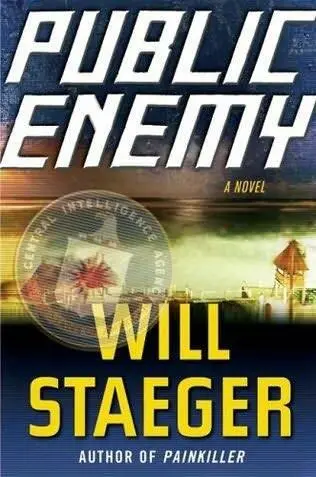
- Название:Public Enemy
- Автор:
- Жанр:
- Год:неизвестен
- ISBN:нет данных
- Рейтинг книги:3 / 5. Голосов: 1
-
Избранное:Добавить в избранное
- Отзывы:
-
Ваша оценка:
Public Enemy: краткое содержание, описание и аннотация
Предлагаем к чтению аннотацию, описание, краткое содержание или предисловие (зависит от того, что написал сам автор книги «Public Enemy»). Если вы не нашли необходимую информацию о книге — напишите в комментариях, мы постараемся отыскать её.
Public Enemy — читать онлайн бесплатно полную книгу (весь текст) целиком
Ниже представлен текст книги, разбитый по страницам. Система сохранения места последней прочитанной страницы, позволяет с удобством читать онлайн бесплатно книгу «Public Enemy», без необходимости каждый раз заново искать на чём Вы остановились. Поставьте закладку, и сможете в любой момент перейти на страницу, на которой закончили чтение.
Интервал:
Закладка:
But Cooper had to face facts: Cap’n Roy Gillespie, dirty though he was, didn’t work that way. Cap’n Roy took every handout available and leaped at the chance to avail himself of such sticky situations-or, Cooper thought, such ordinary police duties-as murder investigations. But he didn’t have killing in him-seeing this kind of thing in people being easy for Cooper. It was easy because he knew exactly what it was to be the opposite.
And Cap’n Roy was not the same as him.
If Roy wasn’t good for it, things became much more complicated. One big question, for instance, was why he and Cap’n Roy were still around at all. If somebody had wanted to shut this thing down at the source-hiding what, Cooper couldn’t figure, unless somebody had an oddly extreme case of the racial-profiling rage Cooper had felt for the statues-then Keeler, the boys on the plane, and the goods themselves were the least of anyone’s troubles. He, Cap’n Roy, and a small army of semidirty RVIPF cops probably knew more than Keeler did, and damn well knew a lot more than anyone on that detonated plane had known.
There was the possibility that whoever it was who’d done the deeds hadn’t known Cooper had interviewed Keeler, and therefore didn’t realize that Cooper knew the shipment had come originally from a man called Ernesto Borrego-El Oso Polar. But any conspirators worth their weight in palm fronds would, Cooper knew, assume that Cap’n Roy had interrogated the man, and that some minimal degree of information on the chain of ownership would therefore have come to light.
Meaning that somebody, by this theory, must have proactively decided not to kill him and Cap’n Roy. There was also the issue of Susannah Grant-though nobody would have been able to track his trip to Austin. He’d done it with fake ID having nothing to do with his current identity.
No, he mused-Susannah aside, there was, in all this, a nifty fit with a highly uncomfortable notion.
It was this: whoever was doing the killing seemed to possess no particular desire to fuck with government employees. If the conspirators knew who he and Cap’n Roy worked for-or at least, in his case, who he technically worked for-it followed that the conspirators might have intentionally refrained from crossing the “government line.” The concluding wrinkle in this theory was that it offered a pretty good chance that the conspirators got their own bread and butter from a government payroll too-American, British, or otherwise-thereby explaining their heightened sensitivity to, and proactive decision against, the murdering of fellow U.S. or British G-men. They were trying to keep quiet whatever they wanted kept quiet, but were only willing to go so far in doing so. As though by scaring other government people off, only without crossing the cop-killer line, these people were looking to put the hush on things without having the hushing come back to bite them in the ass.
Or it could just be a crooked thief with brains enough to know he ought to avoid the cop-killing stigma.
The first monster catch of the night came around eleven; after hauling in what he guessed would be a twenty-pounder, he almost laughed when the slippery little shape of a baby albacore, no more than a foot long, broke from the water and flickered against the moon, wriggling on his hook. Looked as though he’d eaten the entire six-inch baitfish Cooper had used to catch him too.
Keeping the pole in his right hand, Cooper reached out with his left hand and got hold of the hook. It took a balancing act, but he managed, as usual, to set the pole down, pull the hook from the hungry tuna’s mouth, pull the kill stick from his swimming trunks, whack the fish between the eyes, underhand it back to the beach, set the hook into another baitfish, and cast the food out at the pool where he knew that bigger fish than the hungry tuna gathered at night.
Around twelve-thirty, with nothing more than a couple further nibbles that had gone nowhere, Cooper gathered his gear-along with tomorrow’s lunch-and headed back over the hill. An unlucky night-rare were the pickings so slim from the old dock, though he’d had more unlucky nights than usual in recent months.
He saw the lights as he crested the hill. You could always see the lights of Road Town once you stepped over the lip of the trail, at least whenever a fog hadn’t rolled in for the night and obscured the five-mile view.
But tonight it was a different sort of light.
It looked, to Cooper, to be happening somewhere along Blackburn Road, a mile or so east of the harbor. The lights swirled red and blue, piercingly bright even all the way across the channel. He could see there was more than one set of them too; maybe the whole set of them, as close to the entire motor pool of the Royal Virgin Islands Police Force as you’d encounter in any single incident.
Cooper knew upon seeing this that it had been one hell of an unlucky night for someone else too. He felt a sort of white heat rise in his chest as he swung through the half-empty restaurant.
“Son of a bitch,” he said, and decided to make a stop by bungalow nine. He’d get out of his clothes and change into something that didn’t exude the scents of worm and fish.
Probably best to look a little more presentable for what he figured he was about to see in Road Town anyway.
19
Cooper crested another hill, this time from the interior of a minivan taxi, and when the cabbie said, “Can’t go no farther, mon,” Cooper paid him, let himself out, and talked his way past the patrol cop manning the road block. Cooper hadn’t seen the patrol cop more than once or twice before-kid might have been nineteen, and looked more like an eighth-grader in a policeman costume than a law enforcement official. Even the trademark RVIPF cap was too big for his head. Still, without knowing the kid worth a damn, he could read his expression like an open book.
The RVIPF cruisers were parked in an array of angles across and along the side of the road, and what Cooper had suspected from his view across the channel was confirmed now: the carnival of police and other authority types was gathered, more or less, at the front door of the chief minister’s house-the residence of none other than Cap’n Roy Gillespie.
Visible from the road as Cooper marched the fifty yards downhill to Cap’n Roy’s house was a stripe of yellow crime scene tape, draped across the twin rails that flanked the home’s main stairwell. Set directly back and up from the stairwell, in the area of the property Cooper knew to house the pool, a number of lights had been set up. A camera flash popped a couple times while Cooper stared. Over to the right of the pool, a light pole was up, and he could see a couple RVIPF caps moving to and fro behind a hedge near the top of the slope.
The cop at the base of the stairwell normally functioned as a kind of desk sergeant in the department’s main offices. As he stood aside to let him pass, Cooper realized there was, among other emotions, something like fear in the cop’s eyes.
Either the desk sergeant or the kid out front must have radioed ahead, since, as Cooper elbowed open the gate to the pool deck, he found Riley there waiting for him. The lieutenant didn’t say anything, didn’t really offer up any particular expression on his wide-boned, normally cheery face-he just nodded solemnly and stepped back to fall in behind him as Cooper came out onto the deck. It was on the deck that he saw, sprawled halfway between the French doors at the back of the house and the lip of the pool, the splayed, bug-eyed, and clearly dead body of Cap’n Roy.
Cooper stood over the body. It took a few minutes, but in time, the investigative function of Cooper’s mind began to engage itself, and Cooper found comfort in it: two visible bullet holes placed three or four inches apart near the geographical center of his chest; a bloodied, formerly white robe still wrapped partially around him, the robe’s terry-cloth belt partially untied, maybe from the gunshot impacts and subsequent fall, but still curled around itself enough to hold the robe in place; dark blue swim trunks, but otherwise unclothed beneath the robe; one flip-flop fallen off his foot, the left, on the wood planking of the deck, the other still adorning his right, its rubber thong wedged between his toes; a hand, his right, placed against his rib cage, slightly beneath the wounds.
Читать дальшеИнтервал:
Закладка:
Похожие книги на «Public Enemy»
Представляем Вашему вниманию похожие книги на «Public Enemy» списком для выбора. Мы отобрали схожую по названию и смыслу литературу в надежде предоставить читателям больше вариантов отыскать новые, интересные, ещё непрочитанные произведения.

![Томас Гарди - Джуд неудачник [Литрес, Public Domain]](/books/437392/tomas-gardi-dzhud-neudachnik-litres-public-domain-thumb.webp)






Обсуждение, отзывы о книге «Public Enemy» и просто собственные мнения читателей. Оставьте ваши комментарии, напишите, что Вы думаете о произведении, его смысле или главных героях. Укажите что конкретно понравилось, а что нет, и почему Вы так считаете.