Stephen Mertz - The Korean Intercept
Здесь есть возможность читать онлайн «Stephen Mertz - The Korean Intercept» весь текст электронной книги совершенно бесплатно (целиком полную версию без сокращений). В некоторых случаях можно слушать аудио, скачать через торрент в формате fb2 и присутствует краткое содержание. Жанр: Триллер, на английском языке. Описание произведения, (предисловие) а так же отзывы посетителей доступны на портале библиотеки ЛибКат.
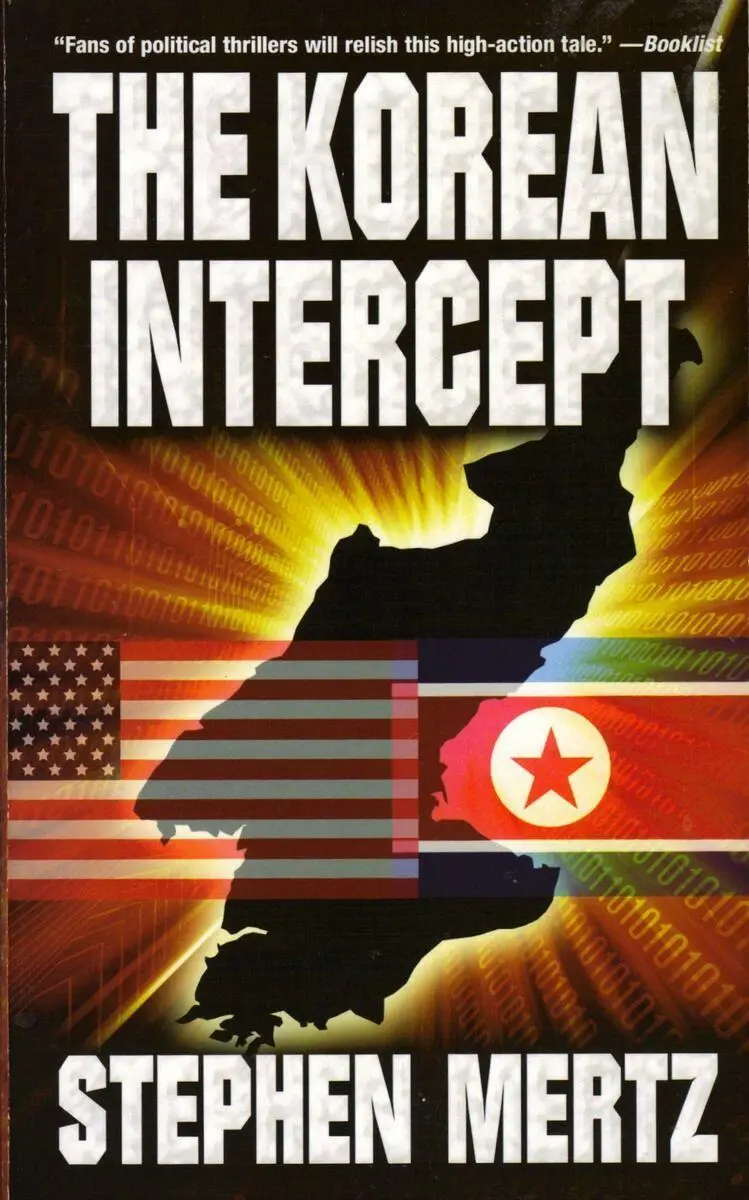
- Название:The Korean Intercept
- Автор:
- Жанр:
- Год:неизвестен
- ISBN:нет данных
- Рейтинг книги:3 / 5. Голосов: 1
-
Избранное:Добавить в избранное
- Отзывы:
-
Ваша оценка:
The Korean Intercept: краткое содержание, описание и аннотация
Предлагаем к чтению аннотацию, описание, краткое содержание или предисловие (зависит от того, что написал сам автор книги «The Korean Intercept»). Если вы не нашли необходимую информацию о книге — напишите в комментариях, мы постараемся отыскать её.
The Korean Intercept — читать онлайн бесплатно полную книгу (весь текст) целиком
Ниже представлен текст книги, разбитый по страницам. Система сохранения места последней прочитанной страницы, позволяет с удобством читать онлайн бесплатно книгу «The Korean Intercept», без необходимости каждый раз заново искать на чём Вы остановились. Поставьте закладку, и сможете в любой момент перейти на страницу, на которой закончили чтение.
Интервал:
Закладка:
He saw the figures being rushed aboard the Blackhawk, the rescue team forming a defensive half circle around them. As they boarded the helo, a female voice crackled with curt efficiency across the radio.
"Big Bird to Apache One," said the Blackhawk's pilot. "We're up, up and away."
Donnelly banked his chopper around and watched the Blackhawk lift off. He radioed the Blackhawk, "We copy, Big Bird. We're gone."
Yokohama
General Tuttle allowed Meiko to exit the comm van first, then he debarked, joining her on the rain-swept tarmac as the reverberations of incoming helicopters rumbled the damp atmosphere. Around the hangar, behind the van, were waiting ambulances and clusters of men intent in conversation near their unmarked black vans with heavily tinted windows. Everything from medical treatment to diplomatic and intelligence personnel awaited the choppers like animals of prey.
Meiko was the only media person present, and her personal involvement in these unfolding events made it impossible for her to distance herself emotionally from this story, as she'd been taught in journalism school. Tuttle had allowed her to listen in as a radio corpsmen monitored the tactical network through a small squawk box in the comm van's main console. It was a "successful hit and git," according to the woman pilot of the Blackhawk. They were coming home with two surviving members of the Liberty crew.
Meiko's stomach was constricted with anxiety. Turmoil ruled her mind, something she was unaccustomed to. She had long prided herself on her mental and emotional discipline, and attributed most of her rise in the news profession to those traits. But never had she felt such a confluence of emotions and circumstances as this. Foremost, of course, was the loss of her father. The pace of events of these past days had not even allowed her the luxury of grief. She so wanted one of the two survivors of Liberty to be Kate Daniels. She wished the whole crew could have survived. But let it be the one who Trev loves, the one for whom he'd risked everything. Let one of them be Kate. And if Kate was alive, what then of Trev and Meiko? In the first stages of their relationship, Trev assured her that his marriage was finished except for the paperwork. She had to believe that he meant that at that time. But who could have foreseen the chain of events from the moment the Liberty went down? Trev was the most incredible man she'd ever known, a man human enough to have a troubled soul and a restless spirit, yet proficient in his every area of endeavor. He could have sprung forth from a movie or a paperback novel. Trev opened her eyes to a standard of excellence that encompassed everything from the intimacy of the bedroom to the world stage in crisis. She loved the man enough to want whatever was best for him. And yet. And yet. She loved him. The more so, strangely, because he had gone to such measures to undertake the rescue of his estranged wife.
The Blackhawk emerged from the soupy darkness and the chopper touched down. The Apache gunships remained aloft, hanging back to provide the necessary security, if required. The Blackhawk's engines began winding down, as did the rpm's of its rotor blades. The pilot extinguished the flight lights. The side door of the Blackhawk was swung aside by a crewmember.
Galt alighted, and assisted the medics who were waiting on the ground with a gurney. They loaded a man-that would be Paxton-onto the gurney and wheeled him at a run toward the nearest ambulance. Galt then extended a hand to someone inside the helicopter, and Meiko found herself striding forward to meet them.
Chapter Thirty
Pyongyang, North Korea
President Kim Jong II sat at his desk, studying his pompadour in a handheld mirror, which he tilted so he could view his haircut from various angles. Generals Yang and Tog stood at attention before him. Jong had not spoken for five minutes, having studied his image while he listened to his generals' report.
Kim set the mirror down with a sharp clatter upon the glass-topped desk. "Very well, then. We shall cooperate with their retrieval of the spacecraft."
"I fear that we have no choice," said Tog. "All they re quest of us is that we stay out of their way."
Tog snorted. "Our humiliation is unspeakable."
Kim gestured indolently with one pudgy hand. "Patience, General. A day of reckoning will come. The great America will be brought to its knees. But this is not the time." He returned to examining his pompadour in the mirror, patting the coif for effect. "On another matter, I've taken some time to render my decision, what with all of these recent distractions, but this new fellow, the young man who styled my hair, he will do, yes. A most pleasant-natured boy, and he does good work, don't you think?"
"Indeed," said Yang.
"I'm sure he will be most gratified," said Tog.
"See that his life is spared, and have him brought up here after you leave." Tiny air bubbles burst at the corners of Kim's fleshy lips. "I, uh, find myself in the mood for some relaxation."
Beijing, China
Huang Peng stared at his reflection in the night-darkened window of his office at the Defense Ministry. Beyond his solemn reflection were the sparse lights of Tiananmen Square as viewed from the top floor of the Great Hall of the People: the lights of military patrols, mostly. Since the student uprising of more than a decade ago, a strict curfew had been imposed on the square. But it was his somber reflection, and his thoughts, which occupied him. He felt as old as he looked in the reflection of dark glass. He felt every one of his seventy-three years.
He had dismissed General Chou after his military affairs commander finished briefing him. The North Koreans, thought Huang. Isolated peasants, led by a simpering fool.
As second ranking member of the Politburo, it was Huang's responsibility to inform the chairman of the incursion of an American force into North Korea, and their claiming possession of the space shuttle. He also informed the chairman of North Korea's decision to, for once, behave prudently and not be confrontational with the United States. Huang had concluded by reporting the death of General Li in the mountains of North Korea. The chairman had listened to Huang's briefing without comment, and had then responded promptly by issuing orders to Huang to smooth ruffled feathers in diplomatic circles and the world media. Much was at stake, Huang had been reminded, from trade status to arms talks.
He swiveled his chair around, away from his contemplation of the old man in the window. He reached for the telephone on his cluttered desk.
Washington, DC
The president received his update from the White House chief of staff while bench-pressing 185-pound weights in his private workout gym on the second floor of the residence quarters. The president wore a snow-white T-shirt, blue athletic shorts, white socks and tennis shoes. He was working up a mild sweat.
Wil Fleming informed him that Trevor Galt, Kathleen Daniels and Robert Paxton had touched down in Yokohama. "For all their bluster," he concluded, "the North Koreans are in no position to take us on unless they have a complete death wish, which they don't."
"Not yet," said the president.
Fleming wore the mandatory West Wing conservative jacket and tie. "China will lean on North Korea to cool it. Beijing has too much to lose for them to want a hot war in the region, what with things so on-track between China and America economically."
The president rested the weights and sat upright. He dabbed with a towel at perspiration on his forehead.
"Galt made all the difference. Him going maverick like he did, the ballsy bastard, going to Japan on his own, is really what forced our hand to initiate the covert op. Today he again took personal initiative and averted what could have escalated into World War III."
Читать дальшеИнтервал:
Закладка:
Похожие книги на «The Korean Intercept»
Представляем Вашему вниманию похожие книги на «The Korean Intercept» списком для выбора. Мы отобрали схожую по названию и смыслу литературу в надежде предоставить читателям больше вариантов отыскать новые, интересные, ещё непрочитанные произведения.






Обсуждение, отзывы о книге «The Korean Intercept» и просто собственные мнения читателей. Оставьте ваши комментарии, напишите, что Вы думаете о произведении, его смысле или главных героях. Укажите что конкретно понравилось, а что нет, и почему Вы так считаете.