Robin Cook - Fever
Здесь есть возможность читать онлайн «Robin Cook - Fever» весь текст электронной книги совершенно бесплатно (целиком полную версию без сокращений). В некоторых случаях можно слушать аудио, скачать через торрент в формате fb2 и присутствует краткое содержание. Год выпуска: 2000, ISBN: 2000, Издательство: Berkley Publishing Group, Жанр: Триллер, на английском языке. Описание произведения, (предисловие) а так же отзывы посетителей доступны на портале библиотеки ЛибКат.
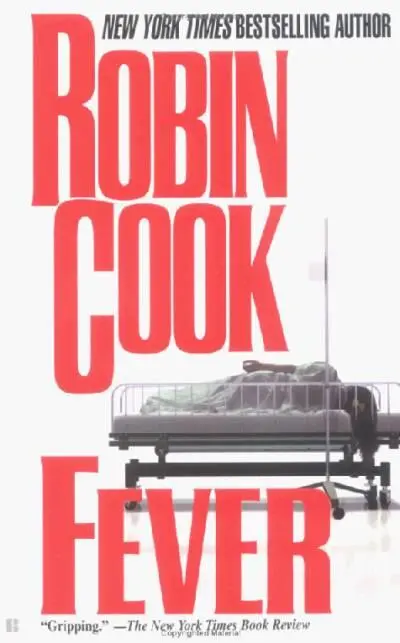
- Название:Fever
- Автор:
- Издательство:Berkley Publishing Group
- Жанр:
- Год:2000
- ISBN:0425174204
- Рейтинг книги:3 / 5. Голосов: 1
-
Избранное:Добавить в избранное
- Отзывы:
-
Ваша оценка:
Fever: краткое содержание, описание и аннотация
Предлагаем к чтению аннотацию, описание, краткое содержание или предисловие (зависит от того, что написал сам автор книги «Fever»). Если вы не нашли необходимую информацию о книге — напишите в комментариях, мы постараемся отыскать её.
Fever — читать онлайн бесплатно полную книгу (весь текст) целиком
Ниже представлен текст книги, разбитый по страницам. Система сохранения места последней прочитанной страницы, позволяет с удобством читать онлайн бесплатно книгу «Fever», без необходимости каждый раз заново искать на чём Вы остановились. Поставьте закладку, и сможете в любой момент перейти на страницу, на которой закончили чтение.
Интервал:
Закладка:
Cathryn quickly pulled herself together for the children’s sake, busying herself with clearing the table and keeping her face averted.
“Such blasphemy!” said Gina with disbelief. Her hand was pressed against her bosom. “I’m afraid Charles has opened himself to the devil.”
“How about a cannoli?” asked Jean Paul, carrying his plate to the sink.
With his father gone, Chuck felt a sense of exhilaration. He knew now that he could stand up against his father and win. Watching Cathryn clear the table, he tried to catch her eye. She had to have noticed how he stood his ground, and Chuck certainly noticed how Cathryn had backed him up. Pushing back his chair, he carried his plate to the sink and dutifully ran water over it.
Charles fled from the house with no goal other than to escape the infuriating atmosphere. Crunching through the crusted snow, he ran down toward the pond. The New England weather, true to form, had completely changed. The northeastern storm had blown out to sea and was replaced by an arctic front that froze everything in its tracks. Despite the fact he had been running, he could feel a raw chill, especially since he’d not taken the time to get his coat. Without a conscious decision, he veered left toward Michelle’s playhouse, noting that the change in the wind had effectively eliminated the smell from the chemical factory. Thank God!
After stamping his feet on the porch to remove any snow. Charles bent over and entered the miniature house. The interior was only ten feet long and a central archway divided it roughly in two: one-half was the living room with a built-in banquette; the other the kitchen, with a small table and sink. The playhouse had running water (in the summer) and one electrical outlet. From about age six to nine Michelle had made tea here for Charles on Sunday summer afternoons. The small hotplate she used was still working and Charles switched it on for a little heat.
Sitting down on the banquette, he stretched his legs out and crossed them, conserving as much body heat as possible. Still he soon began to shiver. The doll’s house was only a refuge from the icy wind, not from the cold.
As the solitude had the desired effect, Charles quickly calmed down, admitting that he had handled Chuck badly. Charles knew he had yet to come to terms with the disastrous day. He marveled how he had allowed himself to be lulled into a false sense of security over the last few years. He thought back to the morning… making love with Cathryn. In just twelve hours all the threads of his carefully organized world had unraveled.
Leaning forward so he could look up through the front window, Charles gazed at the canopy of sky. It had become a clear, star-studded night, and he could see forever, out into distant galaxies. The sight was beautiful but lifeless and all at once Charles felt an overwhelming sense of futility and loneliness. His eyes filled with tears, and he leaned back so that he couldn’t see the terrible beauty of the winter sky. Instead he looked out over the snow-covered landscape of the frozen pond. Immediately in front of him was the area of open water Jean Paul had asked about that morning.
Charles marveled at the depths of his loneliness, as if Michelle had already been taken from him. He didn’t understand these feelings although he guessed it might have something to do with guilt; if he had only been more attentive to Michelle’s symptoms; if he had only paid more attention to his family; if he had only carried out his research faster.
He wished he could put everything aside and just work on his own project. Maybe he could find a cure in time for Michelle. But Charles knew that was an impossible goal. Besides, he could not oppose Dr. Ibanez so openly. He could not afford to lose his job or the use of his lab. Suddenly Charles understood the directors’ cleverness in putting him on the Canceran project. Charles was disliked because of his unorthodoxy, but he was respected because of his scientific ability. Charles was a foil who lent the desired legitimacy that the project needed and a perfect scapegoat if the project failed. It was a decision of administrative genius.
In the distance Charles heard Cathryn’s voice calling his name. In the frigid air the sound was almost metallic. Charles didn’t move. One second he felt like crying, the next so weak that physical activity of any sort was impossible. What was he going to do about Michelle? If the chance of a remission faded, could he stand to watch her suffer with the treatment?
He moved over to the window and scraped off the frost his breath had created. Through the clear areas he could see the silver-blue snowscape and the patch of water directly in front of him. Guessing that the temperature was close to zero, Charles began to wonder about that open water. His original explanation to Jean Paul that morning had been that the current prevented it from icing over. But that was when the temperature hovered about the freezing mark. Now it was some thirty degrees below that. Charles wondered whether there was much current at that time of year. In the spring when the snows melted in the mountain to the north, the river raged and the pond rose by a foot-and-a-half. Then there would be current, not now.
Suddenly Charles was aware of a sweet aromatic smell. It had been there all the time but had not penetrated his consciousness until that moment. It was vaguely familiar, but out of context. He’d smelled it before, but where?
Eager for a distraction, Charles began to sniff around. The odor was about equal in intensity in the two rooms and strongest near the floor. Sniffing repeatedly, Charles tried to place the smell in his past. Suddenly it came to him: organic chemistry lab in college! He was smelling an organic solvent like benzene, toluene, or xylene. But what was it doing in the playhouse?
Braving the cold wind, Charles went out into the knife-sharp night. With his right hand he clutched his sweater tightly around his neck. Outside the aromatic odor was diminished because of the wind, but by bending down at the side of the playhouse, Charles determined the smell was coming from the partially frozen mud around and under the structure. Making his way down to the pond’s edge, Charles scooped up some of the icy water and brought it to his nose. There was no mistaking it: the smell was coming from the pond.
He followed the gradual curve of the pond, walking along the edge of the open water to the point where it merged with the inlet from the river. Bending down again, he brought some water to his nose. The odor was stronger. Breaking into a jog, Charles followed the inlet to the juncture with the Pawtomack River. It, too, was unfrozen. Again, Charles brought a sample to his nose. The odor was even more intense. The smell was coming from the river. Standing up, shaking from the cold, Charles stared upstream. Recycle, Ltd., the plastic/rubber recycling plant was up there. Charles knew from his chemistry background that benzene was used as a solvent for both plastics and rubber.
Benzene!
A powerful thought gripped his mind: Benzene causes leukemia; in fact it causes myeloblastic leukemia! Turning his head, Charles’s eyes followed the trail of the unfrozen, open water. It led directly to the playhouse: the one spot Michelle had spent more time than any other.
Like a crazed man, Charles sprinted for the house. The uneven snow tripped him and he fell headlong, landing on his chest with his palms outstretched. He was unhurt save for a cut on his chin. Picking himself up, he ran more slowly.
When he reached the house, he thundered up the back steps and banged open the door.
Cathryn, already taut as a tightened bowstring, involuntarily shrieked as Charles hurled himself breathlessly into the kitchen. The dish she was holding slipped from her hands and shattered on the floor.
Читать дальшеИнтервал:
Закладка:
Похожие книги на «Fever»
Представляем Вашему вниманию похожие книги на «Fever» списком для выбора. Мы отобрали схожую по названию и смыслу литературу в надежде предоставить читателям больше вариантов отыскать новые, интересные, ещё непрочитанные произведения.








Обсуждение, отзывы о книге «Fever» и просто собственные мнения читателей. Оставьте ваши комментарии, напишите, что Вы думаете о произведении, его смысле или главных героях. Укажите что конкретно понравилось, а что нет, и почему Вы так считаете.