Patrick Lee - The Breach
Здесь есть возможность читать онлайн «Patrick Lee - The Breach» весь текст электронной книги совершенно бесплатно (целиком полную версию без сокращений). В некоторых случаях можно слушать аудио, скачать через торрент в формате fb2 и присутствует краткое содержание. Жанр: Триллер, на английском языке. Описание произведения, (предисловие) а так же отзывы посетителей доступны на портале библиотеки ЛибКат.
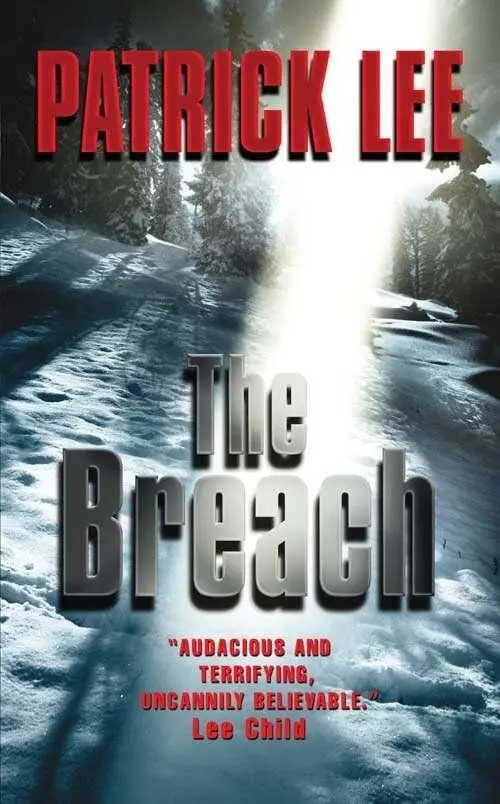
- Название:The Breach
- Автор:
- Жанр:
- Год:неизвестен
- ISBN:нет данных
- Рейтинг книги:4 / 5. Голосов: 1
-
Избранное:Добавить в избранное
- Отзывы:
-
Ваша оценка:
The Breach: краткое содержание, описание и аннотация
Предлагаем к чтению аннотацию, описание, краткое содержание или предисловие (зависит от того, что написал сам автор книги «The Breach»). Если вы не нашли необходимую информацию о книге — напишите в комментариях, мы постараемся отыскать её.
The Breach — читать онлайн бесплатно полную книгу (весь текст) целиком
Ниже представлен текст книги, разбитый по страницам. Система сохранения места последней прочитанной страницы, позволяет с удобством читать онлайн бесплатно книгу «The Breach», без необходимости каждый раз заново искать на чём Вы остановились. Поставьте закладку, и сможете в любой момент перейти на страницу, на которой закончили чтение.
Интервал:
Закладка:
Several hours into the first such meeting, the president turned to a man who'd said almost nothing so far: Peter Campbell, an MIT professor and, at thirty-three, the youngest member of the Science Council.
"You don't appear to agree," the president said.
"I don't."
"Then say what you're thinking."
Campbell chose his words carefully before he began.
"Does anyone in this room really believe we can keep this secret?" He allowed a few seconds of silence for an answer. None came. "Consider the spec data on the Manhattan Project. If there was ever a secret we needed to keep, that was it. How long did we manage? Two years. The Russian bomb program was under way within two years, at the latest. Think of the amount of knowledge they had to obtain from us to make their project work, and then consider that they need only learn two facts this time: that the Breach exists, and that the VLIC created it. After that, all the information they need is there for the taking. The specs on the VLIC were published in Scientific American five years before we finished building it."
The vice president spoke up. "Russia developing its own Breach is problematic, but-"
"Russia, China, India, North and South Korea, Israel, Germany, France, Britain, Japan, Saudi Arabia," Campbell said. "Probably a few more I'm leaving out. Count on each of them to have it up and running inside of ten years. Our VLIC took a decade to build with Department of Energy funding. DOD would've gotten it done in half that time, and we should expect the same urgency in all of these countries." He waved his own copy of the object report in front of him. "You want all their most generous defense contractors fucking around with this kind of stuff?"
Even years later, Campbell would lie awake wondering if one calculated use of the word fuck had saved the world. Certainly something in those few hundred words had struck a nerve, because the conversation tipped at that fulcrum and never managed to tip back. He'd aimed for their fears, that was all. He'd aimed for their fears and hit.
In the end, the president turned the inevitable question back to Campbell. What alternative approach did he propose?
Campbell had an answer. Take away the incentive for any other country to waste resources creating its own Breach. Share this one with all of them. Hold a secret summit with the leaders of these nations and their most respected scientists-but not their military-industrial tycoons. Be straight with them. Be upfront. Set in stone the only policy with a chance of avoiding chaos: the Breach should be overseen by a single organization loyal to the world as a whole and to no nation in particular. Let this group be composed of people with impeccable backgrounds in science and ethics-real ethics of human needs and liabilities, not the limited scope of any one culture's religious morality. Let no one actively seek to join; anyone craving that much responsibility should never be trusted with it. Instead identify excellent candidates and recruit them. The member nations should protect and finance this group, but none should control it. Not even America.
"But the Breach is on our soil," the defense secretary said. "We paid for what created it."
"All the more legitimate our stance will be," Campbell said. "Look, to whatever extent we flex our egos over this thing, we increase the chance of some other superpower saying, 'Forget it, we'll make our own.' Once one of them does that, others will follow. The only way to prevent it is to be evenhanded. Think about it: wouldn't we be grateful if one of them did the same, if one of their research facilities had accidentally generated this thing?"
"I don't believe any other country would do that," the president said.
"I don't either," Campbell said. "Which is why history will think so highly of you."
The debate didn't quite end that day, but over the spring and summer of 1978, nearly every decision ultimately went Campbell's way. The group that would oversee the Breach was designated Tangent. Its objectives were simple: to organize and study everything that emerged; to draw scientific insight-if possible-from those observations and advance human knowledge; to prevent the Breach from ever becoming a wishbone between opposing parties.
And it worked.
For a while.
"My father's strongest ally in the fight to create Tangent was a man named Aaron Pilgrim," Paige said. "He was the president's chief science advisor, and also one of the founders of the original VLIC project. Like my father, he went on to become one of Tangent's highest-ranking decision makers, and was generally considered the smartest member of the organization. He was exceptionally good at figuring out the purposes of the strange and unique entities that came out of the Breach. In time, those were brought to Aaron Pilgrim first, by default."
She paused. Stared out into the harsh sunlight on the plains.
"The Whisper came through in the summer of 1989. It had an attachment that kept it separate from its key, at first. But even switched off, it was dangerous as hell. The key only turns on the intelligence; the self-destructive aspect of it is always on. The first person who held it barehanded murdered two lab assistants and then cut his own throat with a pen. With its intelligence on, it triggers the same murder-suicide impulse, but on the scale of the entire world."
Travis tried to recall the thing's possession of him. He couldn't. His memories of it, vague only a few hours earlier during the interrogations, were simply gone now. All he had left were memories of his own descriptions of the experience, but even those were going.
Paige saw his expression. "No one ever remembers," she said. "In a few more hours, you'd forget you ever held it at all, without others reminding you. No idea why it does that."
"Why did it save my life?" he said. "From the killer in the suit?"
"If we understand anything about its pattern, it works like this: first it addresses any needs on the part of the user. The more desperate the need, the better. So it helped you kill your attacker. And then-I'm guessing a little here-it gave you the ability to read the language you saw on my wall, because that's a need too, if we're going to prevent what's coming."
"But is that my need, or yours?"
"It's everyone's need now."
The way she said it didn't lend itself to doubt.
"So then what?" he said. "When it's done with the user's needs, it gets busy with its own?"
"Something like that. It may toy with the person for a while. Reveal some painful insight into an old wound, things like that. That may be why it uses a voice from the person's past, one with a strong emotional impact. But yeah, it turns toward its own goals pretty quickly, and they're always the same: cause as much harm in the world as possible, as quickly as possible."
"Nice."
"We understood all that about it, early on. The danger was so obvious, we considered locking it away and never studying it at all. But the potential for good was too big to ignore. It knows everything. And everything about everything. It knows how many blades of grass are in Kansas right now, and the length, angle, and arc of each one, and how the arc would change if the wind were half a mile an hour stronger. It knows the cure for cancer. The cure for everything."
"I assume you asked it."
"We asked. We brought in late-stage cancer patients and let them hold it. Should've worked, right? But it didn't. Either it didn't consider their need compelling enough, or…" She hesitated to say the next part, then exhaled and went ahead. "Or it just didn't want to tell us things like that."
Travis waited for her to continue. She looked outside again, maybe reliving the angst the thing had inspired in her over the years.
"You probably don't remember," she said, "but when it switches from help mode to kill-the-world mode, the light changes."
Читать дальшеИнтервал:
Закладка:
Похожие книги на «The Breach»
Представляем Вашему вниманию похожие книги на «The Breach» списком для выбора. Мы отобрали схожую по названию и смыслу литературу в надежде предоставить читателям больше вариантов отыскать новые, интересные, ещё непрочитанные произведения.



Обсуждение, отзывы о книге «The Breach» и просто собственные мнения читателей. Оставьте ваши комментарии, напишите, что Вы думаете о произведении, его смысле или главных героях. Укажите что конкретно понравилось, а что нет, и почему Вы так считаете.