Thomas Cook - Instruments of Night
Здесь есть возможность читать онлайн «Thomas Cook - Instruments of Night» весь текст электронной книги совершенно бесплатно (целиком полную версию без сокращений). В некоторых случаях можно слушать аудио, скачать через торрент в формате fb2 и присутствует краткое содержание. Жанр: Триллер, на английском языке. Описание произведения, (предисловие) а так же отзывы посетителей доступны на портале библиотеки ЛибКат.
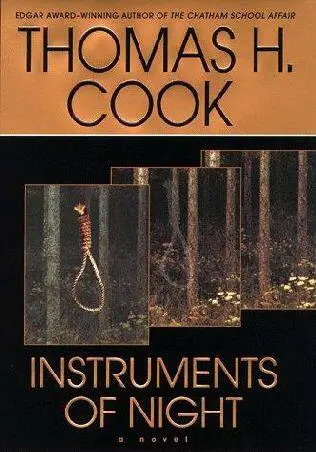
- Название:Instruments of Night
- Автор:
- Жанр:
- Год:неизвестен
- ISBN:нет данных
- Рейтинг книги:3 / 5. Голосов: 1
-
Избранное:Добавить в избранное
- Отзывы:
-
Ваша оценка:
Instruments of Night: краткое содержание, описание и аннотация
Предлагаем к чтению аннотацию, описание, краткое содержание или предисловие (зависит от того, что написал сам автор книги «Instruments of Night»). Если вы не нашли необходимую информацию о книге — напишите в комментариях, мы постараемся отыскать её.
Instruments of Night — читать онлайн бесплатно полную книгу (весь текст) целиком
Ниже представлен текст книги, разбитый по страницам. Система сохранения места последней прочитанной страницы, позволяет с удобством читать онлайн бесплатно книгу «Instruments of Night», без необходимости каждый раз заново искать на чём Вы остановились. Поставьте закладку, и сможете в любой момент перейти на страницу, на которой закончили чтение.
Интервал:
Закладка:
Graves gazed at the photograph for a long time. Then he closed his eyes, breathing deeply before he opened them again.
The next picture had been taken from a few feet beyond the mouth of the cave and showed its entrance, a rugged black recess surrounded by a thick, nearly impenetrable cloak of underbrush. Faye’s body rose like a mound of soiled clothes near the back of the cave. It was obvious that little effort had been made to hide it. Instead, it had merely been dragged to the rear of the cave and hastily covered with a litter of sticks and bramble, a kind of imitation burial that left the dead girl more or less exposed, a mound even the most casual forest rambler could easily have spotted.
The first two photographs had been the sort routinely taken by crime scene photographers. The last picture, however, was nothing of the kind. In fact, it was not a picture of the crime scene at all, but of Faye fully alive, standing on a riverbank, the Hudson flowing to her right, dense forest to her left. In every way it seemed like an ordinary picture, one of many that had no doubt been taken of Faye Harrison before her murder. It was not until Graves turned the photograph over and read the brief note scribbled on its back that he understood why Portman had included it.
Subject: Faye Harrison
Date taken: June 1, 1946
Location: Base of Mohonk Ridge-eastern quadrant-approx. 30 yds. from Manitou Cave
Photographer: Andre Grossman
Graves sat back in his chair and let his mind put it all together.
The resident artist at Riverwood that summer had taken a photograph of Faye Harrison almost three months before her death, and at a location only thirty yards from where he’d later come upon her body.
In his mind Graves saw Faye and Grossman at their first encounter, Grossman standing on the bank of the pond as Faye strolled out of the water in a black bathing suit, shaking her head as she walked, flinging sparkling drops in all directions. From beneath the shadow of his floppy brown hat, Grossman stared at her emptily, feeling his weight, his ugliness, loathing the cruel joke nature had played by putting such a passionately yearning heart in so unattractive a body, laboring to overcome the agonizing debilitation his looks had inflicted upon him, and his accent heightened, combined afflictions so severe and paralyzing that he barely managed to speak.
Hello.
Hi.
You are Faye, yes? Allison’s friend. I have been seeing you with her. Playing tennis, I think. And on the lake. In the boat. How you say? Rowing?
Yes.
Allison told me about you. I am Grossman. Andre Grossman. Painter. I am painting portrait of Mrs. Davies. You are-I hope you don’t mind me to say it-but you are most pretty girl.
Thank you.
Most pretty, yes. I hope you don’t mind if I ask you perhaps something?
What?
You are so… when I saw you come out of water just now it was… I thought you might-how you say it?-sit for me?
Sit?
For painting. There are no models, you see. It is hard. With no models. But I hope you’re not… that you don’t think. My English. I am sorry for my asking. I do not want you to think that… I only. Please, if I gave the wrong… I am sorry.
It’s okay. You don’t have to apologize.
Graves saw Andre Grossman’s eyes soften, heard his voice grow less strained.
So. Do you think perhaps… perhaps that I could… that you would sit for me?
As Graves now imagined it, Faye’s answer could not have been sweeter… or more naive.
I’ve never done anything like that before. But I guess I could. I guess it would be okay.
She posed for him the very next day, as Graves conjured it, Faye lying in the grass beside the water, Grossman a few feet away, peeping out from behind the canvas, studying her long, bare legs, gleaming white in the summer sun, her shimmering blond hair, his body tensing each time he felt her eyes drift toward him.
At first they talked little, but as the days passed they began to exchange bits of information. Grossman spoke of his boyhood in Europe, Faye of the life she’d lived at Riverwood, growing fond of the painter as the days passed, coming to think of him almost as a father. So much so, that it seemed strange when he said:
Please. Call me Andre. Do not think me so old that I can’t… that
I…
He had said nothing more, but had gone on to some other subject.
And so the days had passed, one falling upon another, Faye and Grossman increasingly drawn to each other. Faye toward the father who had died and abandoned her. Grossman toward a girl whose beauty made him want to do more than paint her, made him want to touch her.
Graves felt the story rush ahead, leaping over weeks and months, until the season neared its end. The artist’s time at Riverwood was almost over, the prospect of leaving it, of leaving Faye, became increasingly painful to him, his situation unbearable, his unexpressed desire desperate.
What do you think of it, the portrait?
Do I really look like that?
Yes, you do, Faye. You do not know this?
But I look so… beautiful.
But you are beautiful. Believe this. I have seen many girls. In Europe. In the great cities. I have seen many, many girls, but they are not so beautiful as you.
No, I’m just a No, please. Stop. Don’t say things against yourself.
Graves saw Andre Grossman’s eyes grow wild with longing, knowing that the moment had come, finally summoning the courage to seize it, his words bursting from him like small flames:
Go with me, Faye. When I leave, go with me. We could… be together
… forever.
Graves now watched as Grossman lay his dreams before her, watched him tell Faye exactly what he felt, what he wanted, then stand in an agonized silence as the girl stared at him, shocked by the absurdity of his proposal, stammering her excuses as she swiftly gathered up her things, desperate to get away from him, this poor, pathetic little man.
With the story near its end, Graves looked at the photograph again, concentrating on Grossman now rather than on Faye. Shame and anguish and self-loathing must have swept over him at the moment of his supreme humiliation. Graves saw him in the days that followed her rejection, a stubby figure storming along the edge of the pond, bitter, fuming, his eyes fixed straight ahead, forcing himself not to look toward the radiant teenage girl who, on the morning of August 27th, moved across the lawn of Riverwood, her very beauty an incitement, reminding him that he was vile and disgusting, something to be yanked from a brackish water and hurled against a stone, a slimy, bloated toad.
Graves imagined the final scene as two figures grappling in a swirl of leaves, one pressed down like a heavy stone upon the other, the cord relentlessly tightening around a slender white throat. For a moment he heard the fury of that struggle, Faye’s muted cries, her fingers clawing the tightening cord, a final gasp, and after that only Grossman’s oddly sensual moan.
CHAPTER 14
An evening shade had begun to fall over Riverwood by the time Graves headed back to his cottage. Eleanor Stern was sitting on the porch of her cottage. When she saw Graves, she stood and walked to the wooden railing of the porch. She lifted a glass toward him. “Care to join me?”
Graves never allowed himself a drink, nor even companionship very often, but the slowly falling night seemed to penetrate the wall he lived behind, to inexplicably urge him toward her.
“All right,” he said quietly.
He mounted the stairs, sat down in one of the chairs opposite her, took the glass of wine she offered, but did not sip it.
“You didn’t come to lunch,” Eleanor said.
“No, I didn’t.”
When Graves added nothing else, Eleanor let the matter drop. “Last night I thought I noticed a southern accent. What part of the South are you from?”
Читать дальшеИнтервал:
Закладка:
Похожие книги на «Instruments of Night»
Представляем Вашему вниманию похожие книги на «Instruments of Night» списком для выбора. Мы отобрали схожую по названию и смыслу литературу в надежде предоставить читателям больше вариантов отыскать новые, интересные, ещё непрочитанные произведения.











Обсуждение, отзывы о книге «Instruments of Night» и просто собственные мнения читателей. Оставьте ваши комментарии, напишите, что Вы думаете о произведении, его смысле или главных героях. Укажите что конкретно понравилось, а что нет, и почему Вы так считаете.