M Bennett - S.T.A.G.S.
Здесь есть возможность читать онлайн «M Bennett - S.T.A.G.S.» весь текст электронной книги совершенно бесплатно (целиком полную версию без сокращений). В некоторых случаях можно слушать аудио, скачать через торрент в формате fb2 и присутствует краткое содержание. Город: London, Год выпуска: 2017, ISBN: 2017, Издательство: Hot Key Books, Жанр: Триллер, на английском языке. Описание произведения, (предисловие) а так же отзывы посетителей доступны на портале библиотеки ЛибКат.
- Название:S.T.A.G.S.
- Автор:
- Издательство:Hot Key Books
- Жанр:
- Год:2017
- Город:London
- ISBN:978-1-4714-0677-5
- Рейтинг книги:4 / 5. Голосов: 1
-
Избранное:Добавить в избранное
- Отзывы:
-
Ваша оценка:
S.T.A.G.S.: краткое содержание, описание и аннотация
Предлагаем к чтению аннотацию, описание, краткое содержание или предисловие (зависит от того, что написал сам автор книги «S.T.A.G.S.»). Если вы не нашли необходимую информацию о книге — напишите в комментариях, мы постараемся отыскать её.
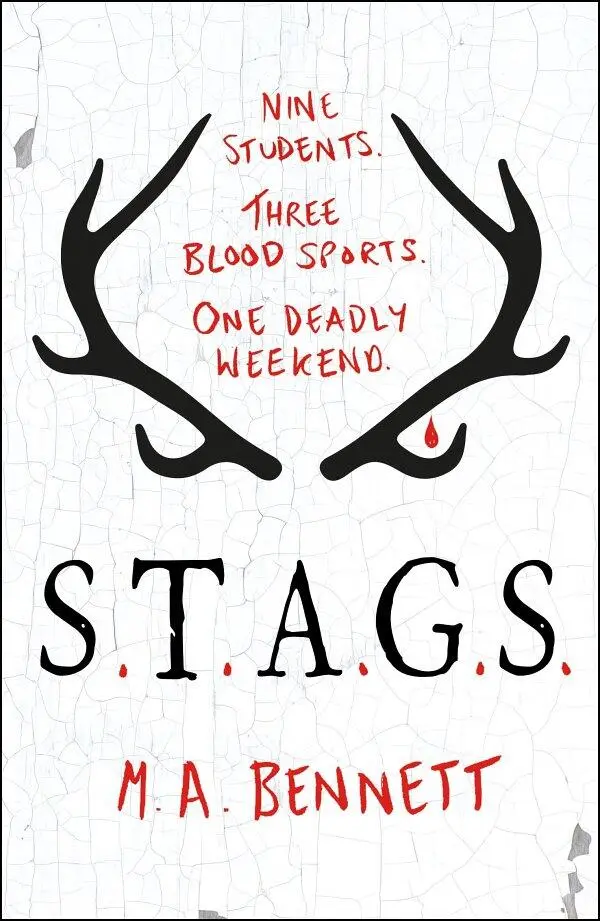
It is the autumn term and Greer MacDonald is struggling to settle into the sixth form at the exclusive St. Aidan the Great boarding school, known to its privileged pupils as S.T.A.G.S. Just when she despairs of making friends Greer receives a mysterious invitation with three words embossed upon on it: huntin' shootin' fishin'. When Greer learns that the invitation is to spend the half term weekend at the country manor of Henry de Warlencourt, the most popular and wealthy boy at S.T.A.G.S., she is as surprised as she is flattered.
But when Greer joins the other chosen few at the ancient and sprawling Longcross Hall, she realises that Henry's parents are not at home; the only adults present are a cohort of eerily compliant servants. The students are at the mercy of their capricious host, and, over the next three days, as the three bloodsports - hunting, shooting and fishing - become increasingly dark and twisted, Greer comes to the horrifying realisation that those being hunted are not wild game, but the very misfits Henry has brought with him from school...
S.T.A.G.S. — читать онлайн бесплатно полную книгу (весь текст) целиком
Ниже представлен текст книги, разбитый по страницам. Система сохранения места последней прочитанной страницы, позволяет с удобством читать онлайн бесплатно книгу «S.T.A.G.S.», без необходимости каждый раз заново искать на чём Вы остановились. Поставьте закладку, и сможете в любой момент перейти на страницу, на которой закончили чтение.
Интервал:
Закладка:
The sports are strange at STAGS as well; we don’t play ordinary games like netball and hockey and football but things like fives and real tennis, in Tudor wooden courts out beyond the playing fields. Those playing fields, known as Bede’s Piece, are immense, but are not used for anything standard like athletics, only for sports like rugby (‘rugger’) and lacrosse. STAGS has its own theatre, but it doesn’t have any fancy lighting or sets; it’s a faithful Jacobean replica playhouse lit by candles. Candles . Instead of German and French we study Latin and Greek. The food too is different from normal school food, in that it is really nice. Actually it’s amazing – it’s the sort you would get in a really good restaurant, not at all like the slop we used to get at Bewley Park. Meals are served by women from the local village, who seem perfectly nice but are rewarded with the nickname ‘dinnerbags’. But the major difference between STAGS and a normal school is, as you might have guessed, that it costs an absolute fortune. The STAGS parents pay the fees willingly, and it didn’t take me long to figure out what they are paying for. They are not paying for their little darlings to benefit from the Jacobean theatre, or the Olympic-sized swimming pool, or for the incredible, knock-your-eyes-out beauty of the place. What they are paying for is for their children to be different too.
For the first thousand years or so there were just four houses at STAGS: Honorius, Bede, Oswald and Paulinus. Then a few decades ago they started to admit girls, so they founded a new girls’ house called Lightfoot. I was told in my admissions letter that the Lightfoot dormitories were in one of the more ‘modern’ buildings, and I arrived expecting lots of pine and glass and central heating. It turned out that the Lightfoot building was built in 1550, and was all diamond-paned windows and crazy spiral chimneys. At STAGS 1550 was evidently considered ‘modern’.
My room was on the third floor at the end of a panelled Tudor passageway. Through an immense oak door, the room itself was modern. It had chipboard furniture, office-blue carpets and a girl already in it. The habit of thinking in films was a hard one to break. If my first encounter with my roommate was in a film script, it would look like this:
GREER(smiling): I’m Greer. What’s your name?
Greer’s roommate looks her up and down in a snotty way.
ROOMMATE(rolling her eyes): Jesus.
After that first encounter I always called her ‘Jesus’ to myself, because it made me smile, and there was little enough for me to smile about at STAGS. I found out later that her name was actually Becca. She was a horse-mad girl, who had pictures of her ponies on her wall like I had pictures of my dad. Maybe she missed them as much as I missed him. I didn’t see how.
That’s pretty much it for dialogue in this part of the story. There will be lots later, but the sad truth was no one talked to me much in that first half-term. Teachers asked me questions in lessons; the dinnerbags would say things like, ‘Chips or mash, hinny?’ (Their accents would make me homesick.) And Shafeen, this kid in my learning set, would occasionally murmur things at me like, ‘The thermal stability of the nitrates follows the same trend as that of the carbonates.’
Despite sharing a room with me, Jesus did not talk to me until it was nearly half-term, and that was only because I got The Invitation. I now think that if I’d had more friends – or any friends – in that first half-term, I never would have accepted The Invitation. Maybe I accepted it because I was lonely. Or maybe, if I’m being honest, I accepted it because it came from the best-looking boy in the school.
Chapter two
I mean, of course, Henry de Warlencourt.
You might have read about him online by now, on that creepy Facebook page they set up for him, or seen his picture on the news. But back then he wasn’t famous – or infamous – outside of his own circle. They say you shouldn’t speak ill of the dead so I’ll just say you would never have known by looking at him what a terrible person he was.
I have to really struggle, now, to remember him as I first saw him; to be fair to that first impression, and try to forget what I know now. He was, quite simply, the most gorgeous boy I’d ever seen. Tall for seventeen, all blond hair, blue eyes and tanned skin. When people were around Henry de Warlencourt they watched him all the time, even though they pretended they weren’t. Even the Friars seemed to be in awe of Henry. He never got punished for anything – and that’s not because he didn’t do anything wrong; it’s because he got away with it. He was like one of those really cool frying pans that everything slides off. He thought he was invincible. But he wasn’t.
Henry de Warlencourt was as British as they come, despite his foreign-sounding name. Apparently some distant ancestor had fought in the Frankish army on the Crusades, and had settled in England afterwards, conveniently marrying some noblewoman who owned half of northern England. The de Warlencourts had been fabulously rich ever since. Their house, Longcross Hall, is a beautiful manor house in the Lake District. I know it better than I ever would have wanted to, because Longcross was the scene of the crime.
Because I was in the top set for all my subjects I saw Henry de Warlencourt a lot; him and his five closest friends. The six of them were known as the Medievals. Everyone knew the Medievals, because it was the Medievals – not the Friars – who really ran STAGS.
The Medievals were the unofficial prefects of the school. You’d see them walking in the quad in their immaculate uniforms, long black coats fluttering in the autumn breeze. The Medievals were allowed to wear any colour stockings they wanted under their Tudor coats, and they emphasised this privilege by choosing crazy patterns like leopard print, or tartan, or chessboard checks. But it wasn’t just the stockings that marked them out; it was a particular kind of confidence they had about them. They lolled about like expensive cats. That confidence, that comfort in their surroundings, told you that their houses were probably not that different to STAGS; that they probably had grounds too, rather than gardens, and houses with wings, instead of neighbours. And antlers too, houses with lots of antlers on the walls.
The Medievals were all tall, beautiful and clever, as if they were especially bred for the job. They held court in the Paulinus quad – a beautiful square of perfectly manicured grass, surrounded by four walkways of elegant arched cloisters, at the heart of Paulinus house.
Henry de Warlencourt was always at the centre of the group, his blond head visible, as if he was that king at Versailles, whichever one it was, one of those millions of Louis. Henry was the sun, and the rest revolved around him. They would hang out there in all weathers, talking, reading and, after dark, secretly smoking. There was a sort of ancient stone well in the middle of the quad, and if you ever got close enough to look down it, you could see that about a foot down a circle of chicken wire had been fixed for safety, and the chicken wire was stuffed with cigarette butts. I once dropped a coin through the holes, to see how deep it was. I listened for ages, but couldn’t hear the splash of the coin hitting the water. I assumed that the bottom of the well was so full of fag butts that they were cushioning the coin’s fall. The Paulinus well was just like the Medievals themselves. It looked pretty, but in its depths it was gross.
Читать дальшеИнтервал:
Закладка:
Похожие книги на «S.T.A.G.S.»
Представляем Вашему вниманию похожие книги на «S.T.A.G.S.» списком для выбора. Мы отобрали схожую по названию и смыслу литературу в надежде предоставить читателям больше вариантов отыскать новые, интересные, ещё непрочитанные произведения.










Обсуждение, отзывы о книге «S.T.A.G.S.» и просто собственные мнения читателей. Оставьте ваши комментарии, напишите, что Вы думаете о произведении, его смысле или главных героях. Укажите что конкретно понравилось, а что нет, и почему Вы так считаете.