Matthew Stokoe - Empty Mile
Здесь есть возможность читать онлайн «Matthew Stokoe - Empty Mile» весь текст электронной книги совершенно бесплатно (целиком полную версию без сокращений). В некоторых случаях можно слушать аудио, скачать через торрент в формате fb2 и присутствует краткое содержание. Жанр: Триллер, на английском языке. Описание произведения, (предисловие) а так же отзывы посетителей доступны на портале библиотеки ЛибКат.
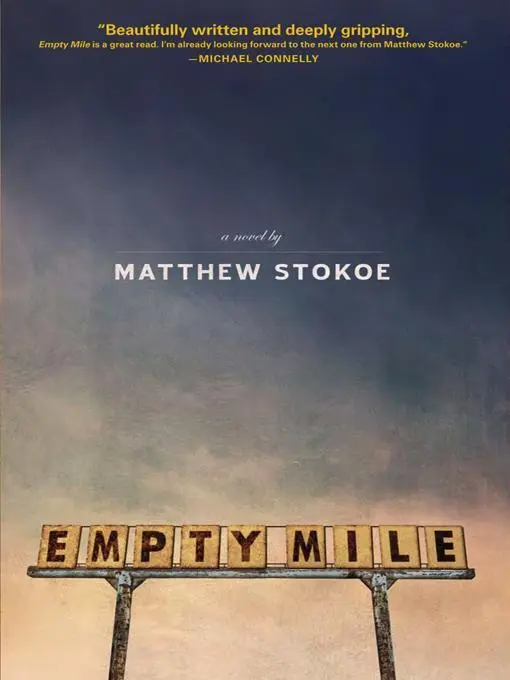
- Название:Empty Mile
- Автор:
- Жанр:
- Год:неизвестен
- ISBN:нет данных
- Рейтинг книги:5 / 5. Голосов: 1
-
Избранное:Добавить в избранное
- Отзывы:
-
Ваша оценка:
Empty Mile: краткое содержание, описание и аннотация
Предлагаем к чтению аннотацию, описание, краткое содержание или предисловие (зависит от того, что написал сам автор книги «Empty Mile»). Если вы не нашли необходимую информацию о книге — напишите в комментариях, мы постараемся отыскать её.
Empty Mile — читать онлайн бесплатно полную книгу (весь текст) целиком
Ниже представлен текст книги, разбитый по страницам. Система сохранения места последней прочитанной страницы, позволяет с удобством читать онлайн бесплатно книгу «Empty Mile», без необходимости каждый раз заново искать на чём Вы остановились. Поставьте закладку, и сможете в любой момент перейти на страницу, на которой закончили чтение.
Интервал:
Закладка:
“She’s in her room.”
Stan looked uncertain.
“Go on, you can go through.”
Stan walked through a square arch in the back wall and a moment later I heard him tapping on a door. Millicent smiled gently at me.
“We were both sorry to hear about your father. What a mystery. He seemed like a decent man.”
“Yes, he was.”
“The police don’t expect to find him?”
“I don’t think so.”
Millicent nodded to herself. “Will you sell the land?”
“My father wanted me to keep it.”
“Well, it’s a pretty enough spot.”
“It is, but I’m kind of puzzled about what he was planning to do with it.”
Millicent shrugged. “First time I met him he was trying to get me to put my house on the market. Maybe when he saw the land he just fell in love with it. Maybe he didn’t have any plans.”
“When was that?”
“February. I remember because it seemed a silly time to be selling a house, but he said there were a lot of buyers in the market for vacation homes and he wanted to get it listed for spring when people started to buy. He said he could get me a good price. I told him to take a look and tell me where I could go on the kind of money I’d get for this place. Our water’s that rain tank out there, toilet’s another tank buried in the ground. He kept trying, of course, I suppose they have to, but he gave up when he saw I wasn’t going to change my mind. We ended up talking about gold, of all things.”
“Gold?”
“Yes, he and the young man he had with him were both amateur prospectors and it happens that one of my ancestors, an Englishman like your father, came to California in the Gold Rush and kept something of a journal about it. Your father asked to see it. He seemed very interested in the history of the area.”
“Who was the guy with him?”
“I don’t know, a friend, perhaps. He didn’t appear to be involved in your father’s business.”
“Does the journal say anything about this land here?”
“A little, I think. It’s been a long time since I even looked at it. It never interested me all that much.”
Stan and Rosie came into the room then. Rosie had her eyes on the floor, as usual, but as she moved to the front door she turned her head slightly toward her grandmother.
“We’re going for a walk.”
She headed on out of the house without stopping. Stan followed her closely. I watched them pass through the doorway and when I looked back at Millicent I saw that she had been watching me.
“You don’t have to worry, you know.”
“What?”
“About him getting her pregnant. I could see it in your face.”
“Stan hasn’t had much experience with girls. Any, in fact.”
“Rosie can’t have children. She had her tubes tied when she was sixteen. She was in a home for disturbed adolescents at the time and she was very withdrawn. No one knew what was going to become of her and they said the operation would be for the best because sooner or later one of the boys there was sure to get at her. I had to say yes. What else could I do? She couldn’t take care of a child.” Millicent stared at the needlework in her lap and after a long pause said, “It was for the best.”
She spoke the words firmly then shook herself.
“You wanted to know if the journal says anything about this place. You can read it yourself if you like. It’s over there.” She pointed to a small set of shelves beneath one of the windows. “The gray one on the end.”
I took the book she indicated. Millicent started her needlework again and while she pushed and pulled the needle and its bright thread through the disk of cotton I sat in that quiet pale room and turned pages that had been written a hundred and thirty years before I was born.
The book was covered with coarse canvas. In places the depressions in the weave still held a residue of its original green color, but mostly the covers were faded to a grubby shale. Inside, the first two-thirds of the book had been damaged by water and were unreadable. The remaining pages were covered in a precise hand that gave little slope to its letters. The name Nathaniel Bletcher was printed on the inside of the back cover-Millicent’s ancestor, I assumed.
The Gold Rush had had its start in January 1848 when James Marshall found traces of gold in a millrace he was building on the American River at Coloma for a would-be land baron named Joseph Sutter. California was relatively sparsely populated at the time but that all changed over the next year as news spread around the world that a man could get rich simply by scooping dirt out of a river. By 1849 fortune hunters were pouring into the state from every part of the world, most of them heading north for the streams and rivers on the western slopes of the Sierra Nevada. Nathaniel Bletcher had been one of them.
With so many men competing for claims it became less and less easy to earn a decent day’s wage with each month that passed, let alone hit the big time. For some men the solution to this problem was to head further inland, beyond the already established diggings, in search of a river or creek that had not yet been discovered and worked by others.
From the journal it appeared Nathaniel Bletcher had been forced, eventually, to adopt this approach. He’d begun his quest for gold on the Feather River where he’d worked a claim for a month without success before selling it and moving on to the Yuba. He prospected this river for three months, moving steadily toward the junction with its south fork. Many of the diggings he passed through had been rich strikes, but he came on them too late to pan anything like the amount of gold he needed to make himself a wealthy man. And so, finally, he abandoned the Yuba, bought a mule and supplies, and walked north into the surrounding forest, determined to keep going until he found his own untouched river.
It took him nine days and even then what he first found was not what he had been hoping for. The bright line of water that guided him out of the forest was already named and known-the Swallow River. To his disappointment there were men there before him and they were panning rich deposits. But there were not many of them and from talking to them he learned that they were the first to reach so far up the Swallow.
He spent two nights on the periphery of this newborn mining encampment, but the lure of his own personal El Dorado was too strong and on the third morning he repacked his mule and struck off alone upriver.
Though California’s population exploded as a result of the Gold Rush it was by no means entirely unsettled beforehand. Places had been named, some of the land had been mapped. Settlers who had known nothing of gold had hacked homesteads out of the wilds and, here and there, small hamlets had formed.
I turned the pages of the journal that charted Nathaniel’s progress upriver, looking for a place name or the mention of a settlement in the hope that I might be able to pinpoint what part of the Swallow River he had journeyed along.
For several pages there was little, just the outline of four days’ slow travel. Immediately beyond the encampment of miners the riverbed had lost its gold-bearing floor of sand and gravel and its water flowed instead over flat rock and jumbles of boulders, terrain poorly suited for the collection of gold dust. Nathaniel’s entries on these days were weighted with despondency and he began to consider cutting his losses and returning to the encampment. On the fourth day, however, he made this entry:
March 15, 1849
At last! The river has grown a little wider and I am camped this evening beside a shoal of gravel that yields good color. From noon to dusk I took two ounces with my pan. The gold is not heavily concentrated, but it is here! It is here! The surrounding land provides good reason for optimism. Upriver, above the tops of the trees, I can see a tall formation of rock that is surely quartz-bearing. It is greatly eroded and can have shed its minerals nowhere else but into the river which it appears to border so closely. Ahead of me the river curves and I cannot see the lay of it but I feel that I am at the ragged end of a great deposit. And of the multitudes who scrabble over this country it is I alone who am here to mine it. What will tomorrow bring? I will journey further. If my luck is good I will find the belly of this lode. If my luck is good.
Читать дальшеИнтервал:
Закладка:
Похожие книги на «Empty Mile»
Представляем Вашему вниманию похожие книги на «Empty Mile» списком для выбора. Мы отобрали схожую по названию и смыслу литературу в надежде предоставить читателям больше вариантов отыскать новые, интересные, ещё непрочитанные произведения.


Обсуждение, отзывы о книге «Empty Mile» и просто собственные мнения читателей. Оставьте ваши комментарии, напишите, что Вы думаете о произведении, его смысле или главных героях. Укажите что конкретно понравилось, а что нет, и почему Вы так считаете.