Randy White - Everglades
Здесь есть возможность читать онлайн «Randy White - Everglades» весь текст электронной книги совершенно бесплатно (целиком полную версию без сокращений). В некоторых случаях можно слушать аудио, скачать через торрент в формате fb2 и присутствует краткое содержание. Жанр: Триллер, на английском языке. Описание произведения, (предисловие) а так же отзывы посетителей доступны на портале библиотеки ЛибКат.
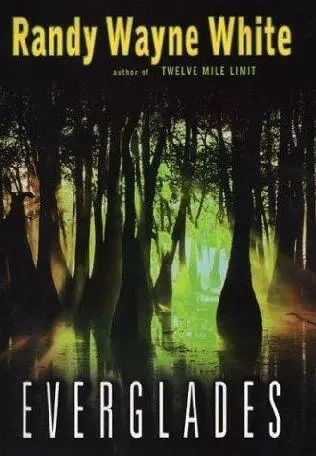
- Название:Everglades
- Автор:
- Жанр:
- Год:неизвестен
- ISBN:нет данных
- Рейтинг книги:5 / 5. Голосов: 1
-
Избранное:Добавить в избранное
- Отзывы:
-
Ваша оценка:
Everglades: краткое содержание, описание и аннотация
Предлагаем к чтению аннотацию, описание, краткое содержание или предисловие (зависит от того, что написал сам автор книги «Everglades»). Если вы не нашли необходимую информацию о книге — напишите в комментариях, мы постараемся отыскать её.
Everglades — читать онлайн бесплатно полную книгу (весь текст) целиком
Ниже представлен текст книги, разбитый по страницам. Система сохранения места последней прочитанной страницы, позволяет с удобством читать онлайн бесплатно книгу «Everglades», без необходимости каждый раз заново искать на чём Вы остановились. Поставьте закладку, и сможете в любой момент перейти на страницу, на которой закончили чтение.
Интервал:
Закладка:
We’d been discussing the most recent of governmental outrages imposed upon our little boating community. It concerned Captain Felix Blane-all six-feet-five inches and 250 pounds of him-who’d been out in his twenty-four-foot Parker, Osprey. He’d had a party aboard when an unmarked flats boat came screaming up alongside, portable blue lights flashing, and forced him to stop.
Two plainclothes U.S. Fish and Wildlife officers then proceeded to accuse him of ignoring the new Manatee Protection Laws that require boaters to travel at idle speed when within five hundred feet of certain mangrove areas.
“One of the Feds had a ponytail,” Mack told me. “The smart-ass undercover-agent type, and he gave Felix a lecture about how he needed to learn basic boating skills, and start caring about wildlife. In front of his clients.”
Captain Felix, who’s been guiding around Sanibel for nearly thirty years endured the lecture like the professional he is, then told the officers, “Do you have navigational equipment? Check your GPS. We’re more than half a mile from the mangroves. I’m way outside the manatee zone. I haven’t broken any laws.”
The long-haired officer replied, “In my judgment, we’re closer to the mangroves than your GPS says. And that’s all that matters. If you want to hire an attorney, I’ll see you in Tampa federal court five or six times over the next few months. So you can start canceling your bookings for May right now.”
May, the beginning of tarpon season, is one of the busiest times of year for guides on Sanibel and Captiva.
I said, “If that’s true, it’s terrible. That’s a sophisticated kind of extortion. No fishing guide can afford to fight federal attorneys, plus miss all those days on the water over a couple-hundred-dollar ticket.”
Mack said, “It is true. Almost the exact thing happened to one of the guides out of Cabbage Key. You know Captain Doug. The plainclothes Feds stopped him twice. The same hippy-looking bugger pointed and told him where he was allowed to run his skiff above idle, then a second unmarked boat pulled him over and wrote him a ticket. It’s not that they tricked him. It’s just that those sots don’t know the area, they don’t know boats and they don’t know the water.”
Sadly, he was right-I’d heard too many similar horror stories to doubt it. I was nodding, as he added, “I enjoy the outdoors and wildlife, manatees, as much as the next man, but it’s just getting too crazy. Environmental wackos, mate. I think they’re tryin’ to take over the entire bloody earth.”
Because I didn’t want to get into an argument with Mack, I shut my mouth tight, walked out to the docks and stepped down into my twenty-one-foot Maverick. I had several five-gallon buckets aboard, and I’d stopped at the marina to fuel up before heading out on a collecting trip.
I don’t have much patience with the term environmental wackos or the callous, shortsighted philosophy the phrase seems to signal. As a marine biologist, I am also, necessarily, an environmentalist. I take pride in the fact that some of the research I’ve done, certain papers I’ve published, have played a role in protecting our dwindling marine resources.
In the minds of many, what is now known as the “environmental movement” began in 1962 with the publication of Rachel Carson’s Silent Spring. It is a fact that, at the time, America’s natural resources were in terrible shape. The Great Lakes were so polluted they were unsafe for swimming. Our rivers were such cesspools of chemicals and petroleum waste that they caught fire and burned. In industrial cities, all six of the most dangerous air pollutants tracked by the EPA measured off the scale.
Private enterprise and a profited-minded government were slowly killing an entire continent. The environmental movement deserves full credit for changing that.
Half a century later, though, what was once a movement has now become the very thing its founders battled. So-called “environmentalism” has become a profit-driven, power-hungry industry in which private political agendas are more important than biological realities, and monetary objectives excuse any perversion of scientific fact.
A few months back, I was talking with someone familiar with Mote Marine, the organization I’m now doing contract work for. He told me that Mote had received an official letter of protest from PETA (People for the Ethical Treatment of Animals) that condemned Mote for housing and studying jellyfish. I’m paraphrasing, but there was a line in the letter that read, “These magnificent creatures should be allowed to roam free in the wild!”
That a national “environmental” organization could pen a letter so stupid, so childishly ignorant of the species that they referenced, is not just sad, it is frightening. Unthinking extremists have taken possession of what was once a noble title, environmentalist, and they are destroying our credibility, just as surely as they are giving credence and power to people who use sad phrases such as environmental wackos.
In the Everglades, when I’d listened to Billie Egret’s short tirade against legislated efforts to save the region, I’d disagreed with her cynicism, but I understood the source of her mistrust: the environmental industry. The En-dustry is made up of governmental agencies, private businesses and “nonprofit” organizations.
Fortunately, each has, in my experience, at least a few men and women who are rational and well-intended, who put the well-being of the environment before their own self-interests. But, like our own natural resources, the numbers of honest ones seem to be dwindling.
I don’t trust the En-dustry, either. No thinking environmentalist should.
So I was sitting in my skiff, ruminating over national matters that are far, far out of my control, when Mack paged me over the PA, telling me that I had a phone call in the office.
It was Frank.
As I listened to DeAntoni, I was also aware that Mack, Jeth and Captain Neville were listening, too, and so I told him I’d telephone him from my house.
A few minutes later, Frank answered, saying, “So how’s it going with you, Dr. Nerd? You still hanging out with that dope-smoking goofball with the cannon for an arm?”
I told him that Tomlinson had pitched against Naples on Sunday, had given up six runs in three innings, plus done a lot of heavy drumming later that night, and so his “cannon” was probably still hurting him on this clear spring morning.
“Fucking Tinkerbell, man. You could throw a tent over the guy and call him a circus. Weird thing is, though? I kind’a like the skinny little dork.”
I had to laugh. It was Tomlinson’s guileless candor that made him likeable, and DeAntoni possessed the same rare quality. You couldn’t help but like the man.
He was headed for Miami, he told me. Traffic sucked. There were so many Third World former donkey-cart drivers on the road, Cubans and Haitians, that I-95, he said, should have its named changed to the Refugee Express. If he survived, he was going to meet Sally for lunch, then spend the rest of the night in his car, watching her house.
“Stu Johnson, the security guard they found floating? The medical examiner says he died of a cerebral hemorrhage. A vessel in his brain popped. But there was also a nasty bruise on his throat. So they’re figuring maybe he hit the dock when he fell. That’s what my cop buddies are telling me.”
I said, “The question is, why would a security guard get out of his car and go stand on a dock?”
DeAntoni said, “Exactly. Sally swears someone’s been in her room, and that lady’s word’s good enough for me.” There was a little smile in his voice, when he added, “Hey, listen to this. We had a great dinner together Saturday night. She was real upset about Mr. Johnson and her dog, too, but we still managed to have some laughs. So we’ve had dinner together every night since. But this one, you’re not going to believe, Ford.”
Читать дальшеИнтервал:
Закладка:
Похожие книги на «Everglades»
Представляем Вашему вниманию похожие книги на «Everglades» списком для выбора. Мы отобрали схожую по названию и смыслу литературу в надежде предоставить читателям больше вариантов отыскать новые, интересные, ещё непрочитанные произведения.


Обсуждение, отзывы о книге «Everglades» и просто собственные мнения читателей. Оставьте ваши комментарии, напишите, что Вы думаете о произведении, его смысле или главных героях. Укажите что конкретно понравилось, а что нет, и почему Вы так считаете.