Martin Smith - Stalin’s Ghost
Здесь есть возможность читать онлайн «Martin Smith - Stalin’s Ghost» весь текст электронной книги совершенно бесплатно (целиком полную версию без сокращений). В некоторых случаях можно слушать аудио, скачать через торрент в формате fb2 и присутствует краткое содержание. Жанр: Триллер, на английском языке. Описание произведения, (предисловие) а так же отзывы посетителей доступны на портале библиотеки ЛибКат.
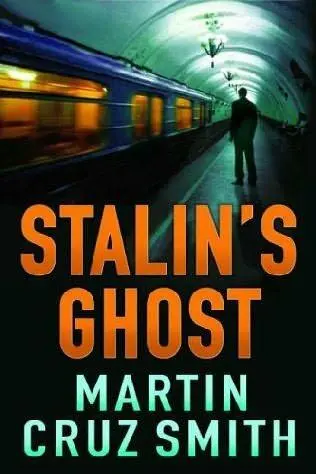
- Название:Stalin’s Ghost
- Автор:
- Жанр:
- Год:неизвестен
- ISBN:нет данных
- Рейтинг книги:4 / 5. Голосов: 1
-
Избранное:Добавить в избранное
- Отзывы:
-
Ваша оценка:
Stalin’s Ghost: краткое содержание, описание и аннотация
Предлагаем к чтению аннотацию, описание, краткое содержание или предисловие (зависит от того, что написал сам автор книги «Stalin’s Ghost»). Если вы не нашли необходимую информацию о книге — напишите в комментариях, мы постараемся отыскать её.
Stalin’s Ghost — читать онлайн бесплатно полную книгу (весь текст) целиком
Ниже представлен текст книги, разбитый по страницам. Система сохранения места последней прочитанной страницы, позволяет с удобством читать онлайн бесплатно книгу «Stalin’s Ghost», без необходимости каждый раз заново искать на чём Вы остановились. Поставьте закладку, и сможете в любой момент перейти на страницу, на которой закончили чтение.
Интервал:
Закладка:
“I’m sorry,” Zhenya said.
Arkady was a little startled. He was at the desk writing in the notebook and hadn’t heard Zhenya approach.
“Thank you. I’m sorry about your father.”
“Did you see it?”
“No, not actually.”
“You don’t remember it?” Zhenya asked.
“No.”
Zhenya nodded, as if that were a good option.
“Do you remember going to Gorky Park?”
“Of course.”
“Remember the Ferris wheel?”
“Yes. Your father ran it.”
Osip Lysenko had hit on a perfect situation for dealing drugs: young people paying in cash for a five-minute ride in the open-air privacy of a gondola. That no one tried to fly from the top of the wheel was a miracle.
“He was never there,” Zhenya said.
Thank God, Arkady thought. Each had gone to the park with a false assumption. Arkady thought that the boy sought a missing father. The boy thought Arkady carried a gun.
One minute was usually the time limit on discourse with Zhenya, but he stood his ground and brightened. “Winter is a bitch.”
“It certainly can be.”
“In the rail yard you could freeze to death. Sniff glue during the day and turn blue at night. That’s when you go to the shelter.”
“Like wintering in the Crimea.”
“The problem is, if a parent shows up they hand you over, even to my father. He said the law was on his side; I’d never get away.”
“You saw him here?”
“Right across the street. He was with a crew filling in a hole.”
“Just bad luck.”
“It was snowing. I didn’t see him when I went out the building. I walked right by him. The wind pushed my hood back and he said my name. He said, ‘Do you still play chess?’ And then he saw my book bag and said, ‘Do you have your chess set with you?’”
“Did you?” Arkady asked.
Zhenya nodded. “Then he told me to give it to him to keep it safe and that we’d pick up where we left. ‘Partners again,’ he said. That’s when I ran. He was in rubber boots, but he slipped on the ice and went down. He yelled. He said ‘I’ll wring your neck like a chicken! The judge will give you to me and I’ll wring your neck like a chicken!’ I heard him for blocks.”
“Where did you go?”
“Where Eva works. She told me to stay away from the apartment.”
“That makes sense.”
“And not to tell you because it would end badly. She knew people who could arrange things so that no one got hurt.”
“That’s a special skill. Who did she have in mind?”
“I don’t know.”
Arkady let the lie go by. Zhenya had unloaded quite a lot.
“Eva was right,” Arkady admitted. “It didn’t end well.”
And it wasn’t getting better. He had no memory of writing 33-31-33. Perhaps it was an imaginary number and his notebook was a fiction concocted to smear a better man. He considered the lengths he’d gone to, casting suspicion on the Kuznetsov investigation and, on no evidence, trying to tie Isakov to Borodin’s solitary death in the woods.
Even drunk, Victor had nailed it. Eva had left him. What made him think she wasn’t happy?
The Great Patriotic War paused for the evening news. Five minutes in, Arkady realized that a Russian Patriot demonstration in Tver was being covered. Nikolai Isakov was in the front rank helping to carry a banner that read Restore Russian Pride! At Isakov’s side Marat Urman continuously scanned the crowd, and in the second row stood Eva, sharp and exotic among round faces.
Through a bullhorn Isakov announced, “I was a lad in Tver, I served in the Tver OMON, and I will faithfully represent Tver in the highest levels of government.”
The day was warm enough for many to wear Patriot T-shirts, making the Americans, Wiley and Pacheco, all the more conspicuous in their parkas. As Arkady entered pages for the two political consultants he remembered breakfast in the Hotel Metropol, the harpist’s closed eyes and the hotel phone number scribbled in ballpoint pen inside a matchbook.
Arkady went to the closet and tore through the cardboard box he had brought from the office until he found the matchbook he had taken from Petya, Zelensky’s all-purpose cameraman. “Tahiti-A Gentlemen’s Club” was printed in red letters against a plastic field of pink. The Metropol number was handwritten inside the flap. There was no phone number for the club itself, initially, but as it warmed in his fingers the imprint of an open hand appeared on the front and the back divulged the phone number 33-31-33. Like a mood ring. One digit less than Moscow. He had no conscious memory of seeing the number before; his mind, out of habit, had collected it. The Tver area code was 822.
He called on his cell phone. On the tenth tone a deep voice said, “Tahiti.” Arkady heard a background of heavy metal, laughs, arguments, the sociable clatter of glasses.
“In Tver?”
“Is this a joke?”
On the chance, Arkady asked, “Is Tanya there?”
“Which Tanya?”
“The one who plays the harp.”
“She’s on later.”
“Her nose is better?”
“They don’t come here to see her nose.”
Arkady hung up. He got a short glass of vodka and a cigarette. He was starting to feel like himself. Zhenya watched the war again. The Hitlerites were in full retreat. Their trucks and caissons wallowed in mud. Dead horses and burnt tanks lined the road. Arkady picked up his cell phone and called a Moscow number.
“Yes?”
“Prosecutor Zurin.”
“It’s you, Renko? Damn it, this is my emergency line. Can’t this wait?”
“I made up my mind about my next post and I want to get there as soon as possible. Not linger, as you say.”
Zurin reorganized himself. “Oh. Well, that’s the right spirit. So, Suzdal it is. I envy you. Very picturesque. Or perhaps you have some other quiet destination in mind. What will it be?”
“Tver.”
A long pause. Both men knew that if in their long professional association the prosecutor could have found any excuse to send Arkady to Tver, Zurin would have seized it. Now that Arkady volunteered for the abyss the prosecutor audibly held his breath.
“You’re serious?”
“Tver is my choice.”
Isakov was from Tver. The Black Berets at the Sunzha Bridge were all from Tver. Tanya was from Tver. How, Arkady asked himself, could he go anywhere else?
“What are you up to, Renko? No one goes to Tver by choice. Are you on a case?”
“How could I be? You haven’t given me one.”
“That’s right. Very well, Tver it is. Don’t tell me why. Just say good-bye to Moscow.”
On the television screen a victorious Red Army carried Nazi standards upside down and hailed the man on Lenin’s Tomb.
Feeling expansive, Arkady added Stalin to his notebook, for good measure.
17
On the way to Tver, Arkady left Moscow and entered Russia.
No Mercedes, no Bolshoi, no sushi, no paved-over world; instead mud, geese, apples rolling off a horse cart. No townhouses in gated communities, but cottages shared with cats and hens. No billionaires, but men who sold vases by the highway because the crystal factory they worked at had no money to pay them, so paid them in kind, making each man an entrepreneur holding a vase with one hand and swatting flies with the other.
For a winter day the weather was freakishly warm, but Arkady drove with the windows up because of the dust pouring off trucks. The Zhiguli had no air conditioning or CD player, but its engine could run on vodka if need be. From time to time the land was so flat the horizon opened like a fan, and meadows and bogs stretched in all directions. A dirt road would branch off to a handful of cottages and a tilted Easter cake of a church framed by birches.
Читать дальшеИнтервал:
Закладка:
Похожие книги на «Stalin’s Ghost»
Представляем Вашему вниманию похожие книги на «Stalin’s Ghost» списком для выбора. Мы отобрали схожую по названию и смыслу литературу в надежде предоставить читателям больше вариантов отыскать новые, интересные, ещё непрочитанные произведения.



Обсуждение, отзывы о книге «Stalin’s Ghost» и просто собственные мнения читателей. Оставьте ваши комментарии, напишите, что Вы думаете о произведении, его смысле или главных героях. Укажите что конкретно понравилось, а что нет, и почему Вы так считаете.