Gordon Ryan - Uncivil liberties
Здесь есть возможность читать онлайн «Gordon Ryan - Uncivil liberties» весь текст электронной книги совершенно бесплатно (целиком полную версию без сокращений). В некоторых случаях можно слушать аудио, скачать через торрент в формате fb2 и присутствует краткое содержание. Жанр: Триллер, на английском языке. Описание произведения, (предисловие) а так же отзывы посетителей доступны на портале библиотеки ЛибКат.
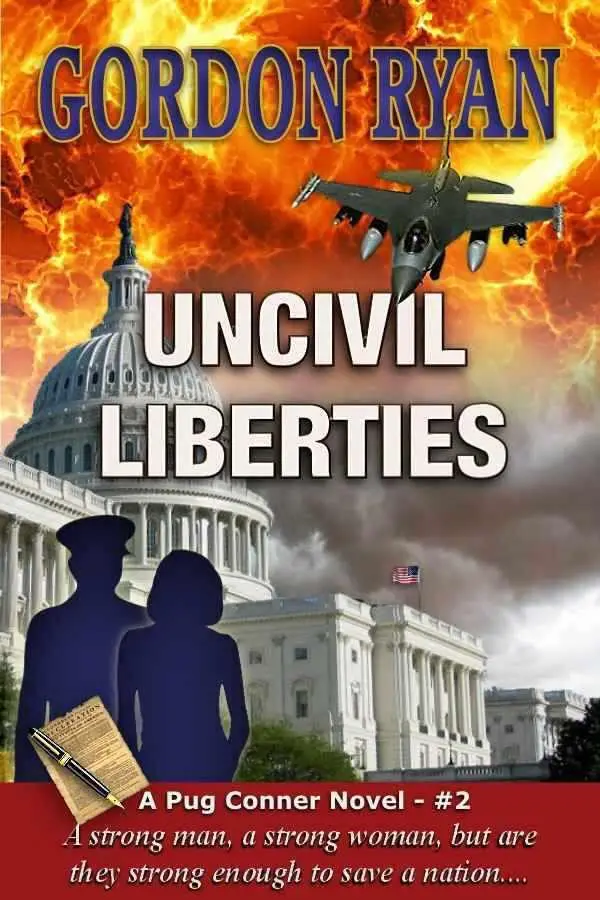
- Название:Uncivil liberties
- Автор:
- Жанр:
- Год:неизвестен
- ISBN:нет данных
- Рейтинг книги:3 / 5. Голосов: 1
-
Избранное:Добавить в избранное
- Отзывы:
-
Ваша оценка:
Uncivil liberties: краткое содержание, описание и аннотация
Предлагаем к чтению аннотацию, описание, краткое содержание или предисловие (зависит от того, что написал сам автор книги «Uncivil liberties»). Если вы не нашли необходимую информацию о книге — напишите в комментариях, мы постараемся отыскать её.
Uncivil liberties — читать онлайн бесплатно полную книгу (весь текст) целиком
Ниже представлен текст книги, разбитый по страницам. Система сохранения места последней прочитанной страницы, позволяет с удобством читать онлайн бесплатно книгу «Uncivil liberties», без необходимости каждый раз заново искать на чём Вы остановились. Поставьте закладку, и сможете в любой момент перейти на страницу, на которой закончили чтение.
Интервал:
Закладка:
Shouts of agreement rose, some men took to their feet and began clapping and within two minutes, Thor Campbell, commander of the Blackfoot Brigade, had pulled the disparate cluster of disgruntled men together through common cause. The American Brigade Command, quickly dubbed the ABC, had been formed.
Chapter 19
Joint Senate amp; House Congressional
Intelligence Committee
Washington, D.C.
April
Senator Andrew Forrest Culpepper, Democrat from Tennessee and a direct descendent of Nathan Bedford Forrest, the infamous Civil War Confederate general, was attired in his trademark white linen suit, a thick mane of curly silver hair offset by long, bushy sideburns and eyebrows. To most, his presentation was a century out of date. His fleshy jowls and rotund bulk betrayed a lack of physical exercise, but his well-known propensity for penetrating intellectual debate overrode the physical shortcomings which caused the uninformed to dismiss the man.
Culpepper sat at the center of the assembled committee members and began to bang his gavel, calling the meeting to order. In total, ten men and three women, senators and representatives from their respective committees, sat around the green, felt cloth-covered dais which had been arranged into a semi-circle. In front of their raised platform was a standard, rectangular witness table, also green felt-covered and equipped with three microphones. Three additional men, each in civilian clothes, sat quietly before the committee members; Secretary of Homeland Security William Austin, Brigadier General Padraig Connor, and White House legal counsel Adam Brooks. The witness table was clear of any documents or books, the three men sitting in silence, their hands folded on the table. In contrast to standard congressional committees, most of which were open to the public, the room had been sealed and no viewers sat in the audience. Two uniformed guards stood outside the doors, barring admission to the curious passerby or determined reporter seeking an inside scoop.
Senator Culpepper cleared his throat, looked left and right down the line of committee members, and began his oratory, his well-known Deep-South drawl stretching out the words and displaying his flamboyant propensity for southern articulation.
“Good morning, ladies and gentlemen. Thank y’all for coming. We should not have to detain y’all too long, if my understanding of the facts is correct. They are, of course, indisputable. We’re here this morning to investigate the complete and utter failure of this president and his lackluster administration to protect the American people. The terrible tragedies that have befallen innocent Americans these past several weeks are despicable, and our failure to apprehend those cowards who perpetrated these actions leaves no room for equivocation in our investigation. The American people demand nothing less than a total change in the administrative structure that has failed to protect them. This committee has a solemn duty, a clear and definable task laid out before us. Because of the failures of this administration, failures, I might add, that would not have happened if we had a competent president…”
Without speaking a word to his two companions, Secretary Austin pushed away from the table, rose from his chair, and began to exit the room. He was followed immediately by General Connor and Adam Brooks.
“Mr. Secretary, Mr. Secretary,” Culpepper boomed, “may I ask what you are doing, sir? We have only just begun our meeting.”
Austin paused, stepping back to grasp the riser behind his chair. “Mr. Chairman, as much as I respect this committee and the congress that authorized its charter, we have far more important issues at stake than a partisan campaign to assess how one political party may gain public acclaim over the purported inaction of another political party. If you will excuse us, Senator, we shall leave to carry on with our duties.”
Culpepper banged his gavel again, looking to his committee members for support. “You will do no such thing, Mr. Secretary. You will sit down immediately and will respond to the formal inquiry of this legally constituted committee.”
Austin began to walk toward the back of the room and Culpepper resumed banging his gavel. “This committee, sir, has the authority to compel your presence, and it shall do so forthwith.”
Austin stopped once again, turning back to face the committee. Pug Connor and Adam Brooks stood quietly at his side. “Mr. Chairman,” Austin replied, “you have every right to compel my presence if this bi-partisan committee, in consensus,” he said, sweeping his hand to reflect the entire committee, “agrees with your request.” He paused to look at the remaining committee members, each of whom had been silent throughout this unusual opening gambit. “However, Senator, I believe that the majority of the members on this committee are aware that America is under attack by a foreign…” he paused a moment, considering his words, “… and, unfortunately, even a domestic enemy. They are aware that the safety and security of our people hangs in the balance. And they are aware, Senator, that political grandstanding to exacerbate the discomfort of our national leaders, including my commander-in-chief, is not in the best interest of our national security. And I, sir, have little time for political posturing or blatant misuse of elected power. Now, if you will excuse me, I have other duties to perform.” Austin turned to head for the door, Culpepper resorting once again to banging his gavel.
Before Austin reached the committee room door, a soft, feminine voice rose from behind the dais, her microphone amplifying her smooth contralto tones. Her voice was stark in respect to the chairman’s raspy bleating. “Secretary Austin, if you will grant me a moment of your time, please,” she said.
Austin stopped immediately and turned to face his questioner. “Senator McKenzie,” he said, his voice conciliatory and a gentle smile playing across his face, “it would be my honor to answer your question.”
Senator Rachel McKenzie, Republican from Kansas and a strikingly attractive woman in her late thirties-early forties, when she admitted it-turned toward the chairman of the committee and addressed him directly. “Mr. Chairman, if I may have the floor for just a moment.”
Culpepper leaned back in his chair. “If you can do something, anything to bring this meeting to order, Senator McKenzie, the Chair will be most grateful.”
“Thank you, sir,” she replied. “Mr. Secretary, please understand that we-this bi-partisan committee-are, as you have indicated, highly aware of the gravity of the current status of our nation. I concur with you, sir, that this is not the time for political divisiveness or party politics. This is the time for American unity. For political cohesiveness. For cooperation, indeed joint action against what seems to be an impenetrable cadre of terrorists who are wreaking havoc with our national sense of security. And I can also assure you, Mr. Secretary, that this committee, comprised of both houses of our Congress and representing all political spectrums contained therein…” she paused, looking up and down the row of her fellow members, “…seeks answers to the difficult problems we face.”
Her smile grew broader and her face softened as her body language appealed to the man standing before her. “Mr. Secretary, we need you here today. America needs you here today. I need you here today. I honor your selfless service to our country over the past four decades and perhaps more importantly, I have learned- personally learned in difficult times-to trust your word. If you would give us your valuable time this morning, I assure you that we will cease any semblance of partisan bickering and together, as Americans, we will strive to find a defensive solution to our current problems. Speaking personally, General, I blame no one person, no particular party, and certainly not the president of the United States. It is the enemy we should despise, and, with all due respect to our esteemed chairman, it is not our political opposition that is on trial this morning. Will you grant me that simple request, General, and remain with us?”
Читать дальшеИнтервал:
Закладка:
Похожие книги на «Uncivil liberties»
Представляем Вашему вниманию похожие книги на «Uncivil liberties» списком для выбора. Мы отобрали схожую по названию и смыслу литературу в надежде предоставить читателям больше вариантов отыскать новые, интересные, ещё непрочитанные произведения.










Обсуждение, отзывы о книге «Uncivil liberties» и просто собственные мнения читателей. Оставьте ваши комментарии, напишите, что Вы думаете о произведении, его смысле или главных героях. Укажите что конкретно понравилось, а что нет, и почему Вы так считаете.