Ken McClure - Lost causes
Здесь есть возможность читать онлайн «Ken McClure - Lost causes» весь текст электронной книги совершенно бесплатно (целиком полную версию без сокращений). В некоторых случаях можно слушать аудио, скачать через торрент в формате fb2 и присутствует краткое содержание. Жанр: Триллер, на английском языке. Описание произведения, (предисловие) а так же отзывы посетителей доступны на портале библиотеки ЛибКат.
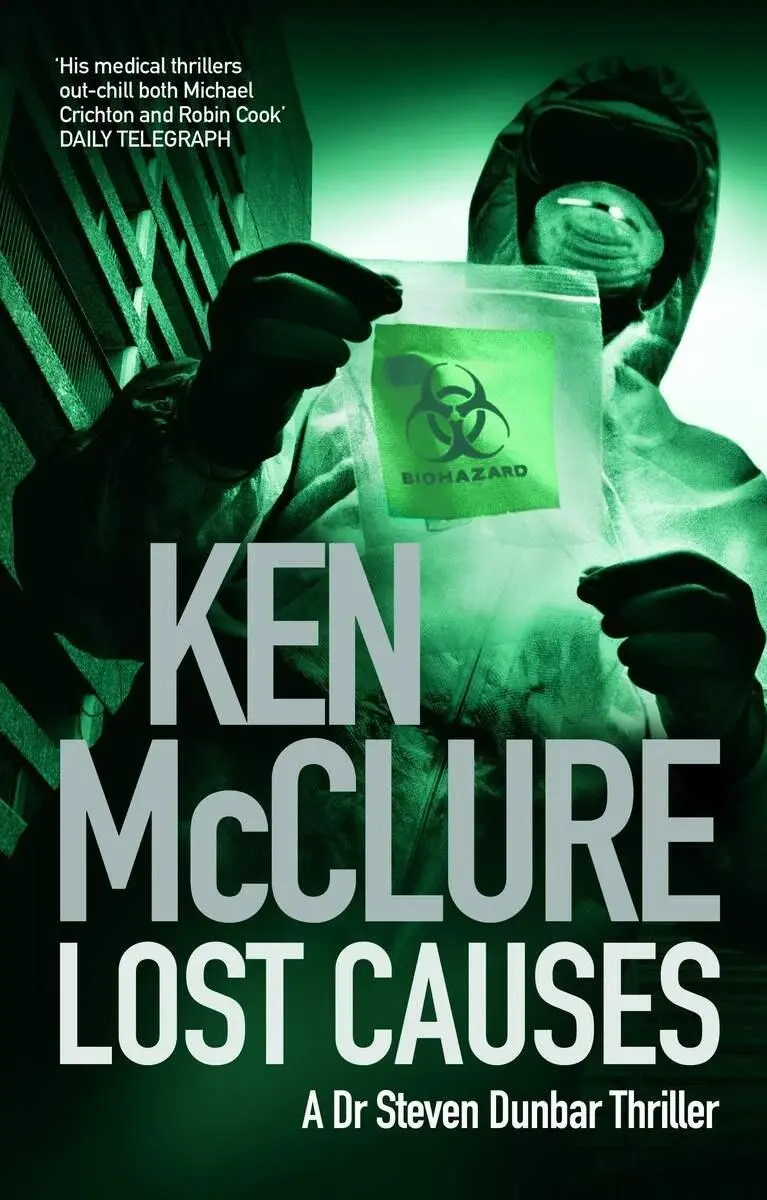
- Название:Lost causes
- Автор:
- Жанр:
- Год:неизвестен
- ISBN:нет данных
- Рейтинг книги:4 / 5. Голосов: 1
-
Избранное:Добавить в избранное
- Отзывы:
-
Ваша оценка:
Lost causes: краткое содержание, описание и аннотация
Предлагаем к чтению аннотацию, описание, краткое содержание или предисловие (зависит от того, что написал сам автор книги «Lost causes»). Если вы не нашли необходимую информацию о книге — напишите в комментариях, мы постараемся отыскать её.
Lost causes — читать онлайн бесплатно полную книгу (весь текст) целиком
Ниже представлен текст книги, разбитый по страницам. Система сохранения места последней прочитанной страницы, позволяет с удобством читать онлайн бесплатно книгу «Lost causes», без необходимости каждый раз заново искать на чём Вы остановились. Поставьте закладку, и сможете в любой момент перейти на страницу, на которой закончили чтение.
Интервал:
Закладка:
‘They all are,’ said the nurse.
‘This place stinks,’ muttered Hussain.
‘They’ve all got rampant diarrhoea,’ whispered the nurse ‘That’s why they’re bl- dehydrated, doctor.’
The young doctor smiled at the put-down but the smile faded from his face as he saw the bedpan on the floor beside the bed, waiting for removal to the sluice room. The cover over it had been dislodged.
‘What are you doing?’ hissed the nurse as she saw him kneel down to examine the contents.
‘Rice water.’
‘What?’
‘I know I’m just another first-year idiot,’ said Hussain, ‘but I recognise the signs. I’ve seen it in my own country. This patient doesn’t have gastro-enteritis… none of them do. They’ve got cholera.’
The diagnosis was confirmed by the lab a few hours later.
UK Under Cholera Attack was the message from every radio and TV station and newspaper during the next twenty-four hours, during which the first patients to die — forty-six so far — pushed the panic button even harder across the nation. The Prime Minister appeared on television to appeal for calm, assuring the public that things were not out of control as messages on the internet were suggesting. Cholera was treatable and preventable. Supplies of vaccine would be available soon. Details would be given on radio and TV the moment they were ready. In the meantime, simple precautions should be taken. All domestic water should be boiled before use. Any suspicious activity, particu larly near water supplies of any kind, should be reported to the police immediately.
‘Do we know any more about how it happened?’ Alice Spiers asked the chief constable at the second day meeting of the major incident team in Edinburgh.
‘Yes, thanks to you pointing the finger so quickly at contaminated water as the likely source. Two days ago two Asian men turned up in a Scottish Water van at Inchmarin Court, saying that they were there to deal with a reported drop in water pressure. Needless to say, no such report had been made. They were shown to the pump room and must have infected the main storage tank. They went on to do the same at the neighbouring three blocks. Much the same thing in the other affected cities. All the attacks were targeted at flats using the same water supply system, where mains water flows into a large storage tank on the ground floor before being pumped up to auxiliary tanks on the upper floors. Contaminate the supply in the main tank and you affect the whole building.’
‘I suppose we must expect more attacks,’ said Lynn James.
The chief constable shrugged. ‘It has to be a possibility.’
‘I think it might be helpful if one of the medics among us told us exactly what we’re dealing with here,’ said the council chief executive, a comment that elicited sounds of agreement from several of the others.
‘It’s a very long time since we saw cholera in this country,’ replied Alice Spiers. ‘Personally, I haven’t come across it in my career, even when I worked abroad. We were lucky an Asian doctor working here in the hospital recognised it so quickly. It’s endemic in parts of India, and the sort of disease that you find breaking out after some natural disaster; a flood or an earthquake or anything that leads to a breakdown in hygiene standards — disrupted water supplies, leaking sewage pipes and so on. Contaminated water is the main cause of initial infection, but of course, once the disease is present, it can be spread in a variety of ways linked to poor hygiene.
‘The disease is caused by a bacterium called Vibrio cholerae. It’s a very serious form of gastro-enteritis, leading to severe dehydration, then shock and finally death if no action is taken. Replacement of lost fluid is vital. Patients can lose up to fifteen litres in twenty-four hours.’
‘The Prime Minister said it was treatable. Are we talking about antibiotics?’ asked the chief executive.
‘Yes…’ replied Alice Spiers hesitantly. ‘It’s a bit too soon to know about that…’
‘I’m sorry?’
‘Cholera is treatable with a number of antibiotics in the normal course of events… but, as yet, we don’t know what we’re dealing with here. The bug might have been… altered in some way.’
‘Genetic engineering,’ murmured the hospital’s medical superintendent.
‘With a terrorist attack, I’m afraid that is a possibility. We’ll have to wait for a full lab report. Our labs are not used to dealing with cholera. We’ve sent samples off to Colindale for analysis. It might take a day or two before we know exactly what we’re dealing with. In the meantime we have to concentrate on isolating the cases we have and rehydrating them. Nursing care is the thing that’s going to save people. We’ll also be giving broad-spectrum drugs and hoping for the best.’
‘As instructed, we’re keeping the cordon we threw round the infected flats in place,’ said the chief constable. ‘It’s very upsetting for friends and relatives but, as I understand it, containment of the disease is all-important.’
‘It is.’
‘The thing is, not everyone living in the flats has been infected
… My men tell me there are some perfectly healthy people there who are asking to leave, and you can see their point. It’s not very pleasant being stuck in the middle of an epidemic.’
‘I don’t think we can allow it,’ said Alice Spiers. ‘Not yet, not until we get the lab reports and know exactly what’s going on. The fact that they’ve been living in the same building makes them suspect. They may be healthy but they could be harbouring the disease — they could even be carriers without knowing it.’
‘But maybe they’ll contract the disease just by being there,’ suggested the chief exec.
Alice Spiers conceded the point with a grimace. ‘That’s the downside,’ she admitted. ‘Ideally all the sick people should be in hospital, in isolation units being attended to by skilled nurses, but we don’t have the capacity to deal with a full-scale epidemic. We have to do the best we can, and that means isolating and containing cases wherever they occur.’
‘Doctors’ surgeries and the NHS 24 phone lines are being overwhelmed by people thinking they’ve been infected. They have to go to the loo and start thinking the worst,’ said Lynn James.
‘I suppose we can’t blame them. It’s a frightening situation,’ said the chief exec. ‘What about the safety of the medical and nursing staff dealing with the patients?’
‘Our travel clinics had limited stocks of cholera vaccine: we’ve used that for front-line people. It’s all gone now and I don’t know when we’re going to get more. I think it’s fair to say that demand exceeds supply right now, but I’m sure the government will be dealing with that.’
‘Our immediate problem is a second wave of cases,’ said Alice Spiers. ‘There are bound to be people who were at the flats during the day of the attack on the water supply but didn’t stay there. If any of them were infected before they left they’ll be falling ill and passing on the infection to friends and family. Our teams are waiting to act to isolate and contain.’
‘The trouble will be telling the genuine cases from the calls we’re getting from people who just think they’re ill,’ said Lynn James.
‘Operator common sense is going to be paramount,’ said Alice Spiers. ‘There’s a world of difference between having cholera and thinking you might be sick. The degree of concern in the relative’s voice should be the benchmark.’
‘Something tells me things are going to get worse before they get better,’ said the chief constable. ‘What a mess.’
‘Well, it’s our mess, ladies and gentlemen,’ said the chief exec. ‘I suggest we get on with it.’
Читать дальшеИнтервал:
Закладка:
Похожие книги на «Lost causes»
Представляем Вашему вниманию похожие книги на «Lost causes» списком для выбора. Мы отобрали схожую по названию и смыслу литературу в надежде предоставить читателям больше вариантов отыскать новые, интересные, ещё непрочитанные произведения.







Обсуждение, отзывы о книге «Lost causes» и просто собственные мнения читателей. Оставьте ваши комментарии, напишите, что Вы думаете о произведении, его смысле или главных героях. Укажите что конкретно понравилось, а что нет, и почему Вы так считаете.