Peter Lovesey - Upon A Dark Night
Здесь есть возможность читать онлайн «Peter Lovesey - Upon A Dark Night» весь текст электронной книги совершенно бесплатно (целиком полную версию без сокращений). В некоторых случаях можно слушать аудио, скачать через торрент в формате fb2 и присутствует краткое содержание. Жанр: Триллер, на английском языке. Описание произведения, (предисловие) а так же отзывы посетителей доступны на портале библиотеки ЛибКат.
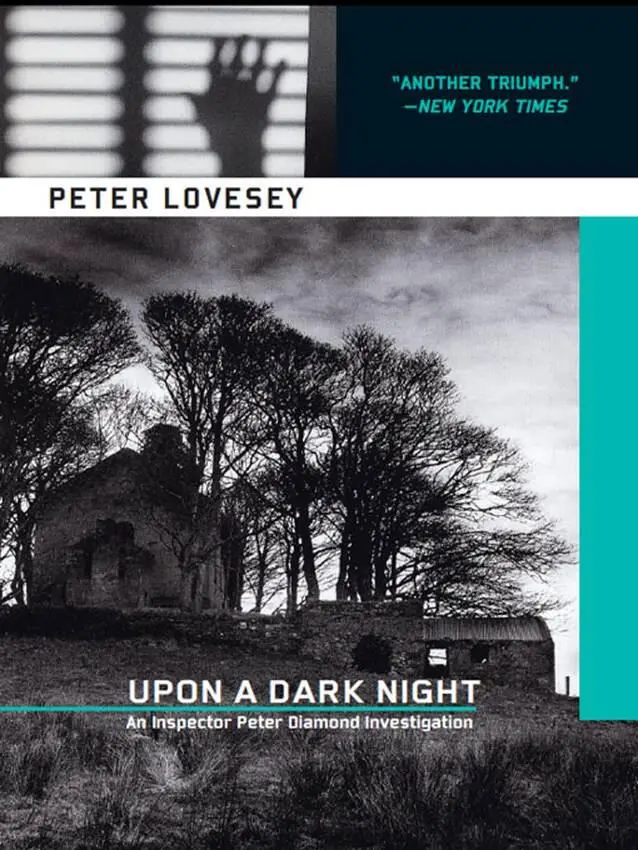
- Название:Upon A Dark Night
- Автор:
- Жанр:
- Год:неизвестен
- ISBN:нет данных
- Рейтинг книги:4 / 5. Голосов: 1
-
Избранное:Добавить в избранное
- Отзывы:
-
Ваша оценка:
Upon A Dark Night: краткое содержание, описание и аннотация
Предлагаем к чтению аннотацию, описание, краткое содержание или предисловие (зависит от того, что написал сам автор книги «Upon A Dark Night»). Если вы не нашли необходимую информацию о книге — напишите в комментариях, мы постараемся отыскать её.
Upon A Dark Night — читать онлайн бесплатно полную книгу (весь текст) целиком
Ниже представлен текст книги, разбитый по страницам. Система сохранения места последней прочитанной страницы, позволяет с удобством читать онлайн бесплатно книгу «Upon A Dark Night», без необходимости каждый раз заново искать на чём Вы остановились. Поставьте закладку, и сможете в любой момент перейти на страницу, на которой закончили чтение.
Интервал:
Закладка:
Julie treated the remark seriously. ‘In a way, yes. I was thinking that the family knew something they wanted to keep to themselves. Suppose they discovered that Rose lost her memory in a car accident she caused, killing or maiming someone. They’d have reason enough for whisking her away and leaving no traces.’
Diamond’s eyebrows pricked up. ‘That’s good. That’s very good.’ He leaned back in his chair, confirming that her theory made sense. ‘If I remember right, she was found wandering on the A46 by some people from Westbury.’
‘Some people Ada is being cagey about in case we prosecute them,’ said Julie.
‘Prosecute them – why?’
‘Oh, come on, Mr Diamond. Rose stepped into the road and their car struck her and knocked her out. They drove her to the Hinton Clinic and dumped her in the car park.’
‘Then they damned well should be nicked.’ But he allowed that trifling thought to pass. ‘Why was she wandering in the first place? That’s the nub of it. You’ve got a point. An earlier incident, on the motorway perhaps. It’s not unknown for people in shock to walk away from an accident. Do we know the date she was found?’
‘It’s on file,’ Julie reminded him. ‘The clinic notified us when she was brought in. There are photographs of her injuries. If you’d care to see them-’
‘Not now,’ he said quickly. He’d seen enough gore for one day.
Julie added, ‘We checked at the time for road accidents on the motorway and every other road within a five-mile radius. There weren’t any that fitted the circumstances.’
‘There weren’t any we heard about. That’s not quite the same thing, Julie.’ He drummed his fingertips on the chair-arm. ‘Look, by rights this could be farmed out to one of Wigfull’s people.’
She listened with amusement, confident of what was coming.
‘But it could be argued that Harmer House provides a link with the Royal Crescent case, so I think we’ll take this on board, Julie. See what you can do with it. Have a talk yourself with Imogen Starr, the social worker, and see what she remembers of Doreen Jenkins, the woman who collected Rose. Then check every detail of the story for accuracy. Find out where Jenkins was staying in Bath. See if there really was a man in tow, as she claimed. Check Hounslow, Twickenham. Check the mother, if you can.’
‘Do you want me to involve Ada at this stage?’
‘Personally,’ he said, ‘I don’t feel strong enough. It’s up to you.’
She got up. At the door she turned and asked, “Will you be concentrating on Hildegarde Henkel’s death?’
‘Someone has to,’ he said with a martyred air.
But the first move he made after Julie had left was to the room where items of evidence were stored, and the item he asked to examine had not belonged to Hildegarde Henkel.
‘A shotgun,’ he told the sergeant in charge. ‘Property of Daniel Gladstone, deceased.’
There was some hesitation. ‘That’s Mr Wigfull’s case, sir.’
‘You think I don’t know whose case it is, sergeant?’
‘Mr Wigfull is very hot on exhibits, sir.’ And so was this sergeant, a real stickler for procedure.
‘I’m sure he is, and he’s right to be. He and I are working hand in hand on several cases, as you heard, no doubt. The gun has been seen by forensic, I take it – checked for prints and so on.’
‘I believe it has, sir.’
‘It’s bagged up, then? Bagged up and labelled?’
‘Yes, sir.’ Said with a note of finality.
‘Good.’ Diamond grinned like a chess-player who has watched his opponent make the wrong move. ‘Just what the doctor ordered.’
‘Is it, sir?’
‘Because I won’t need to disturb the bag. I can examine it without breaking the seal, and no one need get uptight.’
‘Mr Diamond, I don’t wish to be obstructive-’
‘Nor me, sergeant, nor me. So I’ll save your reputation by coming round the back and checking the item here on the premises. It won’t have left your control. Just lift the flap for me, would you?’
Minutes after, the sergeant was privy to the bizarre spectacle of Detective Superintendent Diamond seated on a chair, with the shotgun in its polythene wrapping poised between his legs, the butt supported on the floor, the muzzle under his chin, while his fingers groped along the barrel towards the trigger guard.
‘Be a sport, sergeant, and keep this to yourself. There are things a man wouldn’t like his best friends to know about.’
With his mind still on Farmer Gladstone, he drove out to Tormarton to have another look at the farm. Crime-scene tape was still spread across the gate and the front door. He left the car in the lane and lifted his leg over the tape.
There were several large heaps of earth in the field outside. He went over to one of the pits and looked inside. They had dug to the bedrock.
He detached the tape from the front door of the farmhouse and was pleased to find that he could open it. He went through the kitchen to the back room. The Bible he had found was still on the window-sill, obviously of no interest to John Wigfull. He picked it up and glanced at the family tree in the front, the long line of male descendants ending with a female, May Turner, who had married Daniel Gladstone here in Tormarton in 1943. Then he let the pages fall open at the old Christmas card. He wanted another look at the photo inside, of the woman and child, and the wording on the card, concise, touching and yet remote: ‘I thought you would like this picture of your family. God’s blessings to us all at
this time. Meg.’ Was it really meant to bless, he wondered, or to damn?
He closed the Bible and slipped it into his coat pocket, trying not to feel furtive.
Outside, he made a more thorough tour of the outhouses than before. They had been ravaged by the winds endemic in this exposed place, and patched up from time to time with tarpaulin and pieces of corrugated iron. They should have been torn down long ago and rebuilt. Someone, he noticed, had recently fed and watered the chickens. It was one of life’s few certainties that whenever there were animals at a crime scene, you could count on one of the police seeing to their needs. He scraped away some straw in the hen-house in case there had been recent digging underneath, but the surface was brick-hard.
Then he returned to his car and drove through the lanes to Tormarton village, a cluster of grey houses, cottages and farm buildings behind drystone walls. Rustic it may have appeared, yet there was the steady drone of traffic from the motorway only a quarter of a mile to the south. The inhabitants must have been willing to trade the noise for the convenience. It didn’t take a detective to tell that many were escapees from suburban life. The old buildings remained, but gentrified, cleaned up and adapted to a car-owning population. The Old School House no longer catered for children. The shop and sub-Post Office had been converted into a pub. The Cotswold Way, another modern gloss on ancient features, snaked between the cottages and across the fields.
He parked opposite the church and called at Church Cottage nearby. A woman answered, rubbing her hands on a towel. She smiled as if she knew why he was there. The fragrance of fried onions gusted from behind her, causing Diamond some unease over his still-turbulent stomach. He explained who he was.
‘You’re looking for the vicar, are you?’ The woman grinned. ‘Don’t worry. You’re not the first to make that mistake. Our vicar lives at Marshfield. We have to share him with two other parishes.’
‘Is there a church warden in the village, then?’
‘There is, but if you want the vicar, he may be in the church, still. There was a funeral earlier.’ Her gaze shifted from Diamond. ‘No, get your skates on – there he goes, at the end of the street.’
Читать дальшеИнтервал:
Закладка:
Похожие книги на «Upon A Dark Night»
Представляем Вашему вниманию похожие книги на «Upon A Dark Night» списком для выбора. Мы отобрали схожую по названию и смыслу литературу в надежде предоставить читателям больше вариантов отыскать новые, интересные, ещё непрочитанные произведения.

Обсуждение, отзывы о книге «Upon A Dark Night» и просто собственные мнения читателей. Оставьте ваши комментарии, напишите, что Вы думаете о произведении, его смысле или главных героях. Укажите что конкретно понравилось, а что нет, и почему Вы так считаете.