Michael Slade - Headhunter
Здесь есть возможность читать онлайн «Michael Slade - Headhunter» весь текст электронной книги совершенно бесплатно (целиком полную версию без сокращений). В некоторых случаях можно слушать аудио, скачать через торрент в формате fb2 и присутствует краткое содержание. Жанр: Триллер, Ужасы и Мистика, на английском языке. Описание произведения, (предисловие) а так же отзывы посетителей доступны на портале библиотеки ЛибКат.
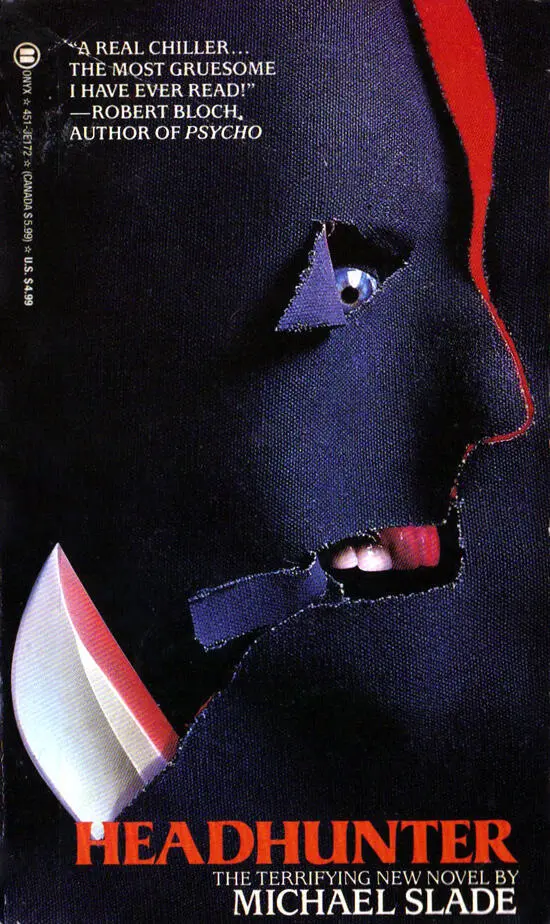
- Название:Headhunter
- Автор:
- Жанр:
- Год:неизвестен
- ISBN:нет данных
- Рейтинг книги:3 / 5. Голосов: 1
-
Избранное:Добавить в избранное
- Отзывы:
-
Ваша оценка:
Headhunter: краткое содержание, описание и аннотация
Предлагаем к чтению аннотацию, описание, краткое содержание или предисловие (зависит от того, что написал сам автор книги «Headhunter»). Если вы не нашли необходимую информацию о книге — напишите в комментариях, мы постараемся отыскать её.
The victims are everywhere — floating in the Fraser River, buried in a shallow grave, nailed to an Indian totem pole on the university campus. All are women. All are headless.
Then the photographs arrive. Carefully posed shots of the women's heads stuck on poles.
The Mounties of Special X are up against a unique brand of killer. A killer whose sexual psychosis stretches back through Ecuador's steaming jungle and a scream-filled New Orleans dungeon to a dead-of-winter manhunt in the Rocky Mountains a century ago.
Headhunter — читать онлайн бесплатно полную книгу (весь текст) целиком
Ниже представлен текст книги, разбитый по страницам. Система сохранения места последней прочитанной страницы, позволяет с удобством читать онлайн бесплатно книгу «Headhunter», без необходимости каждый раз заново искать на чём Вы остановились. Поставьте закладку, и сможете в любой момент перейти на страницу, на которой закончили чтение.
Интервал:
Закладка:
Tuesday, November 2nd, 9:30 a.m.
"Did you enjoy the reading?" Dr. Ruryk asked.
"It was informative," DeClercq replied. "But pretty heavy going."
The psychiatrist nodded. "How shall we handle this?"
"If you have no objection, I'd like to make a tape. It will be on file in the squad room for those who want to listen and benefit from your views. Nothing formal, just a general discussion with free association."
"Sounds okay to me," Dr. Ruryk said. "Let's roll."
Dr. George Ruryk was a man of advancing years and growing reputation. DeClercq's wife Genevieve spoke highly of his ability and was rather amazed that the police had made so little use of his knowledge in the past. She had persuaded her husband not to make the same mistake. That more than any other reason — for DeClercq valued his wife's opinion — was why the Superintendent now found himself sitting in the wicker chair opposite the psychiatrist as filtered sunlight streamed into the greenhouse and brought the color of the roses vibrantly alive. Ruryk wore round wire-rim glasses and a Vandyke goatee that made him look like Freud. As DeClercq picked up the microphone he thought, Why is it that psychiatrists all have beards? What have they got to hide?
He punched on the tape recorder.
"This tape," DeClercq said, placing the microphone down on the corner of the desk between them, "concerns the Headhunter case. With me is Dr. George Ruryk of the Department of Psychiatry at the University of British Columbia. The purpose of our meeting is to discuss a possible psychological profile of the killer whom we seek. I wish to recaution you strongly, however, on the danger of tunnel vision. What comes out of this discussion may parallel reality or be entirely off base. Dr. Ruryk?"
"First let me say that I must agree completely with your warning. A number of years ago the man dubbed the 'Boston Strangler' reduced that city to a state of terror. At one point during the hunt for him a panel of experts composed of psychiatrists, psychologists, social workers, criminologists and policemen was convened. This panel decided that the murderer they were seeking, without a doubt, would be a schizoid, unmarried, latent homosexual with a disturbed psychosexual life and suppressed mother fantasies. When he was eventually apprehended Albert DeSalvo turned out to be a happily married man with two children. So I reiterate your caution.
"Having said that, however," the psychiatrist continued, "I do believe that we can postulate several possible theories about the Headhunter's thinking. I also believe that one at least will eventually prove true. Let us begin though with a general orientation."
As he spoke the doctor reached into the pocket of his tweed jacket, complete with leather patches at the elbows, and removed a smoking apparatus befitting Sherlock Holmes and a package of tobacco. For at least a minute, between sentences, the professor performed his igniting ritual, and when at last great billows of sweet blue smoke twisted about the room, the Superintendent inwardly sighed and thought, I wish you'd think of the plants.
"Psychiatry basically recognizes three major types of mental abnormality," Ruryk stated. "Psychosis. Neurosis. And Character Disorder.
"Of these, the psychotic — the one who suffers from a psychosis — is the most disturbed. He or she would correspond to the layman's term 'crazy.' The distinguishing feature or symptom of psychosis is that there has been a loss of touch with reality: in other words, because of the pressure of the illness, the psychotic has replaced some important aspect of the real everyday world with a creation of his or her own deranged mind. Here are a few examples. At issue in the recent Yorkshire Ripper trial was whether or not Peter Sutcliffe, while standing in a grave that he was digging as a cemetery laborer, actually heard a voice which he interpreted as God informing him that it was his mission to rid the world of prostitutes. David Berkowitz — New York's 'Son of Sam' — evidently conversed with his neighbor's talking dog before killing six people with a.44 caliber pistol.
"The neuroses — that is the second main branch of mental illness — are somewhat different, and for the case in question probably irrelevant.
"Of more importance from our point of view, however, is the third major class of mental aberration — namely character disorder. For it is here that we find the psychopath or sociopath with his or her case history of unbelievable horror.
"In character disorder, rather than a break with reality, there is more what I would call a compromise with reality. Over the course of his or her life a person affected by this disease, instead of developing some symptom such as an hallucination or obsession, develops a change in character structure that systematically alters his or her way of interacting with reality.
"Often this is the failure to develop a normal moral sense, an inability to distinguish between right and wrong. The person affected is still in touch with reality, it's just that he or she does whatever he or she wishes for whatever reason with no concern whatsoever for anyone else's feelings. Sadists often fit this mold — and that's why begging, beseeching and imploring have no effect upon them."
"Will you expand on psychopathy?" Robert DeClercq asked.
"Certainly," Ruryk said. "For this is the area in which we find the vast majority of mass murderers.
"Psychopaths may be divided into two important subcategories.
"The first of these is the under-controlled aggressive psychopath. This is the type of individual who does not have the constraints on behavior necessary in society. Such a person will frequently be involved in acts of aggression and will be well-known to the police because of a number of previous charges or convictions for violence. I put Clifford Olson in this category.
"Far more dangerous and elusive,however, is the second sub-category — the over-controlled aggressive psychopath. For this type of man has many constraints issuing that govern his behavior. He is often a rather meticulous, rigid, obsessional individual. At times of stress, however, this man is unable to control the aggressive urges that lie buried deep within his personality, and at such times violent behavior can occur. It is as though a safety valve has blown or a volcano erupted. Then once the pressure has been released this type of psychopath immediately returns to his normal self.
"You can see why this type of killer is extremely difficult to locate, for the factors which cause such outbursts will vary with each individual: what will upset one man will not perturb another. I put Bundy in this category.
"The most important point, however, is this: both the deeply repressed psychotic and the over-controlled aggressive psychopath may appear perfectly normal on the surface as they go about their daily lives.
"Hunting either one is like searching for the proverbial needle in a haystack."
There was a lull for a moment in the conversation and then Robert DeClercq said: "Doctor, in the readings that you have provided me there is mention of 'the Imposter.' I wonder if you would expand on that term within the present context?"
" 'The Imposter' as we call him is a relatively rare but dramatic form of psychopathic personality. He is relatively common in cases of psychosis. The Imposter is one who is bound neither by society's sanctions, nor by a sense of his own identity. The Imposter assumes the role and status of any part that he might wish to play. In many respects his entire life is the wearing of a mask.
"The danger of the Imposter is that people around him relate to the mask and not to his psychopathic personality which is doubly removed — removed once because he is over-controlled and twice because even his over-controlled identity is hidden behind the mask. As the Chinese say in a proverb: 'Fish see the worm, not the hook.' "
Читать дальшеИнтервал:
Закладка:
Похожие книги на «Headhunter»
Представляем Вашему вниманию похожие книги на «Headhunter» списком для выбора. Мы отобрали схожую по названию и смыслу литературу в надежде предоставить читателям больше вариантов отыскать новые, интересные, ещё непрочитанные произведения.







Обсуждение, отзывы о книге «Headhunter» и просто собственные мнения читателей. Оставьте ваши комментарии, напишите, что Вы думаете о произведении, его смысле или главных героях. Укажите что конкретно понравилось, а что нет, и почему Вы так считаете.