Michael Slade - Headhunter
Здесь есть возможность читать онлайн «Michael Slade - Headhunter» весь текст электронной книги совершенно бесплатно (целиком полную версию без сокращений). В некоторых случаях можно слушать аудио, скачать через торрент в формате fb2 и присутствует краткое содержание. Жанр: Триллер, Ужасы и Мистика, на английском языке. Описание произведения, (предисловие) а так же отзывы посетителей доступны на портале библиотеки ЛибКат.
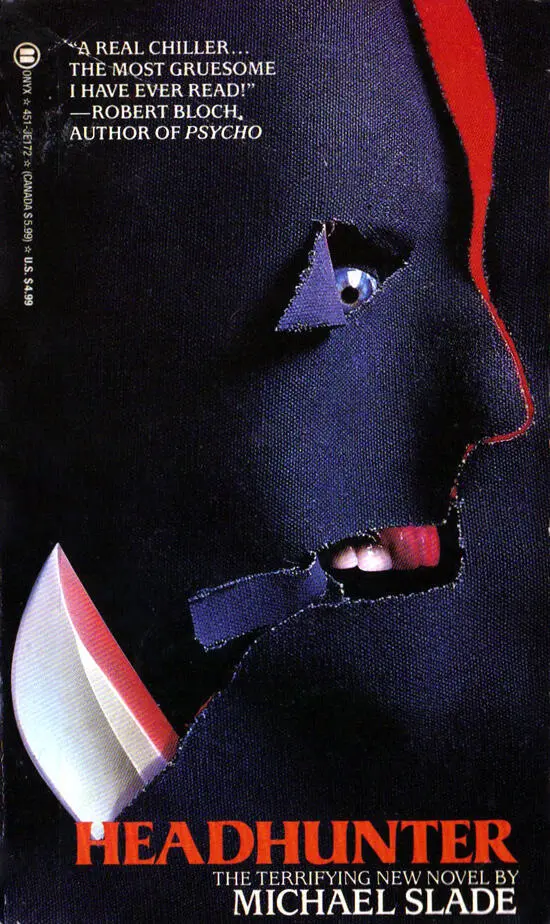
- Название:Headhunter
- Автор:
- Жанр:
- Год:неизвестен
- ISBN:нет данных
- Рейтинг книги:3 / 5. Голосов: 1
-
Избранное:Добавить в избранное
- Отзывы:
-
Ваша оценка:
Headhunter: краткое содержание, описание и аннотация
Предлагаем к чтению аннотацию, описание, краткое содержание или предисловие (зависит от того, что написал сам автор книги «Headhunter»). Если вы не нашли необходимую информацию о книге — напишите в комментариях, мы постараемся отыскать её.
The victims are everywhere — floating in the Fraser River, buried in a shallow grave, nailed to an Indian totem pole on the university campus. All are women. All are headless.
Then the photographs arrive. Carefully posed shots of the women's heads stuck on poles.
The Mounties of Special X are up against a unique brand of killer. A killer whose sexual psychosis stretches back through Ecuador's steaming jungle and a scream-filled New Orleans dungeon to a dead-of-winter manhunt in the Rocky Mountains a century ago.
Headhunter — читать онлайн бесплатно полную книгу (весь текст) целиком
Ниже представлен текст книги, разбитый по страницам. Система сохранения места последней прочитанной страницы, позволяет с удобством читать онлайн бесплатно книгу «Headhunter», без необходимости каждый раз заново искать на чём Вы остановились. Поставьте закладку, и сможете в любой момент перейти на страницу, на которой закончили чтение.
Интервал:
Закладка:
Even taking account of population differences the conclusion is quite obvious: either the American male is in desperate need of psychosexual therapy. Or something is very, very wrong with US laws on gun control.
The two women who left Vancouver for Seattle late that morning were counting on the latter conclusion as being the correct answer. At 5:20 that same afternoon they stopped at the Douglas Border Crossing to reenter Canada. As a matter of routine Canada Customs searches every fiftieth car. Theirs was number fifty. So that was how, both in the trunk and under the back seat, a rather surprised Customs Officer found fifty-two loaded Smith and Wesson.38s purchased that day in Seattle.
As the slogan goes: You can't rape a.38.
Hoodoo
5:46 p.m.
It was Corporal William Tipple of Commercial Crime who first made the connection: in fact were it not for Tipple the left hand might never have known what the right hand was doing.
The Corporal was not the sort of man that the Royal Canadian Mounted Police would portray on a recruiting poster. He was five foot ten with a slight build, a pockmarked complexion and an ever present dusting of dandruff on the padded shoulders of his checkered sports jacket. Though the collar of the shirt he wore was a little frayed and dirty, and though there was also grime under his fingernails, the man made up for his shortcomings by his boundless energy and an effervescent disposition. Tipple had spent the past five years as an electronic surveillance specialist in Commercial Crime Section, but he missed being in harness. Tipple was the sort of member who enjoyed wearing a uniform, passe though that may be.
Late that Monday afternoon the Corporal had come to Headhunter Headquarters to get a feel of the action. He had no other reason to be there. It was just that Tipple was proud to be a Member of the Royal Mounted and liked to feel that he was a part of all that was going on. So late that Monday afternoon Tipple walked into the library.
The library was jammed.
There were men and women everywhere, members in and out of uniform sitting at tables, leaning on walls, some even squatting on the floor reading. Tipple was elated. He was thriving on the activity. Wishing to feel a part of it, he moved about from table to table.
At the photograph table the Corporal paused and gave it a little attention. There were prints coming and going and moving about the surface, photos being passed from hand to hand with the occasional comment, pictures of bodies and pictures of heads and pictures of murder locations, snapshots of women, a shot of a nurse decked out in her graduation garb, mug shots in full-face and profile of hundreds of men, most with dark hints of fetishism and obsession in their eyes.
The man beside him was holding a photo in each of his large hands. In his left was a picture of a woman's head stuck on the end of a pole; and in his right the same face staring out from a mug shot. The man was staring as if in a trance at the snap of the severed head. The Corporal thought that odd.
"It's like a jigsaw puzzle, eh?" William Tipple said.
His eyes dazed, the man turned to look at him without a smile on his face.
"I'm Bill Tipple," the Corporal said, introducing himself. "Commercial Crime Section."
"Al Flood," the man replied, "VPD Major Crimes."
Ah, Tipple thought to himself, so they're working this one too. He was a wee bit hurt. For here was a Vancouver City bull as an outsider on the inside, while he — Bill Tipple of the RCMP — was an insider out in the cold. That wasn't right.
"Looks like a bargain basement sale at the Hudson's Bay Company, eh?" the Corporal said jovially, nodding at all the others.
Flood merely shook his head and turned back to his pictures.
Yeah, well same to you, buddy. Bill Tipple thought. Then he too began to rummage about the table. It seemed to him that pictures of heads and bodies were now at a premium. Someone threw down a photo of a black man and reached for something else. Tipple picked it up. Someone grabbed for an Ident. enlargement of marks on a neck vertebra and revealed underneath a second photo of the woman in Flood's right hand. It was also a mug shot, but a different type of one. Tipple picked that up also.
"Here," he said turning to Flood and handing him the picture. "Another piece for your puzzle."
"Thanks," the Vancouver Detective said, reaching out with nicotine-stained fingers. There was a puffiness under his eyes.
Looks like a cynic. Tipple thought.
Rood added: "This one's from our own VPD mugbooks downtown." He wagged the photograph which he held in his right hand. "The woman's name is Grabowski, she's up for heroin possession. The shot that you just gave me is from the files of the New Orleans PD. I believe the black dude in that surveillance photo in your hand is also linked to her. And to New Orleans."
At the words "New Orleans" Tipple almost jumped as if he'd been jabbed in the ribs. "Can I see that again?" he asked, indicating Grabowski's NOPD picture. Flood gave it to him.
For a minute or two the RCMP Corporal examined the two American photographs, front and back. The names of the persons depicted were printed on the reverse side of the shots. Then Tipple put both pictures in his left hand and dug his notebook out of his jacket pocket with his right. Flipping over several pages, he stopped and nodded. "Well I'll be damned," he said. "Will you take a look at this."
Flood looked at the notebook and at a name written on the page. Tipple held out the photograph of the black man and indicated the name printed on the back. Both names were the same.
John Lincoln Hardy.
9:45 p.m.
It was while Robert DeClercq was pinning the wiretap transcripts from Commercial Crime up on the corkboard beside the photo of John Lincoln Hardy that he noticed his hands were shaking. Lack of sleep, he thought. It had been an exhausting day.
After leaving the scene of the nun's murder he had gone directly home and tried to get some sleep. But sleep wouldn't come. For no matter how hard he had tried to clear his mind of all its nagging thoughts, he could not shake off the sense of tension and urgency that the latest murder had caused. The killings were coming so quickly that the city was bound to explode. And now explode it had.
After obtaining the body release order early in the afternoon, the Superintendent had spent half an hour arranging to have the CPR train with Joanna Portman's body intercepted along the line and her remains rerouted. Then he had left the courthouse and driven out to UBC. Next to the University Hospital, in the Department of Psychiatry building, he had found the office of Dr. George Ruryk where a secretary was waiting.
DeClercq had reached the point in the investigation where he thought it advisable to obtain a psychological profile based on the information that they now had on the Headhunter. He knew as well as anyone that this was a very long bow to draw, that there are as many psychological profiles as there are people on this earth. Being married to a psychologist, however, he had also learned that a disease of the mind might strike any one of those individuals at any time, and that if it did, depending upon the mental illness, that person would show certain recognizable symptoms. There was always the chance that observed symptoms might lead them to the killer.
It was a weak straw to clutch at, sure.
But a straw nonetheless.
"I hope your back is strong," Ruryk's secretary had said. She had pointed to a box filled with books off to the right of the office door. "George marked the relevant parts with bookmarks but said you might want the rest of the volume in order to get your bearings. Otherwise we would have Xeroxed. I understand you're to leave him a synopsis of the investigation."
Читать дальшеИнтервал:
Закладка:
Похожие книги на «Headhunter»
Представляем Вашему вниманию похожие книги на «Headhunter» списком для выбора. Мы отобрали схожую по названию и смыслу литературу в надежде предоставить читателям больше вариантов отыскать новые, интересные, ещё непрочитанные произведения.










Обсуждение, отзывы о книге «Headhunter» и просто собственные мнения читателей. Оставьте ваши комментарии, напишите, что Вы думаете о произведении, его смысле или главных героях. Укажите что конкретно понравилось, а что нет, и почему Вы так считаете.