Jack Du Brul - Deep Fire Rising
Здесь есть возможность читать онлайн «Jack Du Brul - Deep Fire Rising» весь текст электронной книги совершенно бесплатно (целиком полную версию без сокращений). В некоторых случаях можно слушать аудио, скачать через торрент в формате fb2 и присутствует краткое содержание. Жанр: Триллер, на английском языке. Описание произведения, (предисловие) а так же отзывы посетителей доступны на портале библиотеки ЛибКат.
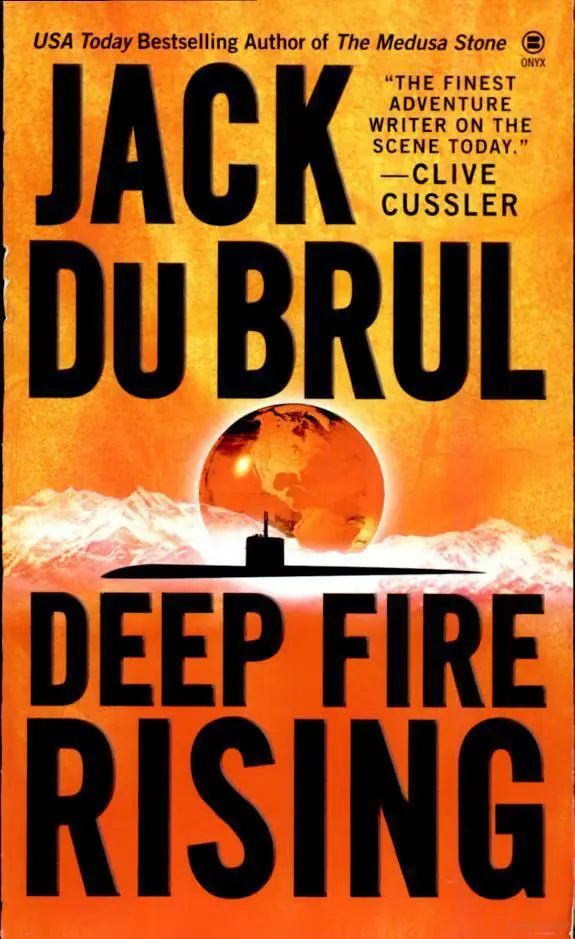
- Название:Deep Fire Rising
- Автор:
- Жанр:
- Год:неизвестен
- ISBN:нет данных
- Рейтинг книги:5 / 5. Голосов: 1
-
Избранное:Добавить в избранное
- Отзывы:
-
Ваша оценка:
Deep Fire Rising: краткое содержание, описание и аннотация
Предлагаем к чтению аннотацию, описание, краткое содержание или предисловие (зависит от того, что написал сам автор книги «Deep Fire Rising»). Если вы не нашли необходимую информацию о книге — напишите в комментариях, мы постараемся отыскать её.
Deep Fire Rising — читать онлайн бесплатно полную книгу (весь текст) целиком
Ниже представлен текст книги, разбитый по страницам. Система сохранения места последней прочитанной страницы, позволяет с удобством читать онлайн бесплатно книгу «Deep Fire Rising», без необходимости каждый раз заново искать на чём Вы остановились. Поставьте закладку, и сможете в любой момент перейти на страницу, на которой закончили чтение.
Интервал:
Закладка:
Construction on the monastery at Rinpoche-La began in 1052 under the guidance of the Indian scholar Atisha and was added on to in fits and starts until its abandonment in 1254 to protest how Godan Khan, Ghenghis’s grandson, had made the Lama of the Sakya Buddhists regent of all Tibet. Because Rinpoche-La was at the outskirts of the Tibetan kingdom, it remained completely forgotten save for the handful of self-sufficient villagers who eked out a living in the shadow of the huge building. That was until Zhu Zhanji, the Confucian who defied the emperor, cached the knowledge of Admiral Zheng He’s historic sea voyages. There were no records in the Order’s archive describing how Zhu Zhanji knew of the valley’s existence. It remained one more of the legends that surround Rinpoche-La.
The nearly six hundred years since saw countless invasions of Tibet from the south and the east and the north, culminating in the totalitarian occupation by the Chinese. Even as they slaughtered an estimated one million Tibetans and doubled the country’s population by the forced migration of ethnic Han Chinese, Rinpoche-La remained nestled in its valley, unknown beyond rumors and the whispered tales of nomads who rarely ventured close to the intimidating mountains. Beyond its geography, the valley was further isolated by a river that was barely negotiable in winter and seemingly impossible to cross in summer.
The monastery dominated the end of the valley, a five-story central structure surrounded by various out-buildings and a thirty-foot-tall, ten-foot-thick wall of mortared stone. Behind the hermitage, the valley dropped away in a sheer hundred-foot cliff, hemmed on each side by towering stone ramparts. The village lay at the monastery’s feet, clutches of stone buildings that seemed to grow out of the living rock. Because the valley was little more than an ax stroke cut into the mountains, little light filtered to the floor and this was diffused by the steam escaping through countless geothermal fissures.
It was the steam that provided the village shelter and also its means of survival. The microbes that flourished in the scalding waters of the hot springs were the basis of a bizarre food chain similar to that found in the deep-sea thermal vents called black smokers. In the absence of sunlight, creatures depended on chemosynthesis, the transformation of chemical, rather than light, energy into life. Around the black smokers, microbes fed off the exotic plumes of chemicals belched from the earth’s interior and in turn fed a myriad of odd creatures: tube worms that grew to six feet or more, mussels and crab species found nowhere else and fish able to withstand the tremendous heat. The difference at Rinpoche-La was at the top of this food chain were goats and yaks that ate nutrient-rich aquatic weeds and provided meat and wool and milk for the villagers. A further advantage to those living amid the geothermal vents was that heat was provided for them. There was no need to gather wood to warm their homes or cook their meals, a time-consuming necessity that handicapped the rest of Tibet’s rural population. Over the generations, the valley had become its own self-contained, self-sustaining ecosystem.
On an upper story of the monastery a window sash rattled as a fresh gust of wind blew by. The candle on the table flickered and shadows jumped along the stone walls of the cell. Tisa barely looked up from where she sat, a cup of pungent butter tea cooling at her elbow. She was physically and spiritually drained, but she knew the bed in the corner would provide no succor. In sleep lay the nightmares that had plagued her for so long.
Added to them were her fears for Philip Mercer.
She was sure he had survived. When she’d left him on the floating tanker truck and struck out for Luc’s boat, she’d tried to convince her half brother that she alone had escaped from the sinking ferry. He hadn’t believed her, but the crush of survivors trying to board the speedboat nearly capsized the vessel and forced him to motor away before mounting a search. Mercer would have surely been rescued when word reached Santorini that the ferry had gone down.
No, her fears were based on what she knew was coming. She wondered if she should have bothered giving him the warning about La Palma now that she couldn’t be with him. Mercer would doubtlessly figure out that the volcano was going to erupt and she was just as certain he would try to minimize the devastation. He’d go to La Palma and be one of the first to die. Her interference had sealed his fate. She’d only just discovered that in their short time together he’d evoked emotions she’d thought she was incapable of. She’d fallen in love with him. Now he was gone forever.
She knew now that whoever said it was better to have loved and lost than to never have loved at all had no idea what they were talking about. She looked at her wrist where for a few hours she’d worn the watch he’d given her. It was the sweetest gesture she’d ever seen. He couldn’t possibly understand why she wouldn’t wear one, couldn’t know the fear she had of time itself, how finite it was and how she couldn’t stand the constant reminder.
She wished now she’d kept it.
The monastery was so solidly built that it seemed to absorb all sound. Tisa didn’t hear the footsteps outside her door, didn’t know anyone was coming for her until the heavy iron lock slid back against its stop.
She remained bowed, not needing to look up to see that it was her brother who had come for her. “Leave me, Luc.”
“You know I would never do that,” he whispered. When they were together at Rinpoche-La, they spoke Tibetan. For some unknown reason, when they were on the outside they conversed in either French or English.
She raised her head. She’d lost her glasses during her escape from the ferry. Her spare pair weren’t the correct prescription, forcing her to squint slightly to focus her vision. Like her, Luc was dressed in voluminous wool pants, a fine cotton shirt and a heavy cloak. She noted he’d taken to carrying a pistol belted around his lean hips. “What did you hope to accomplish by bringing me here?”
He crossed the murky room to stand behind her. She could feel his hands near her shoulders but he refrained from touching her. “I just want to keep you safe.”
“From what?” she snapped. “Inevitability?”
“Tisa, it doesn’t have to be like this. I forgive you for trying to warn the world. At times, even I thought that we should. In the end, we both know it’s for the best that we don’t.”
She turned in her seat to look him in the eye. “Best for who? Who are you to decide?”
“I can ask you the same question. For centuries the Order has done nothing but watch as cataclysms destroyed nations, laid waste to entire regions, and killed millions. No one ever questioned our need to remain silent. Just because the scope is so much greater now doesn’t mean we should part with our traditions.”
“Luc, if we don’t do anything a hundred million people will die outright and many more later as civilization unravels.”
“This is where you and I disagree, dear sister. I don’t see that as a bad thing. Civilization as it is today is fundamentally flawed and can’t be sustained. Its demise is certain. Rampant consumption in the west and exploding populations in the developing world are either going to bleed the planet dry or collide in a monumental war that will destroy both. The eruption on La Palma is a pressure relief valve, a way to turn back the clock a century or two and give humanity a chance to learn from its mistakes rather than continue to build on them.
“This is the very nature of evolution — the adaptation to changing circumstances. Those that can do it will survive, those that can’t will perish. The planet doesn’t care which species resides at the top of the evolutionary ladder so long as it can endure the tests thrown at it. We’ve done well for so long that we forget we’re here only by the earth’s grace.”
Читать дальшеИнтервал:
Закладка:
Похожие книги на «Deep Fire Rising»
Представляем Вашему вниманию похожие книги на «Deep Fire Rising» списком для выбора. Мы отобрали схожую по названию и смыслу литературу в надежде предоставить читателям больше вариантов отыскать новые, интересные, ещё непрочитанные произведения.











Обсуждение, отзывы о книге «Deep Fire Rising» и просто собственные мнения читателей. Оставьте ваши комментарии, напишите, что Вы думаете о произведении, его смысле или главных героях. Укажите что конкретно понравилось, а что нет, и почему Вы так считаете.