Elizabeth Hand - Generation Loss
Здесь есть возможность читать онлайн «Elizabeth Hand - Generation Loss» весь текст электронной книги совершенно бесплатно (целиком полную версию без сокращений). В некоторых случаях можно слушать аудио, скачать через торрент в формате fb2 и присутствует краткое содержание. Город: Northampton, MA, Год выпуска: 2007, ISBN: 2007, Издательство: Small Beer Press, Жанр: Триллер, Ужасы и Мистика, на английском языке. Описание произведения, (предисловие) а так же отзывы посетителей доступны на портале библиотеки ЛибКат.
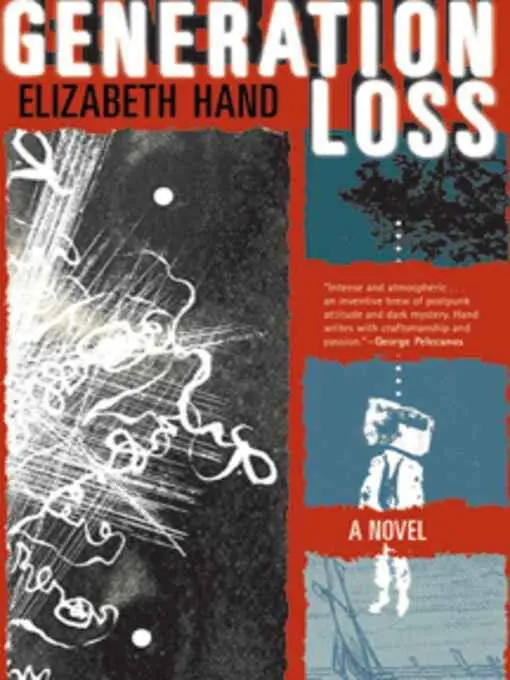
- Название:Generation Loss
- Автор:
- Издательство:Small Beer Press
- Жанр:
- Год:2007
- Город:Northampton, MA
- ISBN:978-1-931520-21-8
- Рейтинг книги:3 / 5. Голосов: 1
-
Избранное:Добавить в избранное
- Отзывы:
-
Ваша оценка:
Generation Loss: краткое содержание, описание и аннотация
Предлагаем к чтению аннотацию, описание, краткое содержание или предисловие (зависит от того, что написал сам автор книги «Generation Loss»). Если вы не нашли необходимую информацию о книге — напишите в комментариях, мы постараемся отыскать её.
Thirty years later she is adrift, on her way down, and almost out when an old acquaintance sends her on a mercy gig to interview a famously reclusive photographer who lives on an island in Maine. When she arrives Down East, Cass stumbles across a decades-old mystery that is still claiming victims, and she finds one final shot at redemption.
Patricia Highsmith meets Patti Smith in this mesmerizing literary thriller.
Praise for Elizabeth Hand’s previous novels: Amazon.com Review
“Inhabits a world between reason and insanity—it’s a delightful waking dream.”
—
“One of the most sheerly impressive, not to mention overwhelmingly beautiful books I have read in a long time.”
—Peter Straub
Generation Loss — читать онлайн бесплатно полную книгу (весь текст) целиком
Ниже представлен текст книги, разбитый по страницам. Система сохранения места последней прочитанной страницы, позволяет с удобством читать онлайн бесплатно книгу «Generation Loss», без необходимости каждый раз заново искать на чём Вы остановились. Поставьте закладку, и сможете в любой момент перейти на страницу, на которой закончили чтение.
Интервал:
Закладка:
“Satisfied?”
I took a step back from the wall. The way the photos were hung made the two windows, with their views of the real islands, look like part of the sequence.
I liked the illusory islands better.
“Yeah,” I said at last. “I guess I am. But…”
I glanced around the room, frowning. “Her other pictures—the ones from the other book. Mors . Where are they?”
“She destroyed them.”
“ What? ”
“She burned them. Or, I dunno, maybe she tore them up and threw them into the ocean. It was a few years after I was born. I don’t remember it, but I remember hearing about it years later. There was some kind of a big scene, with—”
He stopped. I felt as though I’d been kicked in the stomach. “But—why?”
“I don’t know.” He looked away. “Something bad happened. You know about Oakwind? The commune?”
I nodded, and he made a grim face. “Well, this was after Oakwind split up, but I gather it had something to do with that. There was a lot of bad blood there, between her and—well, her and just about everyone except for Toby. It didn’t start that way, but…”
“But why would she destroy those pictures? They were taken, what? In the 1950s.”
He shook his head. “Cass, I have no clue. I wouldn’t bring it up, though, in the unlikely event she talks to you again. Not unless you still want to drive back to New York tonight. You hungry?”
“Not really.”
“Well, I’m heading down to the Island Store to get a sandwich. Want to come?”
I wanted to stay, but I wasn’t sure he’d leave me alone there. And even if I wasn’t hungry, I needed a drink.
“Yeah, sure,” I said. “One minute.”
He waited as I made a final circuit, looking at each photo. Then we went back down to the mudroom.
“My mother’ll be off for a while with the dogs,” he said and pulled on a heavy coat. “They won’t bother you. Mostly they just sneak around looking for a soft place to sleep. But if you were expecting Aphrodite to make lunch or something—uh, she doesn’t do lunch. She barely does dinner. She does cocktails, after-dinner cocktails, pick-me-ups. A lot of pick-me-ups.”
He opened the outer door, looked doubtfully at my leather jacket. “You going to be warm enough?”
“I’ll be warm when I get back to the city.” I swore as the zipper caught in Toby’s sweater. “Your helpful fucking friend already gave me this —”
I yanked the zipper free then opened my bag, grabbed my camera, and slung it around my neck. “And you know what else?”
We crossed the moss-covered yard, heading back to the harbor. “I could use a pick-me-up too.”
11
Instead of going through the woods, Gryffin cut down toward the water. There was no sign of Aphrodite or her dogs.
“This isn’t the way Toby took,” I said. I had to pick among wet rocks and clumps of seaweed, my boots slipping when I tried to climb over a granite mound.
“I like to see the water,” said Gryffin. He stopped and held out his hand to get me over the boulder. I ignored it, and he shrugged. “That’s the whole point of coming here, right? For the water.”
“You tell me. Did you go to school here?”
“School? No.” He seemed amused. “They only have a one-room schoolhouse here. It goes up to eighth grade. After that, kids used to go live on the mainland and go to school in Machias. I don’t think there’s any kids left here now.”
“Is that what you did?”
“I went to the Putney School. In Vermont.”
Nowadays, tuition at Putney will set you back nearly thirty grand. Even back in the ‘70s, it would have cost a nice bit of change.
“Isn’t that where Dylan’s kid went?” I asked.
“Yeah, I think so. But that was after my time.”
The tide was coming in, covering the gravel beach and lifting black strands of kelp from the rocks. I saw another sea urchin shell, almost as big as my fist. The bottom had cracked open and the shell had filled with sand. I sifted the sand through my fingers then pocketed it.
Gryffin started for where a thin line of birches ran up the hillside. When he reached the first tree he paused to stare out to the islands. His profile was sharp, his dark hair tangled in the collar of his coat. The light showed up more gray than I’d noticed earlier. It wasn’t a conventionally handsome face—nose too big, eyes too small, weakish chin—but it was an intense one, eyes narrowed and mouth set tight, as though it were a constant effort not to lose his temper. Deep furrows in his brow suggested this was a habitual expression.
I wondered what he looked like when he really did lose it. My fingers brushed the spiny little mound in my pocket. I thought of hurling it at him, just to see what would happen, but the shell was so fragile it wouldn’t do much good. Instead I popped the lens cap from my camera and shot a few pictures. Gryffin looked back.
“What are—hey, stop that!”
“What, is there a family ban on photography?”
He didn’t reply, just turned and began walking again. I lowered the camera and followed in silence up the hill, to where the birches joined bigger trees, oaks and maples. Some of the birches must have been really old. They were huge, their trunks charcoal gray. Not much moss here, just drifts of leaves with a film of ice and scattered patches of thin snow. The ground crackled underfoot, like walking on crumpled newspaper.
“So, you come up here a lot?” I asked.
“Not a lot. A couple times a year. Usually in the summer, or earlier in the fall. I had to go to a show in October, otherwise I would’ve been here a few weeks ago.”
He didn’t walk particularly fast, but his legs were so long I had to hurry to keep up. He kept his head down and his glasses jammed close to his face. He looked like an overgrown teenager, gangly and wary. “I mostly came to see a friend of mine. Ray Provenzano, he lives on the far side of the island. He was a friend of my father’s. Another poet. Also a book collector—that’s the delivery I told you about.”
“I know his name. Vaguely,” I said.
“Yeah, the Strand’s a place you might still find Ray’s books. Here, we’re at the road again.”
He crashed through a clump of underbrush onto the rutted roadway. I picked my way more carefully, watching that my camera didn’t snag on anything, finally stomped out onto the blacktop.
“See where we are?” Gryffin pointed. “There’s the Island Store.”
“How do you get to see your friend on the far side of the island?”
“There’s roads—tracks, anyway—all over the place. Not a lot of cars, that’s true. Everyone uses three-wheelers or four-wheelers. ATVs. In the winter they use snowmobiles. Hear that?”
A sudden roar like a chainsaw erupted from the woods behind us. “That’s a four-wheeler. A few of the old-timers, they still have their old beaters to get around in. Ray, he has a four-wheeler here. Not that it goes anywhere unless his flunky, Robert, drives it. Not that he goes anywhere.”
“How come?”
“Ray made him himself persona non grata a while ago. He was hiring teenage boys from Burnt Harbor to come over and paint his house. I don’t know what went on exactly.”
He sighed. “Anyway, the kids’ families didn’t like it much. Next time he came over to Burnt Harbor, he was ambushed. Spent the rest of the summer in the hospital. He didn’t press charges, so … everything’s kinda blown over. But he doesn’t go off-island much anymore.”
“How does he get his groceries?”
“He has a teenage gofer. Robert.”
“You’re joking.”
“No. Hey, Ray knows if he tries anything again, he’s dead. Here we go.”
Читать дальшеИнтервал:
Закладка:
Похожие книги на «Generation Loss»
Представляем Вашему вниманию похожие книги на «Generation Loss» списком для выбора. Мы отобрали схожую по названию и смыслу литературу в надежде предоставить читателям больше вариантов отыскать новые, интересные, ещё непрочитанные произведения.







Обсуждение, отзывы о книге «Generation Loss» и просто собственные мнения читателей. Оставьте ваши комментарии, напишите, что Вы думаете о произведении, его смысле или главных героях. Укажите что конкретно понравилось, а что нет, и почему Вы так считаете.