Laura Kasischke - The Raising
Здесь есть возможность читать онлайн «Laura Kasischke - The Raising» весь текст электронной книги совершенно бесплатно (целиком полную версию без сокращений). В некоторых случаях можно слушать аудио, скачать через торрент в формате fb2 и присутствует краткое содержание. Город: New York, Год выпуска: 2011, ISBN: 2011, Издательство: HarperCollins, Жанр: Триллер, на английском языке. Описание произведения, (предисловие) а так же отзывы посетителей доступны на портале библиотеки ЛибКат.
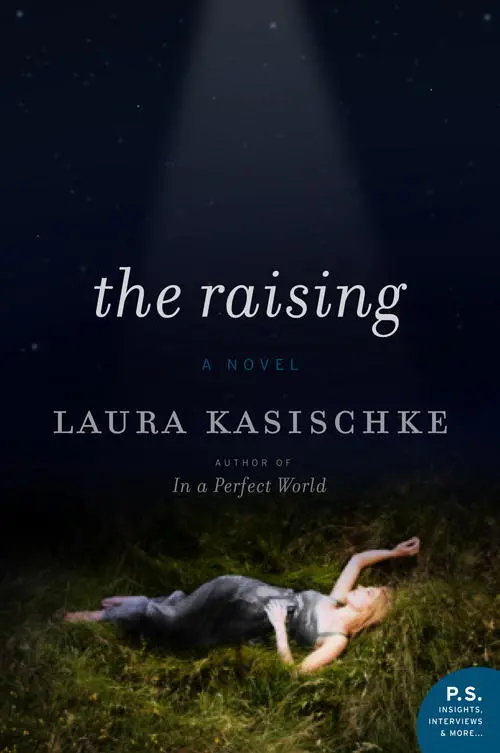
- Название:The Raising
- Автор:
- Издательство:HarperCollins
- Жанр:
- Год:2011
- Город:New York
- ISBN:978-0-06-200478-9
- Рейтинг книги:3 / 5. Голосов: 1
-
Избранное:Добавить в избранное
- Отзывы:
-
Ваша оценка:
The Raising: краткое содержание, описание и аннотация
Предлагаем к чтению аннотацию, описание, краткое содержание или предисловие (зависит от того, что написал сам автор книги «The Raising»). Если вы не нашли необходимую информацию о книге — напишите в комментариях, мы постараемся отыскать её.
Although a year has passed, as winter begins and the nights darken, obsession with Nicole and her death reignites: She was so pretty. So sweet-tempered. So innocent. Too young to die.
Unless she didn’t.
Because rumor has it that she’s back.
The Raising — читать онлайн бесплатно полную книгу (весь текст) целиком
Ниже представлен текст книги, разбитый по страницам. Система сохранения места последней прочитанной страницы, позволяет с удобством читать онлайн бесплатно книгу «The Raising», без необходимости каждый раз заново искать на чём Вы остановились. Поставьте закладку, и сможете в любой момент перейти на страницу, на которой закончили чтение.
Интервал:
Закладка:
Mira sat back in her chair, a kind of recoiling she immediately regretted. The tone of his voice. It was so certain.
Perry Edwards reached into his backpack again, took out another envelope, and out of it, a second photograph—this one of a slender girl with shoulder-length brown hair emerging from one of the sorority houses on the Row. She was glaring at the camera. She looked ready to sneer an obscenity at the photographer, or raise her middle finger. He held the newspaper—the senior portrait of the blond Nicole Werner—up next to the photograph.
Mira looked from one to the other, and said, “I do see the resemblance, Perry, but, surely, you—”
“I know,” he said. “I know these girls all look alike to people who don’t know them. But, Professor Polson, I went all through school with Nicole Werner. We grew up in the same town. We went to Sunday school together. We were confirmed at the same church. I know what she looks like . I see her. She’s here. She’s dyed her hair, but it’s her. I don’t know how. And I didn’t expect anyone to tell me anything except that I’m crazy if I told them, so I haven’t told anyone. But, I thought—well, I read your book, Traditional Burial Practices and Their Folk Origins .” He pronounced the words carefully, as if Mira might not recognize the title of her own book. “And,” he said, “I thought maybe, if you’re working on a new book, a book like it, what could be better than if you had a campus equivalent of this ?” he held up Melvin’s book again, open to the photograph of Etta. “I mean, even if you just think we’re crazy—”
“ We ?” Mira asked.
“That’s the thing,” Perry said. “There are two other guys who’ve seen her. Lucas Schiff. He’s a fifth-year senior. He was our resident advisor last year—”
“I know Lucas,” Mira said. Lucas Schiff. He’d been in her first-year seminar her first year on campus. He’d been busted for possession of a controlled substance then, but had gotten off on some technicality. He was one of those politically active kids who used their political activism as an excuse not to bathe, and to smoke a lot of dope.
“And also Patrick Wright.”
“I know Patrick, too,” Mira said. Patrick was clean-cut, from a small town in the northern part of the state. Nothing like Lucas Schiff. “He’s a junior?”
“Yeah,” Perry said. “He and Lucas—they’ve both been with her since she died.”
“Excuse me?” Mira asked.
“They’ve had sex with her.”
Mira put her hand over her mouth. She wasn’t sure if she was going to laugh or cry. Perry seemed not to notice the gesture. He went on.
“What my point is, Professor Polson. I mean, couldn’t you, maybe, write, say, something comparing Etta to—”
“Nicole Werner?”
“Yeah. I mean, if you’re working on another book. You wouldn’t have to believe us. Melvin doesn’t believe what the villagers are saying about Etta. He just listens. He analyzes.”
Mira looked at Perry Edwards carefully. For a crazy second she wondered if he’d spoken to the dean of the Honors College about her, if he somehow knew she hadn’t even begun the book she was going to have to have published in the next eighteen months. That she hadn’t even come up with a solid idea for the book.
No, of course not. He was just a bright, passionate, or maybe crazy kid. She inhaled. She said, “Why, Perry? Why do you want me to do that? What’s the point?”
“I need your help. There’s something here. I need”—something seemed to catch in his throat, and he swallowed—“a grown-up.”
“Perry,” Mira said, and then stopped, literally biting her tongue.
Although, later, she would try to tell herself that it was this last appeal to her as a “grown-up” that had brought the two of them together in their search for Nicole, Mira could already see, in her office that September afternoon, the book, published by a major university press, in her hands, the bright, smiling senior portrait of Nicole Werner on the cover, her own name underneath that photo, and the letter to the dean from the department chair, and the recommendation it expressed for her tenure.
What, at this point, did she have to lose? Did she have any better ideas?
“Professor Polson?” Perry Edwards asked after Mira was silent for a very long time.
She held up a hand to keep him from saying anything else, and then she put the hand over her eyes and forced herself to count to five before she looked at this boy again, and said, “Okay.”
Part Two
18
It was one of those soul-snatching, deadly dull days at the Chamber Music Society. The offices buzzed with it, literally. A fly caught between the window and the screen in Shelly’s office was tossing itself between the two barriers with exhausted fury. She watched it from her desk, its electrical droning competing with the sound of her dozing computer.
It was the end of September, and the weather was making a concerted effort to change. The sky was closer to lavender now than blue, and there was a smell of leaves sweetening, softening, giving way, shifting into a lower gear. As always, the change from late summer to actual autumn brought back for Shelly every September of her life—the dust swirling around her kindergarten desk, bobby socks and shiny shoes, straight through to her last year of graduate school, lugging an expensive textbook back from the store to her little efficiency over the Beer Depot—along with all the Septembers since then, the years passing one by one outside the window of her office at the university’s Chamber Music Society.
What, she wondered, was September like for people who didn’t work at an educational institution? Did the melancholy reminiscence of September simply skip them?
If so, Shelly thought, it would be a little like skipping one of the Twelve Trials of Hercules: you’d still be stuck with the Christmas despair, but you wouldn’t have to relive the end of every summer vacation of your life, that sad realization of your own mortality, year after year, as the kids swarmed back into your world with their freshly sharpened pencils and new sweaters.
No, she supposed, it wouldn’t be like that. They’d all gotten that calendar engrained on their psyches so early. No one escaped the mortality of autumn.
“God, you depress me,” her ex-husband used to say, and said for the last time on the day she left him, shaking his head sadly—and then, as if some switch had been flipped in his head, charging after her, fists whirling around them both as she stumbled out the back door, and he yanked her back in by her hair.
“Shelly?”
“Yes?”
“Do you think, you know, since we’re all caught up, I—”
“—could leave early?” Shelly tried not to let out an exasperated sigh.
“Yeah,” Josie said. She was twirling a strand of silken black hair around her index finger. She had her face tilted at a right angle, like a sparrow. “It’s Greek Week.”
“You’re in a sorority?” Shelly asked.
“Yeah,” Josie said.
“What house?”
“Omega Theta Tau.” Josie pronounced each Greek letter with irrepressible pride.
Shelly turned around in her chair to face Josie fully in the doorway, and asked, “Isn’t that the sorority Nicole Werner was in, the girl who was killed?”
Josie began to nod slowly and melodramatically with her eyes half closed.
“Did you know her?” Shelly asked. How was it possible that she’d not only not known that Josie was in a sorority but in Nicole Werner’s sorority?
Josie shrugged. She said, “We all knew her. She and I rushed and pledged at the same time. It’s not one of the bigger houses—sixty girls—so, yeah, sure, I knew her. It was a huge shock.”
Читать дальшеИнтервал:
Закладка:
Похожие книги на «The Raising»
Представляем Вашему вниманию похожие книги на «The Raising» списком для выбора. Мы отобрали схожую по названию и смыслу литературу в надежде предоставить читателям больше вариантов отыскать новые, интересные, ещё непрочитанные произведения.






Обсуждение, отзывы о книге «The Raising» и просто собственные мнения читателей. Оставьте ваши комментарии, напишите, что Вы думаете о произведении, его смысле или главных героях. Укажите что конкретно понравилось, а что нет, и почему Вы так считаете.