Paul McKellips - Jericho 3
Здесь есть возможность читать онлайн «Paul McKellips - Jericho 3» весь текст электронной книги совершенно бесплатно (целиком полную версию без сокращений). В некоторых случаях можно слушать аудио, скачать через торрент в формате fb2 и присутствует краткое содержание. Город: Washington, DC, Год выпуска: 2012, ISBN: 2012, Издательство: FBR Press, Жанр: Триллер, на английском языке. Описание произведения, (предисловие) а так же отзывы посетителей доступны на портале библиотеки ЛибКат.
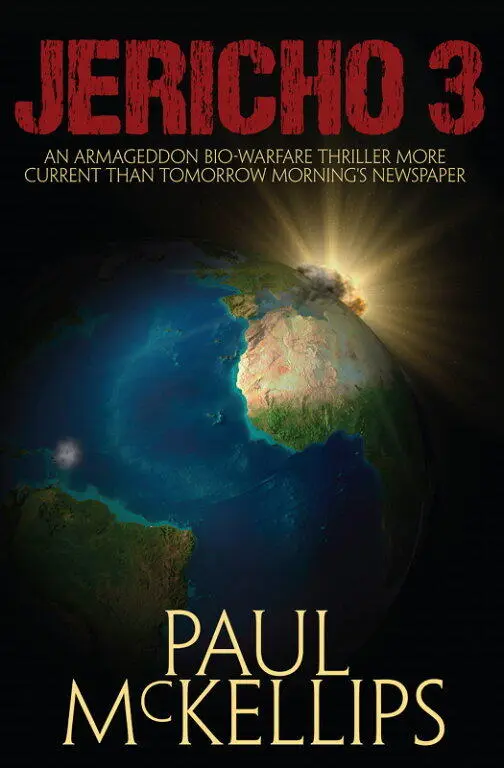
- Название:Jericho 3
- Автор:
- Издательство:FBR Press
- Жанр:
- Год:2012
- Город:Washington, DC
- ISBN:978-0-9853322-0-4
- Рейтинг книги:5 / 5. Голосов: 1
-
Избранное:Добавить в избранное
- Отзывы:
-
Ваша оценка:
Jericho 3: краткое содержание, описание и аннотация
Предлагаем к чтению аннотацию, описание, краткое содержание или предисловие (зависит от того, что написал сам автор книги «Jericho 3»). Если вы не нашли необходимую информацию о книге — напишите в комментариях, мы постараемся отыскать её.
In a remote corner of Afghanistan, three members of the Taliban are diagnosed with a rare, incredibly infectious disease. At a U.S. base just outside Pakistan, an American army doctor is kidnapped by a local tribe to perform an unlikely surgical procedure on the wife of a powerful leader. And back in the U.S., Camp is handed his most challenging assignment ever, which leaves the normally confident hero desperate for answers. All the while, Camp must hold back his secret desire for Leslie Raines, his beautiful cohort, as they are sent off on two sides of the same mission… only to reunite when the stakes get deadly.
With his trademark grit and a globe-racing plot, Paul McKellips takes readers deep into the Middle East conflict, raising timely questions of radicalism, faith, and honor. As the clock ticks down toward Armageddon, Camp and Raines must do everything it takes to stop the total annihilation of two countries.
Timely, gripping, and frighteningly real, JERICHO 3 is a one-of-a-kcenter thriller that will open eyes long after the final page has been turned.
JERICHO 3 Infectious disease. Bio-warfare. Nuclear weapons. WAR JUST GOT PERSONAL.
Ambassador John Bolton writes: “
is a gripping novel… an urgent message… about an Iranian bio threat that should wake us up to the range of horror that could be visited on America and its friends and allies by our sworn enemies.”
Jericho 3 — читать онлайн бесплатно полную книгу (весь текст) целиком
Ниже представлен текст книги, разбитый по страницам. Система сохранения места последней прочитанной страницы, позволяет с удобством читать онлайн бесплатно книгу «Jericho 3», без необходимости каждый раз заново искать на чём Вы остановились. Поставьте закладку, и сможете в любой момент перейти на страницу, на которой закончили чтение.
Интервал:
Закладка:
Omid closed his eyes in disbelief.
“One would expect that a man such as Reuven Shavit, Director of Mossad’s kotsas in the Middle East, would know such things,” Omid said as Reuven finally relaxed and smiled, a smile that cut the tension in the Suburban 10-fold as they drove through the Gesher kibbutz near the Beit She’an Valley in northern Israel.
Within minutes the three Suburbans came to a stop on the edge of an outlook. The view was expansive ahead of them as a fertile valley sprawled out for nearly 20 miles.
“This is it, US Navy Captain Campbell. This is where you wanted to eat. We have baskets of food, drinks and sweets in the third car. Shall we? I’m already fully amused with this adventure,” Reuven said as he opened his door.
Camp and Omid got out along with Reuven and his driver. Finn and Yitzhak joined them looking out over the valley as the others got the food out of the last car.
“Where we’re standing, right now, this ridge… what is it called?” Camp asked.
“In Hebrew, it is har megiddo , the Mountain of Megiddo. But as you can see, it’s not much of a mountain, more of a vantage point, a rising really. Anglicanized, you know it as Armageddon, and spreading out before us is the Jezreel Valley,” Reuven said as baskets of food were placed on the hood of his Suburban. “Shall we eat? I’m sure there’s something you want to tell us Camp… now that we’re all here.”
“Can we walk, down into the valley? Maybe take some food to go?” Camp asked.
“As you wish, this is your order.” Reuven and Camp selected some sandwiches, fruit and water and loaded them into the small bags that were inside the basket.
“Go on,” Finn said to Omid who was still stunned. “You three go for your walk. Yitzhak and the rest of us will stay up here and eat.”
Omid moved slowly to the food, and somewhat begrudgingly filled his bag.
The three men started to walk down slowly into the Jezreel Valley. There was silence. More tension. Reuven and Omid seemed to be waiting for Camp to say something profound.
“This reminds me of a joke,” Camp finally said.
“A joke?” Reuven asked.
“I don’t remember how it ends, but the beginning is hysterical.”
“Then humor us. Let’s hear the beginning of your hysterical joke, Captain Campbell.”
Camp stopped, turned and faced both Reuven and Omid.
“So… one day a Christian, a Jew and a Muslim were walking through the valley of Armageddon to have a picnic…”
Camp stopped. It was the end of his joke. Reuven looked at Camp, then at Omid. Omid looked back at Reuven, then Camp. At first there was just a smile, then two. The more he thought about it a laugh rumbled out of Reuven’s mouth, then Omid. Before they knew it, all three were doubled over in laughter.
They found a nice grassy knoll with rocks, suitable for sitting, eating and enjoying the beauty of Jezreel.
“This place must have incredible history,” Camp said as he looked out over the wheat, cotton, sunflowers and corn. “Can you tell me some of it?”
Reuven swallowed some of his sandwich then took a long swig from his bottled water.
“Jezreel means ‘God sows.’ Since ancient times, this area has been the most fertile agricultural land in all of Palestine. It has always been strategic land. Jezreel and the Esdraelon plain is the only east-west access between the Mediterranean and the Jordan Valley. This was the major north-south trade route between Mesopotamia, or ancient Greece and Egypt. With the desert to the east and both sides of the Jordan River blocked by highlands — and access to the Jordan valley quite minimal thanks to the Dead Sea — most travel ran through the Valley of Jezreel.”
“And wars,” Omid added.
“Yes, and wars. It became a corridor for invading armies. It was the most level land in the area, perfect for battles.”
“From Gideon to World War I,” Omid added to the history. “This land was once controlled by the Canaanites who had chariots, mighty chariots. The Canaanites were people from the Gaza Strip, West Bank and Lebanon.”
“It was Gideon, the mighty warrior, the destroyer, the judge of the Hebrews, who defeated the Midianites and Amalikites right here,” Reuven said.
“But Gideon tested God twice, first with a fleece of wool that was wet, then one that was dry the next morning,” Omid said filling in the details.
“Gideon was facing a mighty enemy, but he had 32,000 men among the ranks of his army. God said he had too many men. If Gideon won the battle with an army that large, the men would claim victory because of their sheer numbers and because of their might. So Gideon allowed all those who wanted to go home, the permission to leave. More than 22,000 went home. But God told Gideon that 10,000 soldiers were still too many.”
Omid finished the story.
“Gideon took his men down to the water to let them drink. God told him to watch and separate those men who lapped the water with their tongues like dogs, from those who kneeled down to drink. Only 300 men lapped the water to their mouth from their hands. So Gideon marched this army of 300 to the enemy camp. Everyone was given a trumpet and a clay jar with a torch hidden inside. Trumpets blew, and fires raged, as Gideon and his 300 men defeated a far superior army, the Midianites.”
All three men fell silent.
“You share a common knowledge of history,” Camp said.
“We share much of the same history,” Reuven said.
“We shared both sides of many wars,” Omid punctuated.
“Too many wars,” Reuven concluded. “King Solomon fortified the ancient fortress of Megiddo to guard the pass. It was here that Jehu’s army defeated the armies of Jezebel which started bloodshed in the Northern Kingdom that lasted for years. And it was at Megiddo that King Josiah was killed as he tried to block the Egyptians from marching through the pass to save the Assyrians who were, themselves, trapped by the Babylonians.”
“Perhaps nowhere else on earth has there been as much bloodshed and violence than right here in this peaceful valley,” Omid said. “Megiddo is still the name used… your har megiddo , Reuven, and your Armageddon, Camp… the ultimate symbol for war and conflict.”
Camp stood and stepped up on a rock. He held out his arms and embraced the warm breeze as it hit his face.
“Does it really have to be this way?” Camp asked.
“I don’t wish for your annihilation, Reuven; most Muslims don’t either. The vast majority of Muslims are willing to live in peace. Yes, we’d like a Palestinian state, but we don’t need Israel to be destroyed.”
“What about the Twelvers?” Reuven asked. “Don’t they need Israel to be destroyed, in order to usher in the Twelfth Imam?”
“Their theology is bent; it doesn’t feel right. Not all Twelvers believe this, Reuven.”
“Most?”
“Yes, most of them do,” Omid finally conceded. “But I don’t want the blood of Iran, or Israel, to flow through the Valley of Jezreel up to the horse’s bridle.”
“What about the nuclear program, colonel? What will that mean for Israel?” Reuven asked.
“You have the power to kill me right now, Reuven. Israel has the power to destroy all of Iran and our Persian homeland. America and Russia could destroy both of us if they chose to. If I tell you something… can you assure me that Iran will not be destroyed?”
“I don’t have that kind of power, Farid… you know that,” Reuven said sincerely.
“If there’s any hope, any hope that we can all live as neighbors in this holy and ancient land, I believe there must be an Islamic Reformation, where faithful Muslims can reject radical thought while remaining faithful to Allah. But we need a Palestinian homeland, too.”
Читать дальшеИнтервал:
Закладка:
Похожие книги на «Jericho 3»
Представляем Вашему вниманию похожие книги на «Jericho 3» списком для выбора. Мы отобрали схожую по названию и смыслу литературу в надежде предоставить читателям больше вариантов отыскать новые, интересные, ещё непрочитанные произведения.




Обсуждение, отзывы о книге «Jericho 3» и просто собственные мнения читателей. Оставьте ваши комментарии, напишите, что Вы думаете о произведении, его смысле или главных героях. Укажите что конкретно понравилось, а что нет, и почему Вы так считаете.